What repeating tarot cards mean: compare context and responses
A recurring card gives you a reason to revisit your notes. Compare its roles and surrounding facts, check a possible shared theme and choose an adjustment from what actually happened.
Start here
A card has appeared in separate readings and you have notes to compare.
In the drawing records, follow how Eight of Pentacles changes from Advice to Situation to Obstacle. Which fact supports stopping in the last entry, and what would be lost by calling all three readings ‘work harder’?
Compare starting, reviewing and finishing with the same cardOrara editorial · Updated · Our approach
On this page
Check whether this was another selection or the same reading
A recurring card is one recorded in more than one separate selection. Reopening a saved Orara reading shows its original cards. Returning to the same date shown on Today also keeps that date’s card. Seeing either again is a revisit, rather than another draw.
A new Orara spread selects from the full deck again, so a card used in an earlier reading can return by chance. A card cannot occur twice within that one spread. Your question helps frame interpretation; it does not choose the cards. The repeat alone cannot establish a hidden cause, prediction or instruction.
For a physical deck or another app, record how the cards were selected, including whether they were returned to the deck between readings. Keep records from different selection methods distinct. This article uses recurrence as a cue to compare interpretations and observations.
Put the original notes beside their dated updates
Choose two or three existing entries for the card. Keep each question, known circumstances, card position and orientation with its initial interpretation. A position is the role assigned to a card in a spread, or layout. Upright means the picture faces the normal way up; reversed means upside down and can use another reference meaning.
Add what you chose to do and the later observation, with its own date. Leave missing fields marked unknown. A current memory of the reading is different from a note written at the time; label it as a later recollection rather than silently completing the old entry.
Compare what stayed the same and what changed before naming a pattern. Keep the other cards from each spread available for context, and inspect nearby entries where a different card appeared. If you have no earlier notes, begin keeping them with a reading you already intend to do; a new draw cannot reconstruct a lost record.
Example: one card, three different jobs in a drawing practice
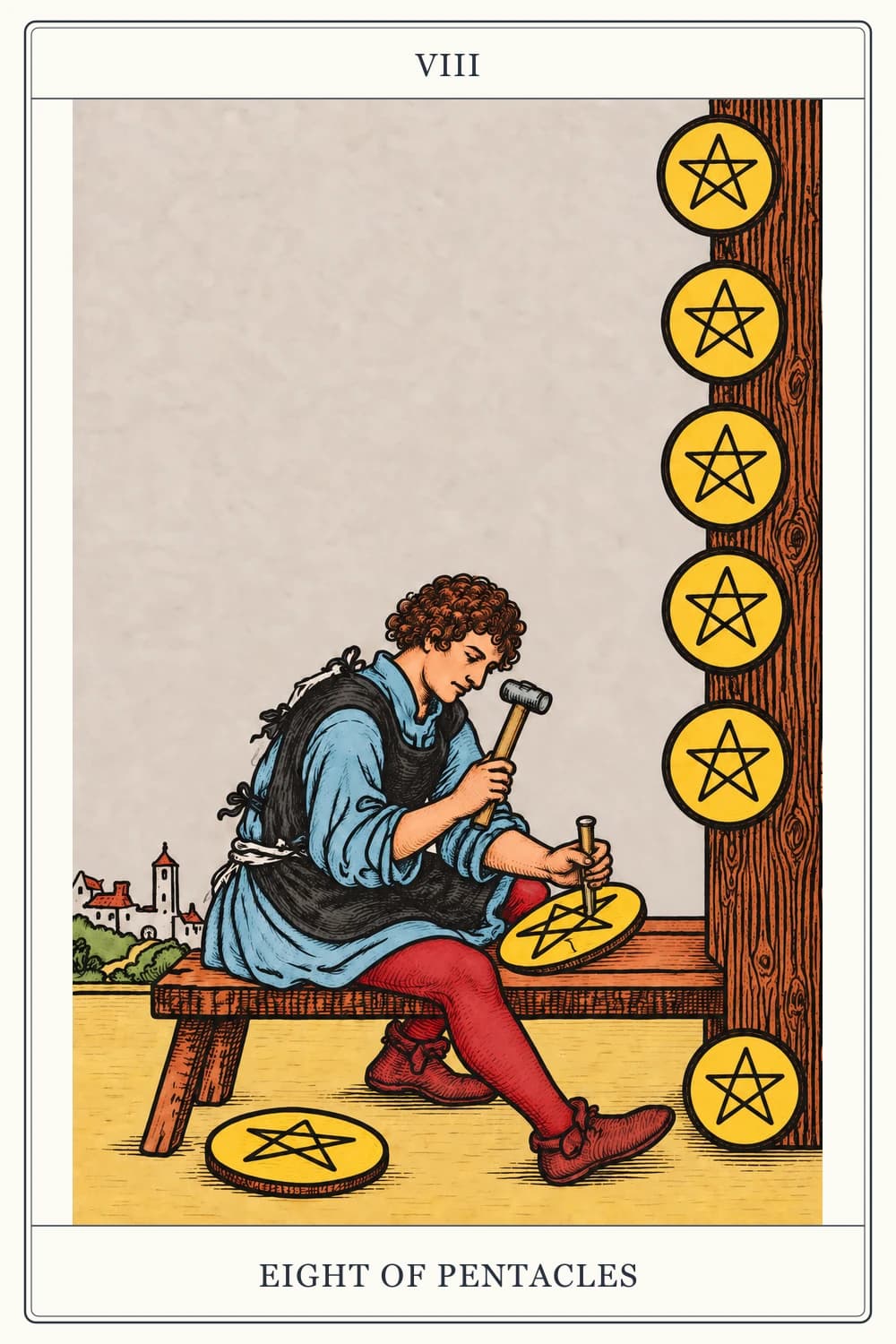
The craftsperson on Eight of Pentacles works on a star-marked disc while similar pieces hang nearby. Those discs are called pentacles. Joan Bunning’s reference associates the card with diligence, knowledge and detail; Orara’s upright entry also names practice and feedback. A useful starting theme here is attention developed through repeated attempts.
The following records are invented to teach comparison. Eight of Pentacles was deliberately selected for all three, so they are not a random sample or evidence about how often the card appears. They model excerpts from separate Clarity readings: Situation describes the current picture, Obstacle examines a difficulty and Advice considers a response.
Only the recurring card is examined below. All three use its upright meaning, but give that theme different jobs. Follow the dated records to see why the response changes; keeping the same card does not require repeating the same advice.
| Entry and role | Open the record |
|---|---|
| 12 October 2026 · Advice | Begin one small study |
| 15 October 2026 · Situation | Describe the practice already happening |
| 18 October 2026 · Obstacle | Check whether another pass serves the finishing task |
12 October: use Advice to begin one small study
Question: “What could help me start a sketchbook habit?” Your paper and pencil are ready, the first page is blank and you have ten minutes for drawing after the reading. Eight of Pentacles is upright in Advice. The repeated-work theme can become a manageable response: shade one bowl for that available session.
Initial note, 12 October: “Advice / Eight of Pentacles, upright. I can practise one skill in a ten-minute bowl study. I will check afterwards whether I began and what needs attention next.” This proposes a first attempt; it does not establish a habit.
Later note, 12 October: “I shaded the bowl for ten minutes. Having one subject helped me begin. I have not decided when I will practise again.” The record supports starting on that occasion, while leaving the routine unresolved.
15 October: use Situation to describe the existing practice
Question: “What deserves attention in this week’s practice?” Your dated drawings show short bowl studies completed on 12, 13 and 14 October. Eight of Pentacles is upright in Situation. Here, repeated attention describes something already happening; the role does not automatically ask you to add more sessions.
Initial note, 15 October: “Situation / Eight of Pentacles, upright. Three short studies show a beginning routine. Use my available five minutes after the reading to compare the dated pages: what changed, and what have I not tried?” The response is an inspection of work you have, rather than another drawing session.
Later note, 15 October: “I judged the third bowl’s shading more even. All three subjects were bowls; I have not tested this on angled objects.” Keep the limited comparison and the untested area together. Three studies do not establish general improvement across drawing skills.
18 October: use Obstacle to question an unnecessary extra pass
Question: “What could help me finish this small drawing?” The drawing contains a bowl and a book. Your own finish checklist asks for their outlines and light and dark areas on both; those requirements are already met. You have spent the last two passes polishing one patch on the bowl. Eight of Pentacles is upright in Obstacle.
The same repeated-effort theme now raises a difficulty: “Am I using another pass to practise when this task is to finish?” The role and recorded facts support that question. You have not changed the card to reversed or diagnosed a personality trait.
Initial note, 18 October: “Obstacle / Eight of Pentacles, upright. My finish checklist is met; repeated work on one patch is keeping this page open. Close the drawing and keep further experiments for a study.” A later note that day says, “I marked the piece finished with an uneven patch still visible. Its stated checklist was met; that does not mean every detail was polished.”
If the task were to study that patch, another pass could fit. The supplied question concerns finishing a piece whose own requirements are already satisfied. A clock or a repeated card alone would not establish that an unfinished requirement had been met.
Test the common thread and choose one adjustment from the records
A possible thread is how you use repeated attention: to begin a study, inspect an existing routine or notice when another pass no longer serves the finishing task. “Keep working harder” would erase those differences. The later notes support different, limited conclusions rather than one message repeated three times.
Check a nearby record with another card too. In this invented set, a 14 October entry with The Hermit in Advice records a ten-minute bowl study that began as planned. Starting a short study was therefore not unique to the Eight of Pentacles entries.
An alternative explanation for the similar responses is that you kept bringing drawing questions to ready materials and short available sessions. The notes do not isolate which factor caused you to begin. A useful shared theme can guide review without explaining why a card was selected or showing that it predicted an outcome.
Comparison note, 19 October: “In these three Clarity entries, Eight of Pentacles is upright each time. The roles and aims changed: start, describe, finish. A different-card entry also records a short study. Possible thread: check what repeated attention is for. Difference to keep: the finish checklist was already met only in the last entry. The comparison does not establish that practice always helps or that more work is always needed.”
The untested angled objects in the 15 October note give you a specific adjustment to consider. For the next planned ten-minute session on 20 October, with materials ready and the time confirmed, write “study the edges of one box” before beginning. Use a new page so that the finished drawing can remain finished. This follows the records and needs no additional draw.
An illustrative update, 21 October: “I tried the box for ten minutes. I found the angled edges difficult and noted one line to compare next time. Naming the task helped me distinguish studying from finishing; one attempt did not establish improvement.” Keep that observation even though it does not turn the earlier theme into a success claim.
Optional practice
Keep the first two records, but change what survives from 18 October. You can confirm a separate Clarity selection and an upright Eight of Pentacles, but its question, position, drawing and original notes are unavailable. The only later line says, “I stopped.” You cannot recover the missing information now. Can you still conclude that repeated polishing was delaying completion and that stopping finished the drawing?
See one possible answer
No. You know the card recurred in a separate selection and that a later line records stopping. You do not know its role, the task, the drawing’s requirements or whether they were met. Mark those fields unknown and limit the comparison accordingly. The first two entries still support comparing a proposed first attempt with an observed routine; the three-stage start/review/finish account is no longer supported. Do not reconstruct a finishing checklist, change the unknown role to Obstacle or treat another draw as a replacement for the lost evidence.
Keep a comparison you can revise
Write one possible thread, an important difference and a mismatch or missing fact that limits the comparison. Choose an adjustment only when the records and current circumstances support it, then set a review after a real attempt or relevant event. If no useful thread emerges, “no clear connection” is a valid entry.
Use a notebook or document to keep the original records with your comparison and later update. The journal template in the main action below helps preserve each entry’s facts, interpretation, response and observation. Opening it does not save a reading or fill in this comparison for you.
A quick journal note
Card / which separate selections or revisits I have:
Dates, questions, known facts, roles and orientations:
Initial interpretations / chosen responses / dated later observations:
Possible thread / important difference / another-card comparison:
Missing fact or mismatch that limits the account:
One adjustment, if supported / when and what to review:
Later: what happened and what remains unresolved:
Detailed journal worksheet
Recurring card comparison worksheet
Card being compared:
Selection method for each entry — fresh spread, Today date, saved reading or physical method:
Are these separate selections or revisits of the same one?
Entry 1 — date, question, known facts, role and orientation:
Original interpretation and chosen response:
Dated later observation, separate from the original note:
Entry 2 — date, question, known facts, role and orientation:
Original interpretation, response and dated observation:
Entry 3, if available — date, question, facts, role and orientation:
Original interpretation, response and dated observation:
Other cards or context from these spreads that matter:
Nearby entry with a different card and what happened:
Possible common thread and the evidence for it:
Important difference or alternative explanation:
Missing field, mismatch or observation that would weaken this account:
What the records do not establish about selection or outcomes:
One adjustment supported by the records and current limits, if any:
When to review and what to inspect:
Later date: what I tried or observed and what remains uncertain:
Sources and further reading
External references for these reading methods. Orara created the examples on this page.