Tarot journal prompts and a reusable reading template
A useful tarot note preserves what you knew and thought at the time. This guide shows how to make a short entry, choose a prompt when you get stuck, and add a later observation without rewriting the original reading.
Start here
You have a reading and want a note you can understand when you return to it.
Take one sentence from your reading. Mark which part was already a known fact and which part is your interpretation, then put them in separate fields below. Leave the later observation blank for now.
Use the five-field journal templateOrara editorial · Updated · Our approach
On this page
Start with a five-field note
Use a reading you already have; journaling does not require another draw. Copy the short template into a notebook or document. Fill the first four fields now and leave the last for a dated update. The longer worksheet is optional when you want to record more of your reasoning.
In the first field, put the date, your question and what you already know. In Cards, include each name, its position — the role assigned to it in the layout — and its orientation: upright if the picture faces the right way up, reversed if it is upside down. Those details let you reconstruct what you were interpreting.
Keep your interpretation separate from those facts. Record one possible alternative or write 'unclear' if none fits. Choose a response only if it follows from the situation; 'wait for missing information' can be enough. Set the review after the event you want to observe, such as a reply or a planned session.
A quick journal note
Date, question and known facts:
Cards, positions and orientations:
My interpretation; alternative or uncertainty:
Response, if any; when to review:
Later: what happened: (add the date and what needs revision)
Detailed journal worksheet
Reading entry
Date:
Question or focus:
Known facts before the reading:
Spread and positions:
Cards and orientations:
What I noticed in the images:
Core themes from the reference:
How each theme fits its position:
My connected interpretation:
An alternative interpretation:
One small action I could try:
When I will review:

Later check-in
What happened or changed:
What fit, and what did not:
Which assumption needs revision:
What I want to carry forward:
Example: responding to a volunteer request
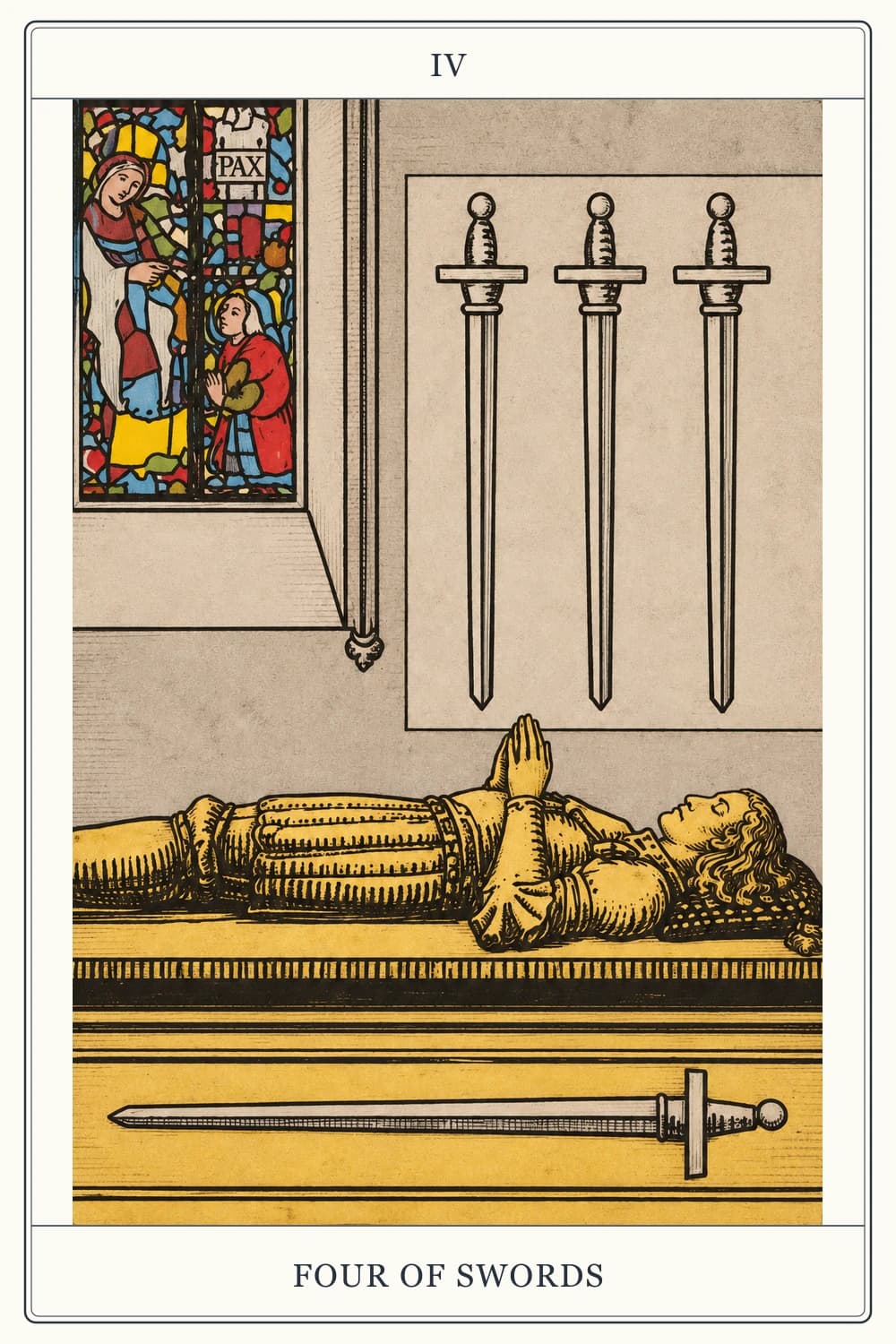
On 22 October, you are asked to take an extra volunteer shift. Your evenings look full, but you have not checked every commitment. The organizer needs a reply by tomorrow evening. Your question is 'How can I respond to this request?' This is an invented example, with Four of Swords chosen to show the record-keeping method.
The image shows a reclining carved figure, three swords above it and one below. Rest, contemplation and quiet preparation are conventional associations. We have assigned the card the role Advice, so we consider a response: 'Pause to check my commitments before agreeing.' The reply deadline makes a short pause feasible; the card does not establish how much time is free.
A more direct reading of rest could suggest declining the shift to preserve an evening off. That would fit if you knew you needed that rest. The original facts establish uncertainty about the calendar, so checking it is the better-supported first response. Record the alternative without turning it into a new fact about your needs.
The initial note can end: 'Tonight I will check the calendar, then reply by tomorrow evening. I will review after replying: did the check change what I could offer?' Keep the question, card, interpretation and this plan together. The copyable version below shows all five fields; its Later line is added only after the events in the next section.
Read the completed entry
Completed five-field example
Date, question and known facts: 22 October. How can I respond to an extra volunteer shift? Evenings look full; I have not checked every commitment. Reply due tomorrow evening.
Cards, positions and orientations: Four of Swords, Advice, upright.
My interpretation; alternative or uncertainty: The still figure and contemplation theme suggest checking my commitments before agreeing. Declining to protect rest is another possibility, but I have not established that need here.
Response, if any; when to review: Check tonight, reply by tomorrow evening, and review after replying. Did checking change what I could offer?
Later: I found no free evening and declined the shift. Update, 23 October after replying: the check clarified my availability; it did not create time. Next time I will consult the calendar before offering a shift. The organizer's reaction is still unknown.
Add what happened, including what remains unknown
Read the original entry before adding your update. Start with an event you can describe, then assess your interpretation or plan. In the example, a 23 October update might say: 'I checked the calendar, found no free evening and declined the shift.' That is the outcome. 'Checking helped me give an accurate answer' is your assessment of the response.
You could finish: 'My uncertainty about availability is resolved. I still do not know how the organizer took the reply.' Avoid replacing the original question with 'I knew I had to say no.' The note shows that the decision followed a calendar check, not that the card predicted the answer.
If you did not try the plan, write that too: 'I replied before checking; I cannot assess whether a pause would have helped.' If the event has not happened, mark it pending and choose a relevant review point. No action or no clear conclusion is still useful information; neither requires another card.
Choose a prompt for the gap in your note
Use the row that matches what you cannot yet explain. The third column shows how a prompt changes the volunteer entry. You do not need to answer every row for every reading.
| If your note is missing… | Ask… | In the volunteer example… |
|---|---|---|
| Context | What did I know before seeing the card? | Evenings look full; the reply is due tomorrow. |
| A link from picture to interpretation | What can I see, what meaning did I look up, and what am I adding? | A still figure; contemplation; my idea to check the calendar. |
| An alternative | What else could fit, and what fact would favor it? | Declining to preserve rest would fit a known need for an evening off. |
| A feasible response | What can I do within the actual time and resources? | Check tonight, before tomorrow's reply deadline. |
| A useful review | What happened, what did I learn, and what is still unknown? | No evening was free; I declined; the organizer's reaction is unknown. |
Compare the context when a card returns
A repeated card gives you a reason to compare entries. Look at the question, position, known facts and later observation, rather than copying the old response. Four of Swords in Advice about an unchecked calendar can suggest a pause. In Obstacle — the role for what gets in the way — the same theme could raise the question of delay, if you already know you have been putting off a reply.
Even with the same Advice role, a changed deadline can make yesterday's response unsuitable. Try adapting the note below. The longer guide in 'Where to go next' shows how to compare several appearances of a card.
Optional practice
Change the volunteer example: a reply is due in ten minutes, and you have already checked that every evening is occupied. Four of Swords is still upright in Advice. Write a revised response and review question without inventing free time or permission to reply tomorrow.
See one possible answer
One response is: 'I will decline before the deadline because I have no available evening. I can take a brief pause to compose a clear reply.' The pause now concerns wording, not postponing the decision or rechecking an already settled fact. After replying, note whether you met the deadline and represented your availability accurately; leave the organizer's reaction unknown until you hear it. Preserve any earlier plan with its date and mark this as a revision based on the new facts.
Keep the original and the update together
Use the same notebook page or document entry for the initial reading and its dated update. For a multi-card reading, list each card with its role so that a later note remains understandable. You can use the printable worksheet linked above if you prefer writing by hand.
In Orara, explicitly save a completed reading before relying on it as a record. New saves require an account; copying a template only puts its text on the clipboard. Paste it somewhere you can keep and edit it. The storage guide explains device and account saves before you change devices or clear browser data.
Sources and further reading
External references for these reading methods. Orara created the examples on this page.