How to read tarot card combinations
A combination explains how two card meanings relate in one question. Learn to give each card a distinct job, connect the ideas and check whether the response fits the situation you actually have.
Start here
You understand the cards separately but cannot connect them.
In the game-summary example, separate the work already done from the reader test being proposed. What could that test reveal that another solo revision would leave open? Use the answer to explain how the two cards work together.
Follow a pair from meanings to a connected readingOrara editorial · Updated · Our approach
On this page
Connect a pair through its question and roles
Start with a question, known facts and a position for each card. A position is the role assigned to it in the reading: Situation describes what deserves attention now; Advice asks for a possible response. The same theme can do different work in each role. Knowing two definitions is a starting point, not yet a connected reading.
The examples below are selected teaching cards, all upright, with the pictures the normal way up. You can follow without drawing cards. For your own attempt, choose two roles before drawing from your deck or selecting study cards. Use your guidebook or each card's linked reference to check its meaning. These role assignments are for this exercise; other spreads can ask different questions of the cards.
If no connection makes sense, check each card separately against its role, the question and the facts you know. Revisit the picture and reference once. If you still cannot explain how the two contributions relate, record what remains unclear and leave the connection open. You can gather information or reflect on the question without forcing a combined meaning or drawing more cards to resolve it.
- Write one question, the facts already known and the two assigned roles.
- Inspect each picture and check one relevant meaning in its reference.
- Write a short clause for each card that answers its role.
- Explain the relationship: 'and' can add a contribution, 'but' can preserve a tension, and 'so' can introduce a possible response.
- Test the connection against the facts. A joining word does not supply evidence or make a response feasible.
- Record what you will try or check, then add what happened later without rewriting the initial reasoning.
A shared theme: practice and collaboration
Question: 'How can I improve my game-rules summary before Saturday?' You have written a one-page draft and revised it alone three times. You own the game and its rulebook. You have twenty minutes on Friday, and a friend has agreed to read the page during the first five. Nobody else has tried using the summary yet.
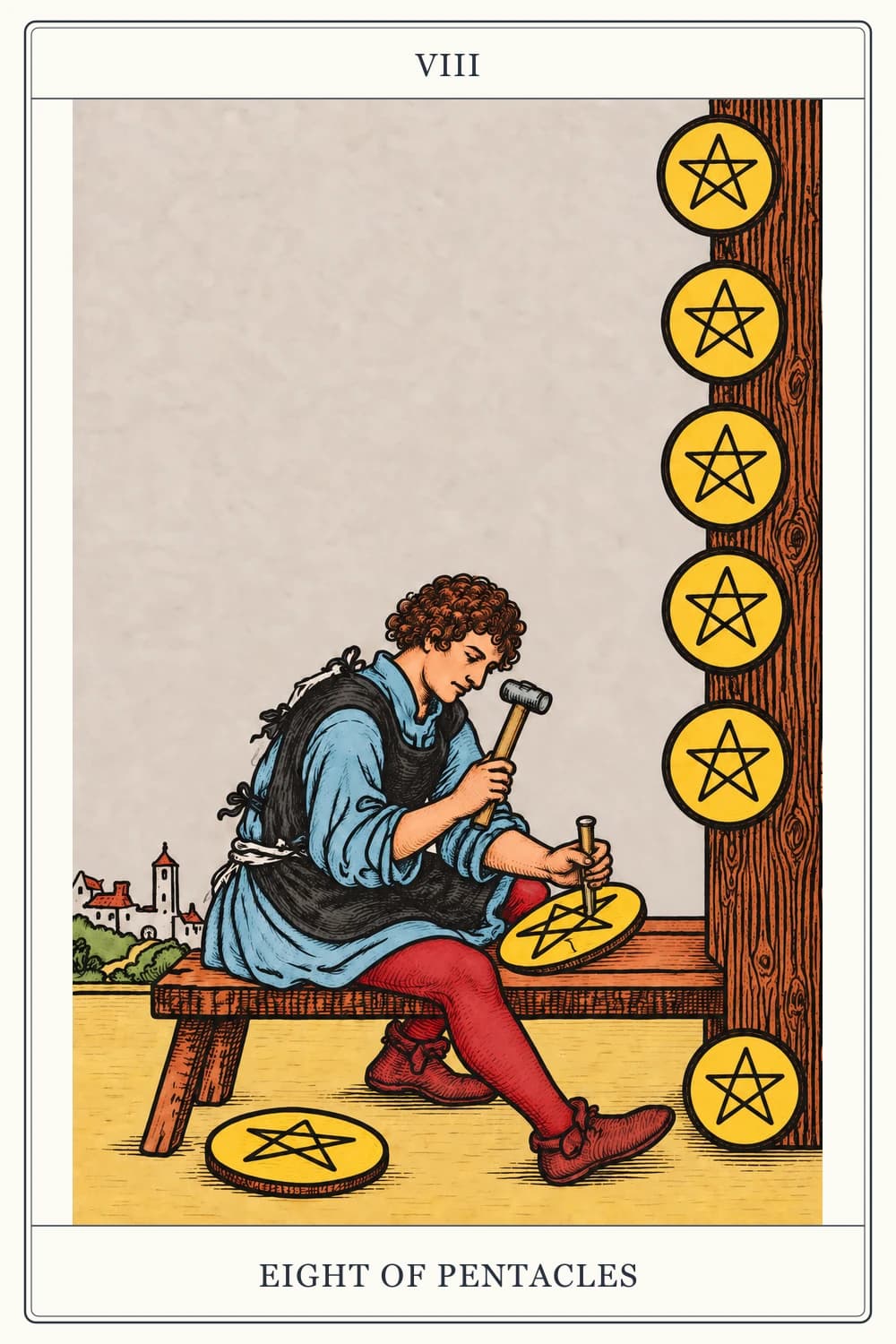
Eight of Pentacles shows a craftsperson working on one disc, with other pieces hanging nearby. Its traditional associations include diligence and attention to detail. In Situation: 'I have been developing the summary through repeated work.' That fits the revisions you have made, while leaving open whether a new reader can follow the result.
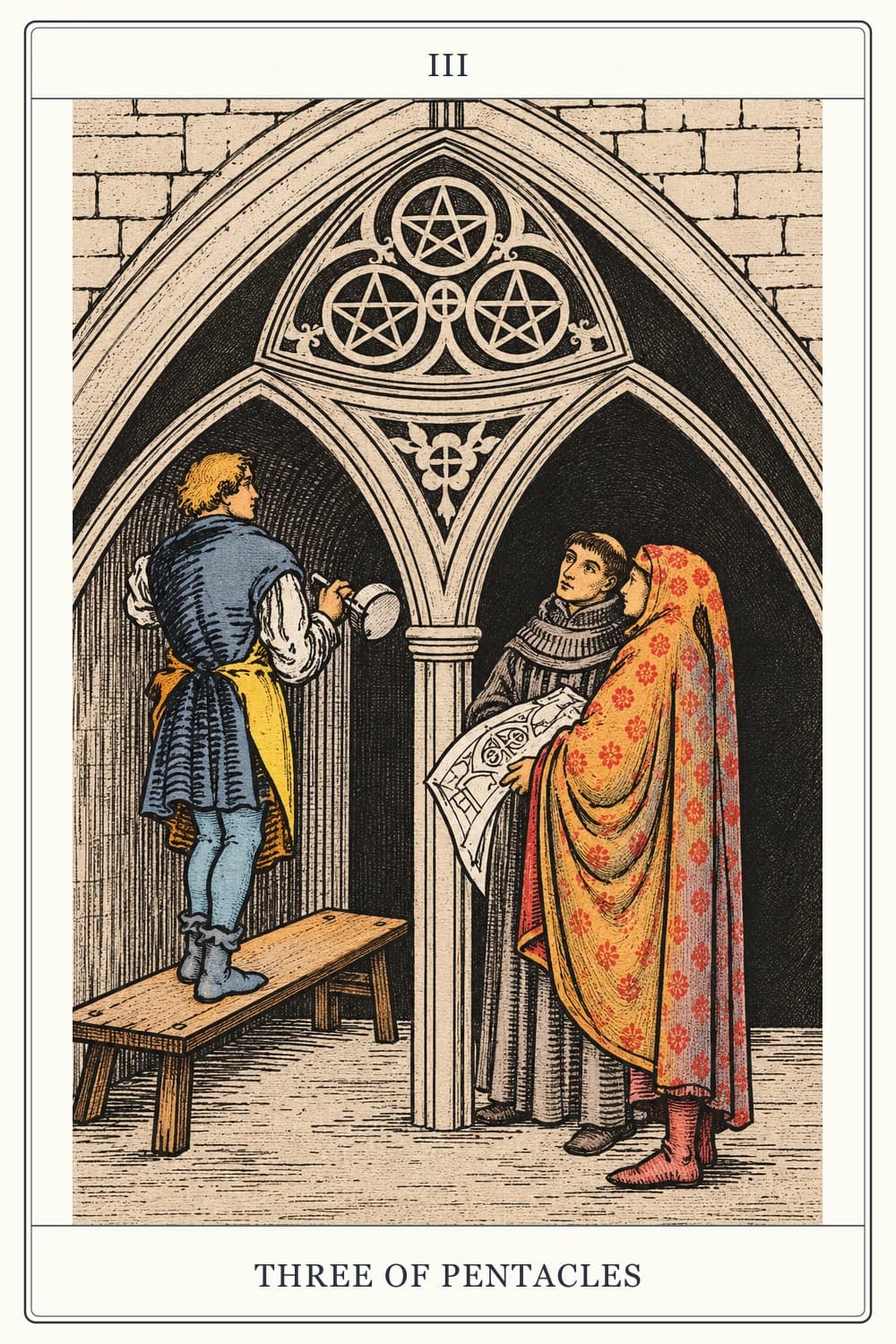
Three of Pentacles shows a worker on a raised platform and two other people beside a plan. Its associations include teamwork and planning. In Advice: 'Use the agreed reading time to test the page with someone else.' Ask your friend to explain the first turn from the summary and point out where they need clarification. The friend's availability is a known fact, not support promised by the card.
Connected reading: 'I have developed the details through repeated work, and a reader's attempt could show what still needs explaining.' Both cards concern practical work, but one describes the effort already present and the other proposes cooperation. 'More practice plus teamwork' only lists themes; the connected version explains what each contributes to this task.
Try it now: write your own one-sentence connection, keeping Eight of Pentacles in Situation and Three of Pentacles in Advice. Name the work already done and one thing a new reader could reveal that another solo revision might leave unchecked. Keep the friend's five-minute limit.
Optional practice
Compare your sentence with one possible answer. Does each card contribute something specific, and can the proposed reader check fit into five minutes?
See one possible answer
One answer is: 'My solo revisions have developed the summary, and I could use the agreed five minutes to ask a reader to explain the first turn and flag unclear instructions.' Eight of Pentacles describes the work already done; Three of Pentacles introduces a shared check of how that work reads to someone else. The check may reveal a confusing step, but it cannot establish that the whole summary is clear.
Finish with a response and a later check
An initial note could read: 'Eight of Pentacles / Situation: repeated solo revision. Three of Pentacles / Advice: ask my agreed reader to explain one turn. Use the first five minutes for that check and the remaining fifteen to revise the most confusing step. At Saturday's game, note whether that step still needs explanation.' The time limit keeps the response within what is available.
An illustrative later note: 'My friend could not tell when to draw a card, so I clarified that instruction within the session. On Saturday, we followed the first turn more easily, but still checked scoring in the rulebook.' This shows one limited improvement and a remaining question. It does not establish that the entire summary is clear.
There is another plausible emphasis in Three of Pentacles: planning the work. If your friend had already tested the page and supplied a clear list of corrections, Advice could mean agreeing which correction to handle first rather than requesting the same test again. The card stays the same; the known state of the task changes what cooperation needs to do.
A contrast: direction can include a pause
Try a different selected pair for the same preparation question. Keep the twenty-minute limit and the friend's five-minute reading offer. For this comparison, you are determined to finish the page and feel pulled toward changing several sections at once. This added fact gives the contrast something specific to address.
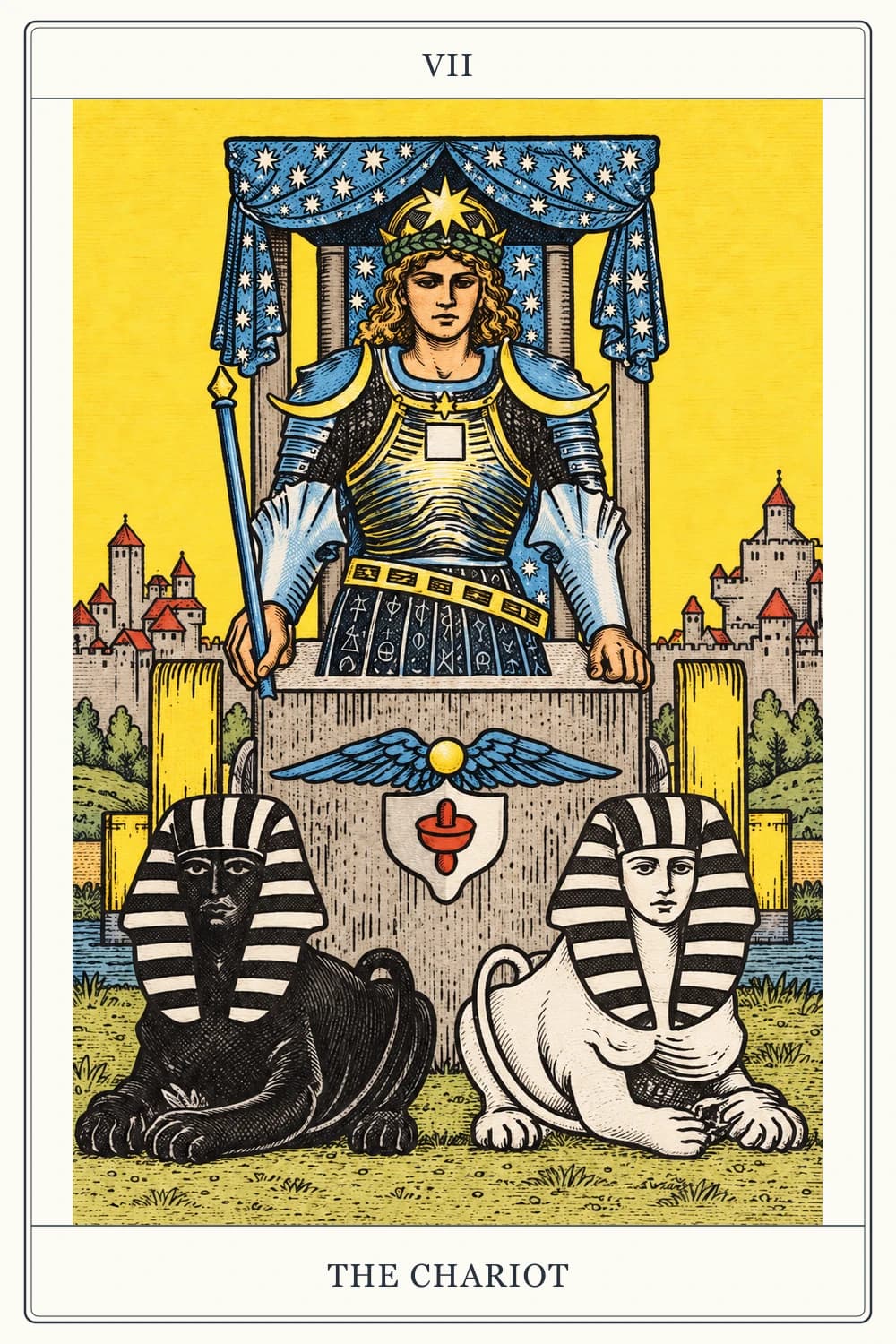
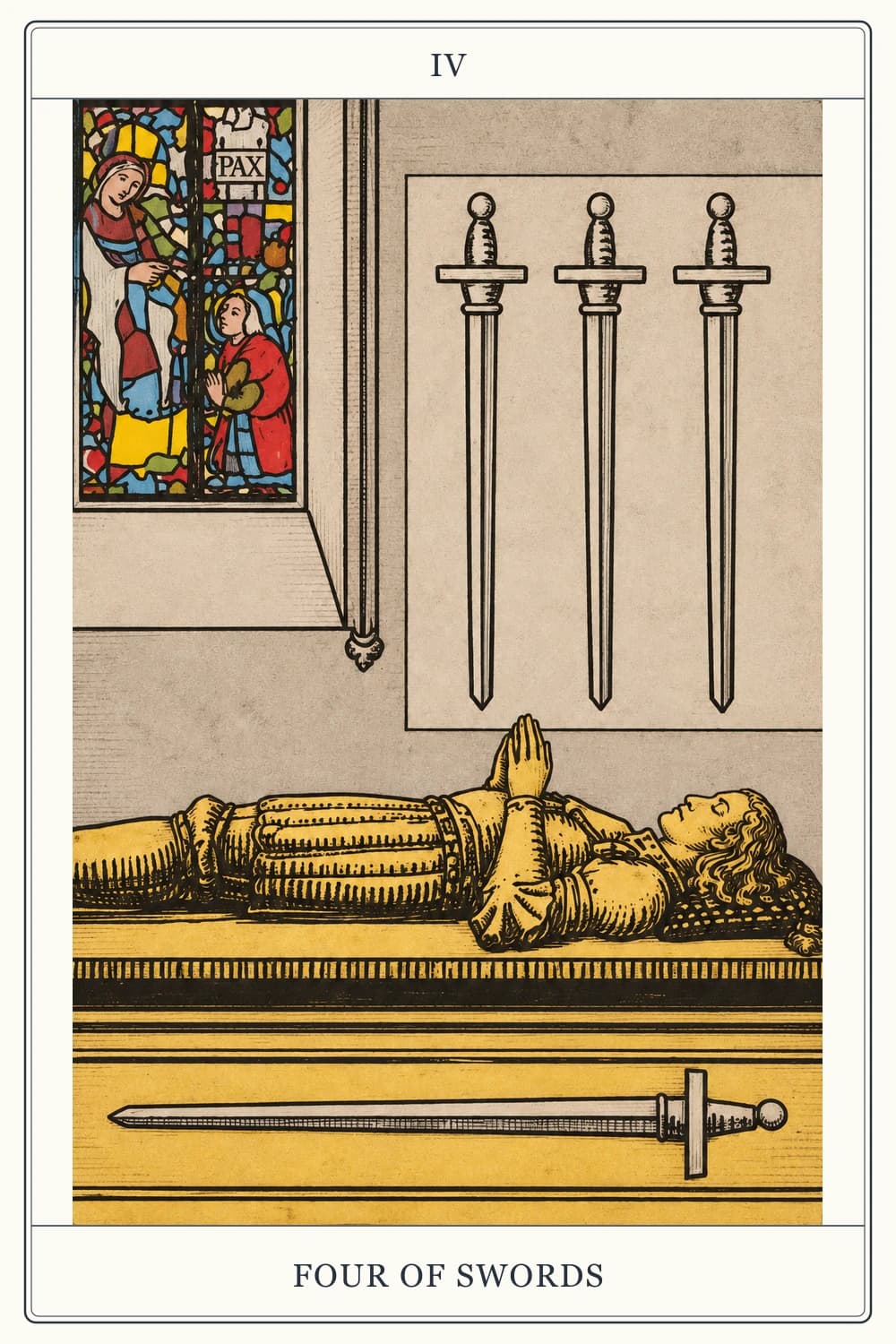
The Chariot shows a driver beneath a canopy with two sphinxes in front. Its associations include determination and directed effort. In Situation: 'I am pushing to get the summary ready.' Four of Swords shows a reclining figure with three swords above and one below. Its associations include rest and contemplation. In Advice: 'Pause briefly to decide what most needs attention.'
Connected reading: 'I want to finish the page, but a short pause could keep that effort focused on one useful correction.' After the five-minute reader check, take two of the remaining fifteen minutes to choose a priority, then use thirteen for that change. The pause supports the direction; it does not cancel the task or create extra time.
If a priority is already clear and you are using pauses to postpone it, this particular response would fit less well. Examine what the pause would accomplish before choosing it. The cards do not require you to manufacture a conflict between action and rest.
Change a role and rewrite the connection
Return to Eight of Pentacles and Three of Pentacles. For a new comparison exercise, change the first role from Situation to Obstacle, meaning what could complicate the task. Keep Three of Pentacles in Advice and retain the original facts: three solo revisions, an untested page and an agreed reader. This is a deliberate study variation, not a reason to rename a position during a reading.
Eight of Pentacles still concerns careful work. In Obstacle, a possible clause is: 'Attention to details alone may be leaving readability untested.' With Three of Pentacles in Advice, the connection becomes: 'Solo refinement leaves the reader's experience unchecked, so I could use the offered review before revising again.' The second card now responds to a possible limitation in the first.
Repeated revisions alone do not prove perfectionism. If each revision corrected an error found in a real test, the careful work may be helping. Keep that alternative open and check what the revisions actually did. Position directs the question; it does not turn an upright card into an automatic problem.
Try the pair when the offered help disappears
Use the original Situation–Advice roles. Change one condition: your friend cancels, and no other reader is available before Saturday. You still have the same twenty minutes, game and rulebook. The earlier instruction to use a reader's feedback cannot be carried out as written.
Optional practice
Write a connection that includes both the work already done and the missing chance to test it together. What can you check alone, and what must remain unresolved? Keep the time limit and do not invent another helper.
See one possible answer
One connection is: 'I have developed the page through repeated work, but whether another person can follow it remains untested.' You could use the twenty minutes to compare the first-turn instructions with the rulebook and note the question you wanted a reader to answer. Three of Pentacles can keep the need for a shared test visible without supplying a participant. A solo accuracy check is useful, but it is not evidence of readability for someone else. Leave that check pending rather than claiming the collaboration happened.
Optional: connect three distinct roles
Once you can explain a pair, try a three-card study variation of the original case, with the friend's offer still available. Add a fact for this variation: you keep postponing the reader check until you have a whole quiet afternoon, although only the twenty-minute session is available. Use Situation, Obstacle and Advice, with the selected upright cards below.
Four of Swords is now in Obstacle, unlike its Advice role in the contrast example. Its pause theme raises a question about waiting for quiet preparation. The supplied pattern of postponement supports that reading here; the picture alone would not establish avoidance.
Connected reading: 'I have worked on the details, but waiting for ideal quiet keeps the page untested, so I could use the short review already offered.' Keep the original twenty-minute limit: five minutes with the reader, then fifteen for a targeted revision. The table separates what each card contributes.
| Role and card | Contribution to this reading |
|---|---|
| Situation · Eight of Pentacles | Repeated solo work has developed the page. |
| Obstacle · Four of Swords | Waiting for a long quiet session is delaying a reader's test. |
| Advice · Three of Pentacles | Use the reader's agreed five minutes within the session you have. |
Check what each card contributes
Each clause in the three-card connection answers a different role. If you removed the middle clause, you would lose the reason the available review keeps being delayed. If you removed Advice, you would lose the proposed response.
For your own pair or three-card reading, try the same deletion check: does removing a card remove something specific? Then check each claim against the question and known facts. A sentence that identifies an unknown helper, assumes someone's private intention or silently changes a role needs revising. A repeated suit or similar picture may suggest a connection, but you still need to explain it.
Keep the question, roles, connection and intended check in a note, then add later observations separately. The pair practice below gives you example situations and answer choices with feedback. Use it to practise keeping both cards and the stated constraints in one response.
Sources and further reading
External references for these reading methods. Orara created the examples on this page.
- Joan Bunning — opposing and reinforcing pairs as an interpretive framework
- Joan Bunning — Eight of Pentacles: diligence and attention to detail
- Joan Bunning — Three of Pentacles: teamwork and planning
- Joan Bunning — The Chariot: will and directed effort
- Joan Bunning — Four of Swords: rest and contemplation