Reversed tarot cards: choose a method and read in context
An upside-down card adds a reading convention, not an automatic negative answer. Learn how to choose that convention, explain what it changes and check the interpretation against the situation.
Start here
A card is upside down and you are unsure what that changes.
Compare the two versions of Eight of Pentacles below. Keep Advice as the role and use one rule for the reversed version: check for too much or too little attention. Which known fact supports that reading?
Compare an upright and reversed card in AdviceOrara editorial · Updated · Our approach
On this page
Choose whether to use reversed cards
A card is upright when its picture is the normal way up relative to the reader, and reversed when it is turned 180 degrees. That is its orientation. The same scene remains on the card; readers use different conventions to decide what the changed orientation contributes. It does not establish that something bad has happened.
You can make a complete reading with upright cards alone. If you want to use reversals with a physical deck, decide which direction faces you before starting. One way to introduce them is to turn a face-down packet 180 degrees before shuffling. Keep the resulting orientations as you lay out the cards.
In Orara's spread setup, find the Include reversed cards checkbox below your selected spread. Choose before drawing; the revealed cards identify their orientation. A card placed sideways across another card in a crossing layout still has its own Upright or Reversed label. Sideways placement and reversal are separate.
Choose one method for a first attempt
A reversal method is a rule for examining the card's usual theme. For a first attempt, choose one before drawing and write it down. This makes the reasoning easier to follow. The table gives three possible methods, expressed as questions rather than claims that a card has detected a hidden condition.
For the comparison below, use excess or lack: ask whether attention to a skill is out of proportion to what the task needs. Facts help you decide whether either possibility fits. If neither fits, leave that interpretation open rather than switching methods until you get a preferred answer. You can compare another method in a separate study attempt.
| Method | Question to ask | What would support it? |
|---|---|---|
| Excess or lack | Is there too much or too little of this theme? | Compare what you actually do with what the task needs. |
| Blocked expression | What makes this theme difficult to put into practice? | A known constraint, such as unavailable time or materials. |
| Inward expression | How am I experiencing this theme privately? | Something you recognize in your own experience, rather than a guess about someone else. |
Compare the same card in Advice
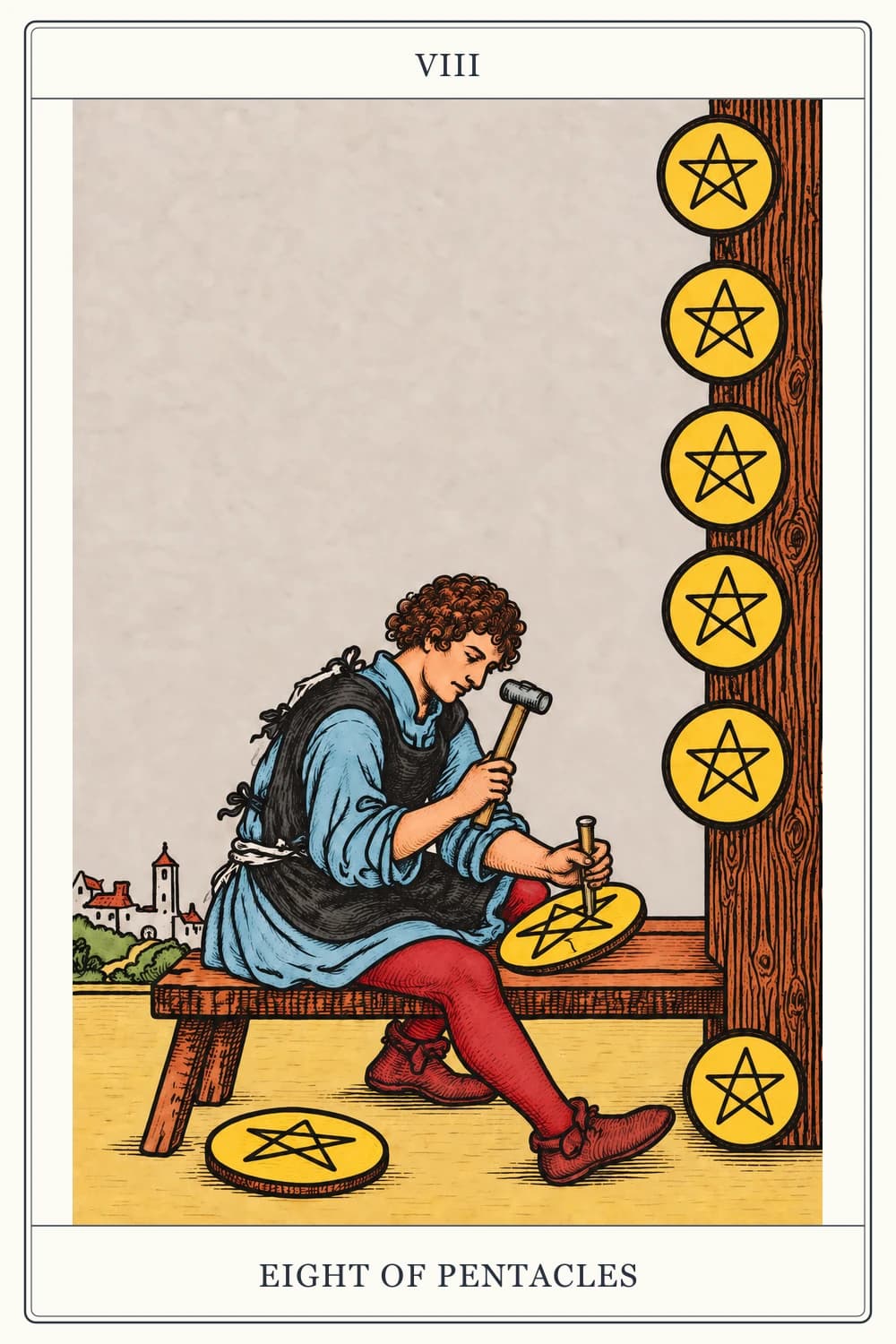
Question: 'How can I prepare my two-minute photography-club talk?' You have a photo and an outline covering why you chose it and what you noticed. You have rewritten the opening sentence several times, but have not tried saying the rest aloud. Ten minutes on Friday are available before Saturday's meeting. These two orientations are selected alternatives for teaching, not two cards drawn together.
Advice is the position: the role assigned to the card in this comparison. It asks for a possible response. Keep that role and the question fixed so you can see what the orientation method adds. You can follow without a deck; the linked card name opens the full upright and reversed reference for your own attempt.
The picture shows a seated craftsperson working on one star-marked disc while other pieces hang nearby. These discs are called pentacles. The traditional associations include diligence and attention to detail. Orara's upright reference emphasizes building a skill through useful repetition and feedback. In Advice: 'Practise a part of the talk you have not tested yet.' Saying the rest aloud could reveal where the outline needs work.
Turning the picture upside down does not itself show a flaw in your preparation. Apply the chosen excess-or-lack question to the same practice theme. Here, repeated work on the opening sits beside no spoken attempt at the rest. Orara's reversed reference allows both insufficient attention and detail that makes finishing difficult. The facts support uneven attention; they do not establish a fixed personality trait.
A reversed Advice sentence could be: 'Give less of the available preparation to rewording the opening and more to trying the whole outline aloud.' Set a ten-minute limit. Spend up to two minutes trying the outline aloud, note where you hesitate or run out of time, and use the remaining preparation to work on one unclear part. Stop when the ten minutes end. Both orientations can lead toward useful practice; reversal does not have to produce the opposite action.
Keep the reason, then add what happened
An initial note could read: 'Friday. Eight of Pentacles reversed / Advice. Method: excess or lack. Evidence: repeated opening edits, no spoken attempt at the rest. Interpretation: attention is concentrated on one part. Response: use the available ten minutes for an aloud attempt and one targeted change. After Saturday's talk, check what was easier and what still needed preparation.'
An illustrative later note: 'Saturday. I used the ten minutes and found that the transition to my observation was unclear. I changed that link. At the meeting, I got through the opening but still lost my place later. The practice helped one part; it did not make the whole talk fluent.' Keep both notes. The later observation can improve the next plan without becoming something the card supposedly revealed in advance.
Different facts would change the choice. If each opening revision corrected a real error and the rest had already been rehearsed, repeated editing would not by itself support this imbalance reading. If every rehearsal had instead been interrupted, a blocked-expression method might be useful in another study attempt. Explain that change of method rather than presenting every possible reading as simultaneously true.
Keep orientation, method and position distinct
Orientation tells you which way the picture faces. The method tells you how to examine the theme. Position tells you which question the card must answer. In a new study variation, keep Eight of Pentacles reversed, the excess-or-lack method and the original talk facts, but assign Obstacle: what could complicate preparation?
The possible imbalance now describes friction instead of proposing a response. The table keeps the difference visible. Obstacle is not a diagnosis, and Advice still has to fit the time and materials available. Do not rename a position during a reading to make an uncomfortable interpretation easier.
| Position · same reversed card and method | Sentence for the talk |
|---|---|
| Advice · a response to try | Use the ten minutes to try the rest aloud rather than keep polishing only the opening. |
| Obstacle · possible friction | Concentrating on the opening may leave the rest untested before the meeting. |
Revise the response when preparation time disappears
Return to the original Advice role and keep the reversed card and excess-or-lack method. Now change the constraint: the ten-minute slot disappears, there is no other preparation time before the meeting, and nobody can rehearse with you. Your photo and existing outline are still available.
Optional practice
What remains reasonable in the interpretation, and what must change in the response? Keep the same method without inventing a rehearsal slot or promising a fluent talk.
See one possible answer
The opening has received more attention than the untested remainder, but the planned rehearsal cannot happen. A revised response could be to use the existing outline during the talk and accept that the rest has not been tried aloud. This does not replace rehearsal or guarantee fluency. In a later note, record that the preparation trial did not occur and distinguish that from what you actually observed at the meeting. The card does not create more time or require another draw to justify the change.
Common questions
- Are reversed tarot cards always negative?
- No. Reversal methods ask different questions about a card's theme. A reversed card may lead you to consider a limitation, an excess or an inward experience, but the orientation alone does not establish any of them. Upright cards can also raise difficult questions.
- Can I turn all the cards upright?
- Yes, if you choose upright-only reading before starting. If you chose reversals for this reading, keep the orientations in its record. You can choose a different convention for a later reading. Do not keep flipping or redrawing a card to get a preferred answer; you can leave an interpretation unresolved.
Sources and further reading
External references for these reading methods. Orara created the examples on this page.