Two-card cross tarot spread: read Situation and Obstacle
The Two-Card Cross examines one situation and what complicates it. Learn to link each card’s picture and meaning to its role, then choose and review a response grounded in the facts.
Start here
You can name one situation but are unsure what makes it difficult.
Write the aim and one limit you already know. Read Situation first, then ask how Obstacle changes that picture. The newsletter example shows how a response can follow from the pair.
Connect a newsletter’s aim with its obstacleOrara editorial · Updated · Our approach
Two-Card Cross at a glance
- Situation
- Obstacle
Use when: You can name one situation and want to explore what makes it difficult.
Choose another approach if: You want an automatic yes/no verdict or a complete history of the situation.
Example questions
- What is making it hard for me to move forward?
- What is getting in the way of this project?
- What deserves a closer look before I respond?
On this page
Give the two cards distinct roles
A spread is a layout of cards, and a position assigns a role to each one. In Orara’s Two-Card Cross, card 1 is Situation and card 2 is Obstacle. Read Situation as a perspective on the question you bring. Obstacle examines friction that may affect how you approach that situation.
The second role does not turn every card into a bad sign. A theme such as patience, confidence or cooperation can become difficult in a particular context, depending on what is happening. Explain the connection to known facts rather than treating the position as proof that something is wrong.
This layout has no Advice position. You can still choose a response after considering the pair. That response is your practical use of the interpretation; it does not require a third card or a new name for the second position.
Keep sideways placement separate from reversal
The diagram above places card 2 sideways across card 1. That quarter-turn shows the crossing role. Upright means using the picture the normal way up; reversed means it was upside down when selected and may use a different reference meaning. Crossing and reversal describe different things.
For this first attempt, choose an upright-only method before drawing. With a physical deck, shuffle, take two cards without looking and turn both pictures the normal way up. Note them as upright. Place Situation vertically, then turn Obstacle sideways across it. Record the second card’s orientation before turning it sideways so the layout does not erase that information.
In Orara, Start Two-Card Cross opens setup. Check the selected layout, clear Include reversed cards, then use Draw 2 cards. In the resulting reading, the Upright or Reversed label identifies orientation independently of the crossed placement. Selecting a numbered card opens its larger details. The separate illustrations in this guide keep each card readable; use the numbered diagram for the cross arrangement.
Choose a question with a situation you can describe
Ask about an interaction, task or difficulty you can name. “What is making this first newsletter hard to finish?” fits the two roles: what you are trying to do, and what may be complicating it. A request to discover someone’s hidden intentions would need evidence the cards cannot supply.
Keep the facts beside the cards. For an unfamiliar card, open its linked name or use your deck’s guidebook. Check a visible detail and a reference theme, then write a sentence answering that card’s assigned role. Read the two sentences together before deciding what you could do.
Example: a first newsletter that keeps growing
In this invented example, you volunteered to write a first newsletter for a hobby club. Its agreed purpose is to tell members the next meeting’s date, time and room. Those three details are confirmed and available. You can choose whether to add extra features, and you have 30 minutes for a draft.
You already have an outline, but keep adding an interview, a puzzle and reports on every activity. You have told yourself that the first issue must cover everything, although the club did not require those features. Question: “What is making this first newsletter hard to finish?” The following two upright cards are selected to illustrate the reading, rather than drawn for you.
| Position | Annotated card |
|---|---|
| 1 · Situation | The Chariot in Situation |
| 2 · Obstacle | Eight of Swords in Obstacle |
1 · Situation — The Chariot
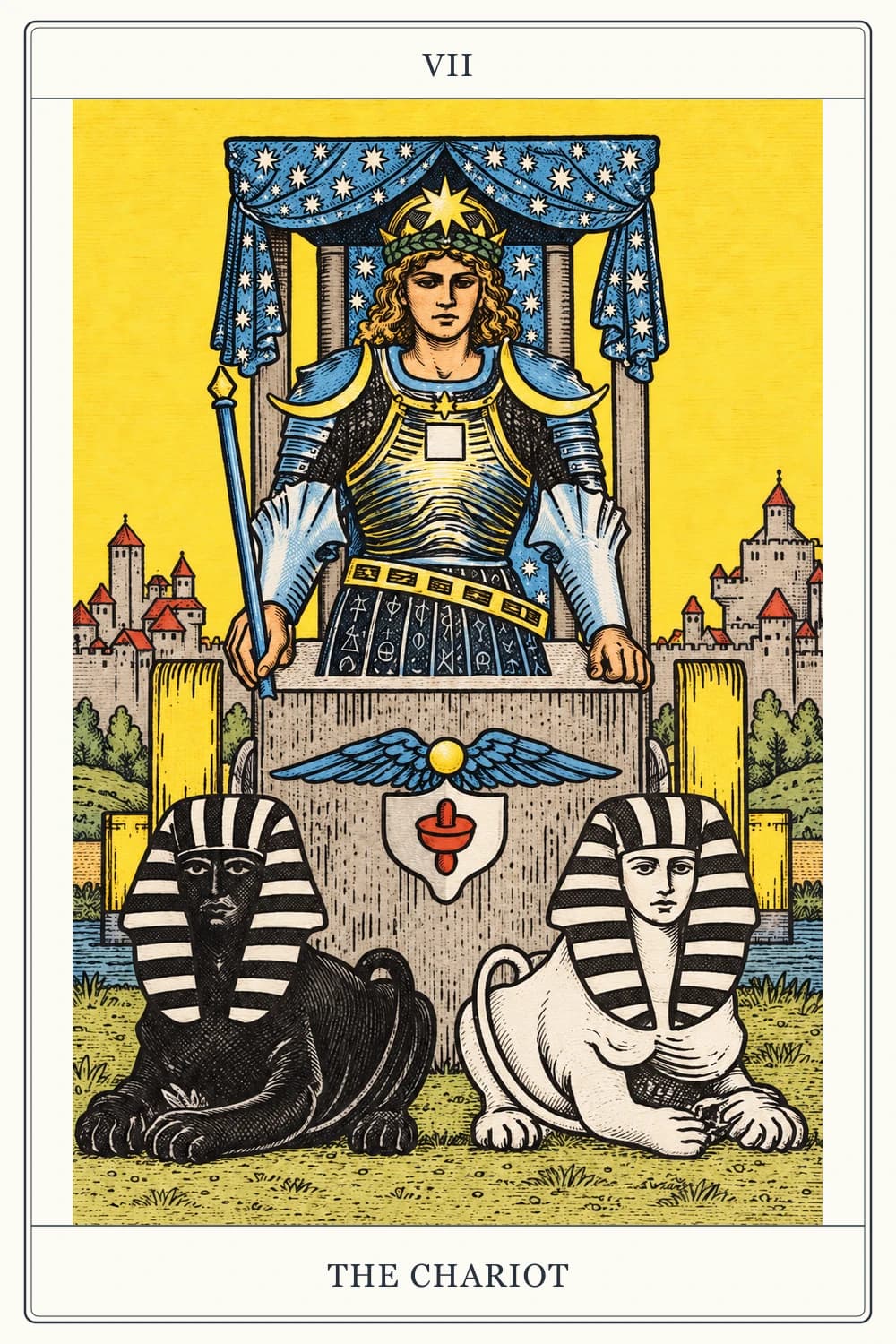
Illustrative card · Situation
The Chariot — read the card meaningThe Chariot shows an armoured figure in a chariot, with a black and a white sphinx in front. Those are picture details. Determination and focused intent are reference themes; Orara’s upright entry also describes managing demands while choosing a clear direction.
In Situation, one possible sentence is: “I want to get a useful first issue to the club’s members.” Volunteering and having an outline support that account of your aim. The card does not prove that the issue will succeed or instruct you to work faster. Keep the goal visible while reading what crosses it.
2 · Obstacle — Eight of Swords
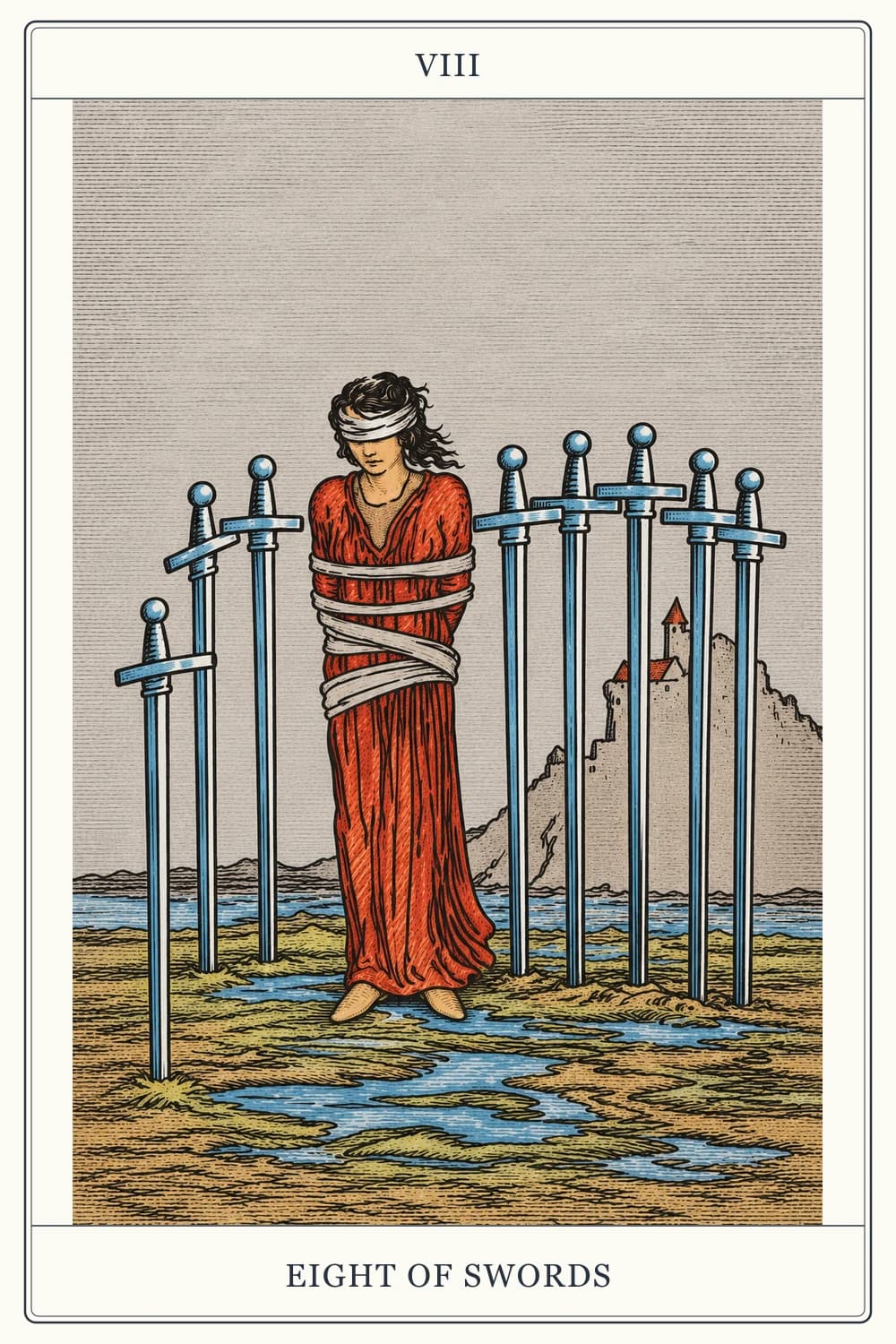
Illustrative card · Obstacle
Eight of Swords — read the card meaningA blindfolded figure with bound arms stands among eight swords. Restriction and confusion are reference themes. Orara’s upright entry invites a distinction between practical constraints and assumptions. The image makes restriction visible as a theme, but it cannot tell you which real-world limit applies.
In Obstacle: “My rule that the issue must cover everything keeps expanding the draft.” That fits your stated rule and the optional features you keep adding.
An alternative would be a genuine missing requirement: if the club had required the reports or had not confirmed the meeting room, the difficulty could not be solved simply by changing your expectation. Check what is actually required and available before calling a restriction an assumption.
Let the obstacle change how you use the situation
Read the pair together: “I want to get the first issue finished, but I am directing that effort into an ever-growing version; returning to the agreed meeting notice could make the draft manageable.” Situation identifies the aim. Obstacle questions the rule governing the work. The second card changes where the first card’s determination might be useful.
A response within the original facts is to set aside the optional interview, puzzle and activity reports. Use the 30-minute period to draft the confirmed meeting date, time and room clearly, then check all three against the supplied information. Stop when the work period ends and record what remains. You can reduce these extras because you have that choice in the example, not because a card grants permission.
Neither card has become Advice. You derived the response from the relationship between the aim, the possible restriction and the actual brief. If the known facts change, the same two cards may support a different response.
Optional practice
Change the brief: the club now requires a room-change notice for a different activity, and it cannot be omitted. Its new room is unconfirmed, and nobody can verify it within your 30 minutes. Keep the same cards. Can you still treat the restriction as only your “cover everything” rule? What can you finish, and what must remain open?
See one possible answer
The unconfirmed room is a real information gap tied to a required item. You can prepare the confirmed first notice and mark the second as awaiting the new room in the draft. Do not invent a room, silently omit the required notice or call the issue ready to distribute. Record the incomplete requirement and the confirmation needed. The Chariot can still frame your aim, while Eight of Swords now points to a constraint that changing your attitude cannot remove.
Keep the response beside the result you observed
Before drafting, a note could read: “Question: What is making this first newsletter hard to finish? Selected upright example: Chariot / Situation; Eight of Swords / Obstacle. Aim: give members the confirmed meeting date, time and room. Thirty minutes available; extra features optional. Possible obstacle: my rule that the issue must cover everything. Response: draft the core notice and check its three details. Review at the end of the work period.”
An illustrative later note: “At the end of the 30 minutes, I had drafted the short meeting notice and checked its date, time and room against the supplied information. The optional features remain outside this draft. I have not distributed it or checked whether members can find the details easily.” You completed a bounded draft in the example. Distribution and reader understanding still need their own evidence.
If the draft were unfinished after 30 minutes, retain that result. The task might need more time or another kind of help. A fluent interpretation is not proof that you identified every difficulty. Keep the first reading beside later observations so you can revise the explanation.
Use the worksheet in your notebook or document. Opening the setup does not save this guide’s note or preload these cards. Your own pair may have different themes; keep the two roles and explain their relationship using your actual question and facts.
Reading worksheet
Two-Card Cross reading worksheet
Date, question and known facts:
Requirements, resources and time available:
1 · Situation — card and orientation before any layout turn:
Picture detail, reference theme and Situation sentence:
2 · Obstacle — card and orientation before crossing:
Picture detail, reference theme and Obstacle sentence:
How the obstacle affects the situation:
A plausible alternative or real constraint to check:
One response derived from the pair:
Review point and what I will check:
Later: what I actually did and observed:
What remains unconfirmed, unfinished or needs revising:
Common questions
- Is the crossing card automatically reversed?
- No. Crossing is the sideways placement of card 2; reversal is its selected orientation. In a physical reading, record orientation before crossing. In Orara, use the Upright or Reversed label. The example here uses upright meanings for both cards.
- Do I need an Advice card to choose an action?
- No. You can reflect on the relationship between Situation and Obstacle, then choose a response that fits your facts. Keep those two roles unchanged. If you want to examine advice in its own position, choose an appropriate layout before a later reading.
Sources and further reading
External references for these reading methods. Orara created the examples on this page.