How to read a tarot card in context
A card’s meaning can lead to more than one interpretation. Use the question, the facts you know and the card’s role to choose one you can explain—and see what would change your choice.
Orara editorial · Updated · Our approach
On this page
Start with what you want to understand
Suppose you have drawn a character’s face and want the expression to look curious. The background is unfinished, nobody has seen the sketch, and you haven’t asked whether anyone can look. Your question is: ‘What could help me get useful feedback on the face?’
For this study example, use Four of Pentacles upright, with the picture the normal way up. We’ll compare how its theme works in different positions, then follow one interpretation through a request and a reply.
Find a theme in the picture
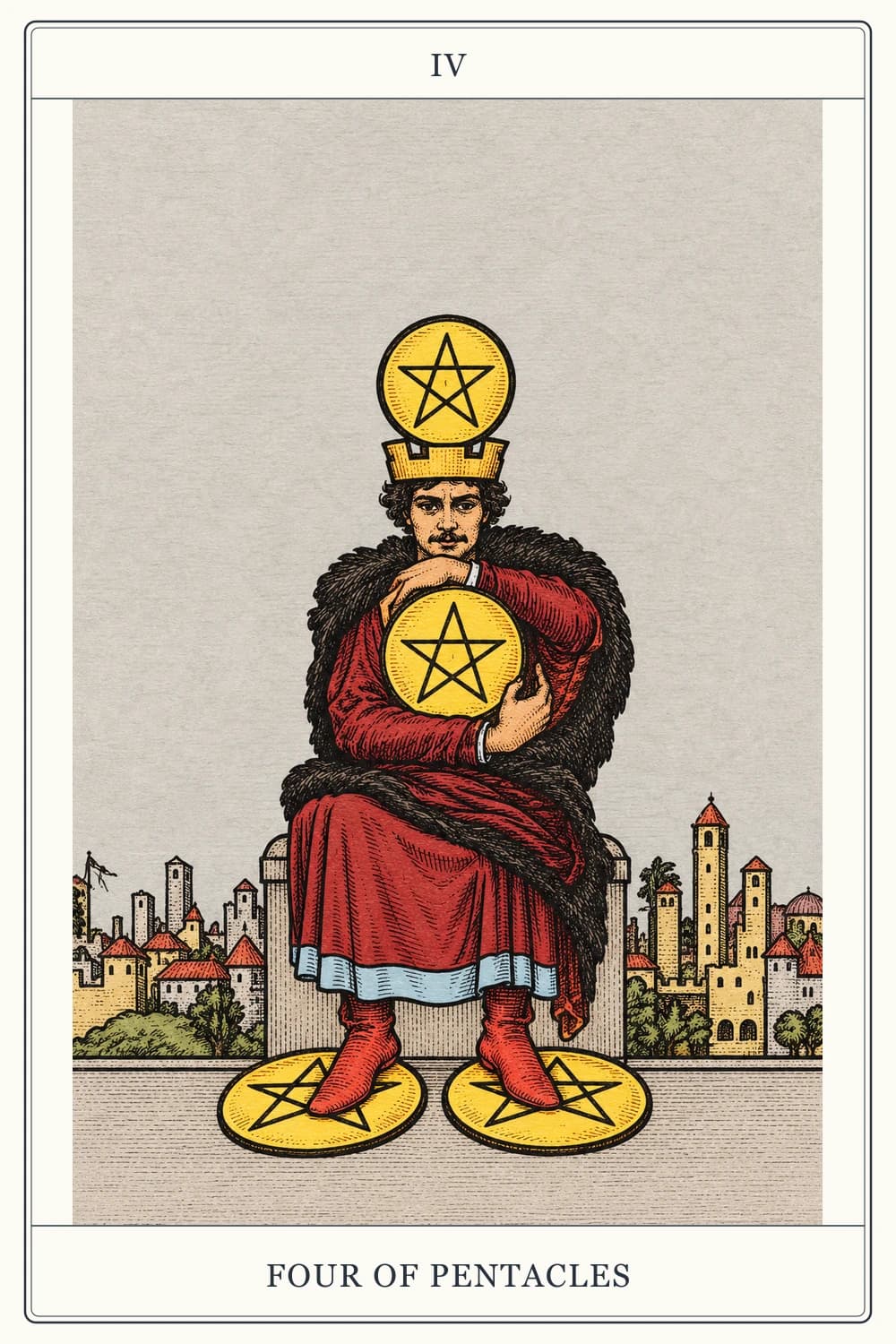
The seated figure holds a star-marked disc against the chest, with two more beneath the feet and another above the head. These discs are pentacles. Holding them close is visible; what that might suggest about your sketch is an interpretation.
Orara’s card reference describes protecting stability and considering whether a limit helps or restricts you. Joan Bunning also associates Four of Pentacles with control and resistance to change. For this question, begin with the theme of keeping something protected.
You haven’t shown the sketch, so the theme has a connection to the facts. It doesn’t tell you why you kept it private. The next question is what that protection does for the feedback you want.
Let the position give the card a job
A spread is a layout of cards. Each position assigns a job: Situation describes what is present, Obstacle explores a difficulty, and Advice suggests a response. Choose those jobs before drawing your own spread.
Here are three alternative placements of Four of Pentacles, keeping the sketch and question the same. The theme of holding something close stays recognizable; the sentence changes to answer the position.
| Position | Possible interpretation | Connection to the sketch |
|---|---|---|
| Situation · What is present? | I am keeping the sketch private. | Nobody has seen it. |
| Obstacle · What may get in the way? | Keeping it private may limit feedback on the face. | A viewer needs to see the expression to comment on it. |
| Advice · What could I try? | Ask whether someone is willing to look at just the face. | A narrow request lets you keep the unfinished background private. |
Check what the question needs
Now put Four of Pentacles in Advice and keep it there for both questions. For feedback on the face, its theme could suggest keeping the request narrow: ask what a viewer sees in a close-up. The expression is drawn, so the unfinished background can stay private.
Change the question to ‘What could help me get feedback on the whole composition?’ The missing background now matters: it affects how the character sits in the picture. Preparing a rough background before asking may be useful protection for work that cannot yet be assessed. Waiting has a different purpose.
Neither ‘always share’ nor ‘always wait’ follows from the card. What you want assessed helps you decide whether the same limit supports the task or gets in its way.
Try a response and keep what happens separate
Return to the face question, with Four of Pentacles in Obstacle. ‘Keeping it private may limit feedback’ fits because you want to know how someone reads the drawn expression. An alternative is that a viewer needs more context. A focused request can help you find out.
If you want to share it, first ask whether a friend is willing to look. Then ask what expression they see, before saying you intended curiosity. This is your response to a possible obstacle; the card’s role remains Obstacle.
An initial note could read: ‘Four of Pentacles, upright / Obstacle. I want feedback on the face, but nobody has seen it. I’ll ask if a friend can look at that part and name the expression. The unfinished background may matter less for this question.’
Later, you might add: ‘My friend agreed to look. They saw worry where I intended curiosity. The response gives me something to consider, but I’m still deciding what to change. It tells me nothing about the whole composition.’ Keep both notes so you can see what the request revealed and what remains undecided.
For your own reading, review the original note beside the later observation rather than replacing it.
Use the method with your own card
Keep the question and role beside the card. For an unfamiliar meaning, use its linked reference or your deck’s guidebook as you work through these steps.
- Write the question, the known facts and the position’s job.
- Describe a visible detail and check a related reference theme.
- Write a sentence that answers the position in this situation.
- Compare an alternative: what fact or change of question would make it fit better?
- Choose what to try or check. Keep the initial note, then add what happened later.
Give a neighboring card its own contribution
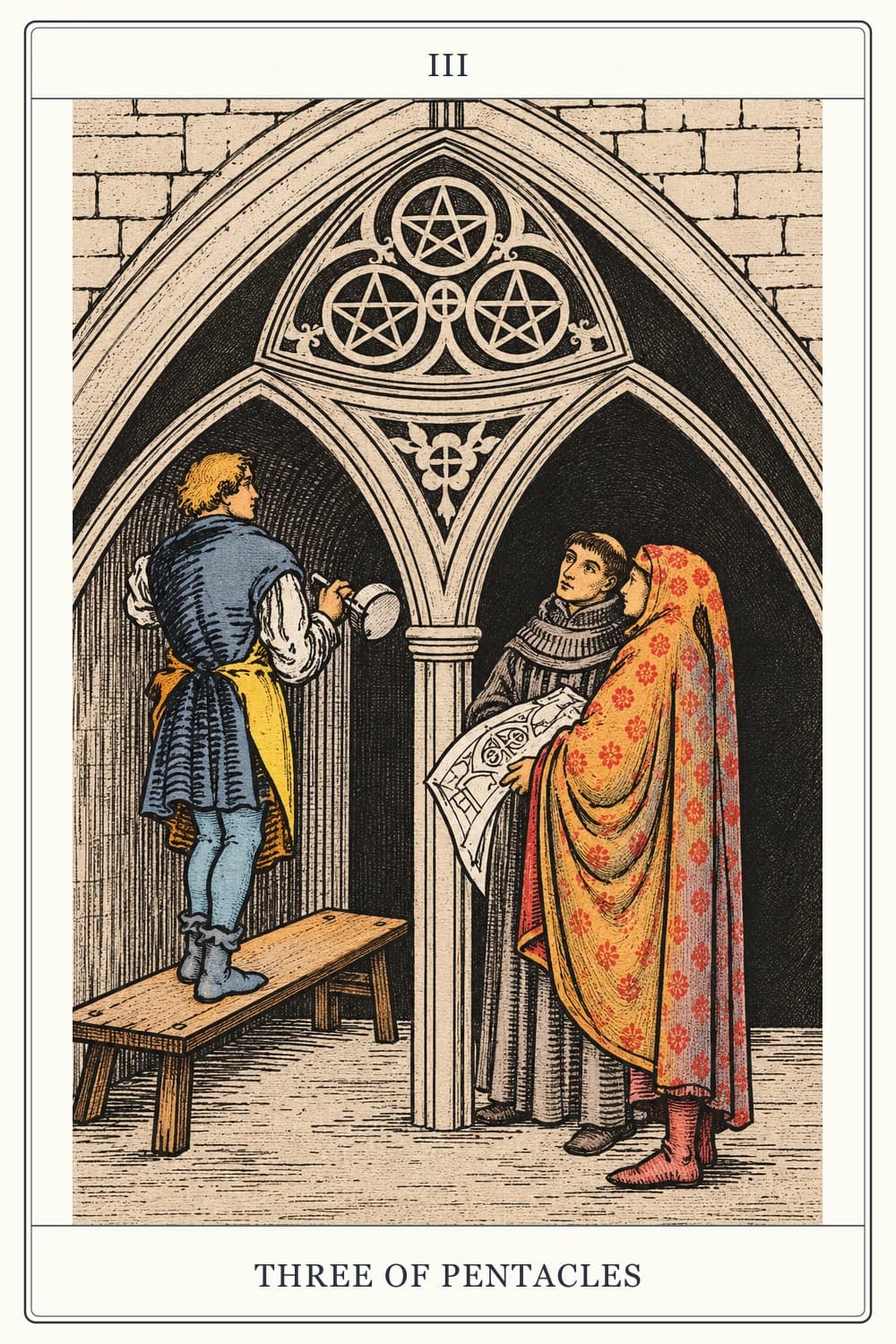
To extend the example, return to the moment when the friend has agreed to look, before showing the face. Keep Four of Pentacles in Obstacle and add the selected upright Three of Pentacles in Available support. The friend’s offer is now a known fact.
Three of Pentacles shows a worker on a bench and two others beside a drawing. Its themes of shared skills and feedback fit Available support: someone is willing to offer another perspective. Without that offer, the card would not establish that a viewer was available.
Together: ‘Keeping the whole sketch private limits feedback, but a willing viewer lets me ask a focused question about the face.’ One card identifies a possible difficulty; the other contributes offered support. You can make use of that support without showing more than the question needs.
For more practice, learn to connect two cards through their assigned roles.
Try a fresh question and pair
Orara’s Connect two cards practice supplies a question, context and roles. It opens with Full deck selected, so the cards may differ from this example. Try a connected answer in your own words or choose from the answer options, then compare your reasoning with the feedback.
If you cannot explain a connection in your own reading, note what is missing. Another card is useful when it has a distinct question to answer; it cannot fill a gap in the facts by itself.
Common questions
- What if I did not assign positions before drawing?
- Keep the question you actually asked. A single card drawn as an open prompt can offer a perspective; you do not need to rename it Obstacle afterward. For your next spread, choose the roles before drawing and keep them while interpreting.
Read each role, then write one answer that explains how the two contributions fit the situation.
Reading worksheet
A card in context
Question / known facts:
Card / orientation / assigned role:
Visible detail and reference theme:
My interpretation and why it fits:
Alternative or missing information:
Response and review point:
Later observation / what I would revise:
Practice: change what you want assessed
Keep Four of Pentacles in Obstacle and Three of Pentacles in Available support. Now you want feedback on the order of six finished drawings. A friend has offered to review the sequence, but you plan to show only your favorite drawing. Is that enough for this question? Suggest a response and explain what each card contributes.
See one possible answer
One drawing cannot show the sequence. Four of Pentacles can frame how holding most of the work back limits this feedback; Three of Pentacles points to the review already offered. You could show all six in your intended order and ask how the sequence reads. The materials and viewer are available here; neither card supplies them.
SourcesJoan Bunning · Learning the Tarot
These references explain the traditional associations used here. The sketch example and practice question are Orara’s own.
External references · learntarot.com