Minor Arcana: four suits, Ace to Ten and how to read them
Suit and number give you a starting point for a card. Its picture, reference meaning and role make that starting point specific. Use the comparisons below to see how, or go straight to the 40-card reference.
Start here
You want to use a card's suit and number without letting a shortcut replace the picture.
Compare the two Twos below. One shows two people offering cups; the other shows a blindfolded figure holding swords. What does each scene ask you to examine in the same game-evening question?
Compare two Twos in one situationOrara editorial · Updated · Our approach
On this page
Find your way around the 56 Minor Arcana
In Orara's 78-card deck, the Minor Arcana are the 56 cards belonging to four suits: Wands, Cups, Swords and Pentacles. A suit is a family of cards with the same kind of object. The other 22 cards are the Major Arcana, with individual names such as The Fool or The Star.
Each suit contains Ace through Ten, then Page, Knight, Queen and King. An Ace takes the place of One in this sequence. There are 40 Ace-to-Ten cards and 16 court cards. This guide concentrates on the numbered cards; court ranks have their own reference linked at the end.
The examples use upright cards, with their pictures the normal way up, and Orara's Rider–Waite–Smith-based artwork. You can follow them without a deck. For your own attempt, use your deck's guidebook or open a card's linked name to check its meaning.
Use the suit to choose an area of attention
The four suits offer different ways to examine the same situation. For a board-game evening, you might need an idea, an understanding of what friends enjoy, a clear decision and practical preparation. No single suit describes the whole evening.
Fire, Water, Air and Earth are symbolic associations used in Orara's lessons. They help organize the suit themes; they do not measure a person's temperament or establish what will happen. The suit names below refer to the whole family, rather than only its Ace.
| Suit / element | Area of attention | For a game evening |
|---|---|---|
| Wands / Fire | Initiative and creative effort | What could we try? |
| Cups / Water | Feelings and connection | What would each person enjoy? |
| Swords / Air | Thought, language and decisions | What needs clarifying? |
| Pentacles / Earth | Time, tools and practical skills | What can we prepare with what we have? |
Treat a number as a study question
A number lets you compare cards across suits, but it does not give a complete interpretation. Orara's study cues below group broad questions you can test against the pictures. They are not a code shared by every tarot author. For example, Eight invites a comparison of effort or movement, yet its cards can show very different situations.
Use the cue to decide what to look for, then check the individual card reference. The next examples show why you sometimes need to narrow or set aside a broad number pattern.
| Rank | Study question | Check in the scene |
|---|---|---|
| Ace | What could begin? | An opening is not a finished result. |
| Two | What is meeting or held in tension? | An exchange differs from a stalled choice. |
| Three | How is something developing? | Notice who takes part and what they do. |
| Four | What is being held in place? | Support, rest and restriction are different. |
| Five | What kind of difficulty is present? | Competing efforts differ from disappointment. |
| Six | What response or adjustment appears? | Giving, recognition and moving on differ. |
| Seven | What needs assessing or defending? | Look for the particular challenge. |
| Eight | What kind of effort or movement? | Practice is different from feeling restricted. |
| Nine | What experience has taken shape? | Satisfaction, vigilance and worry differ. |
| Ten | What has accumulated or ended? | Fullness may feel welcome or burdensome. |
Compare two Twos before choosing a meaning
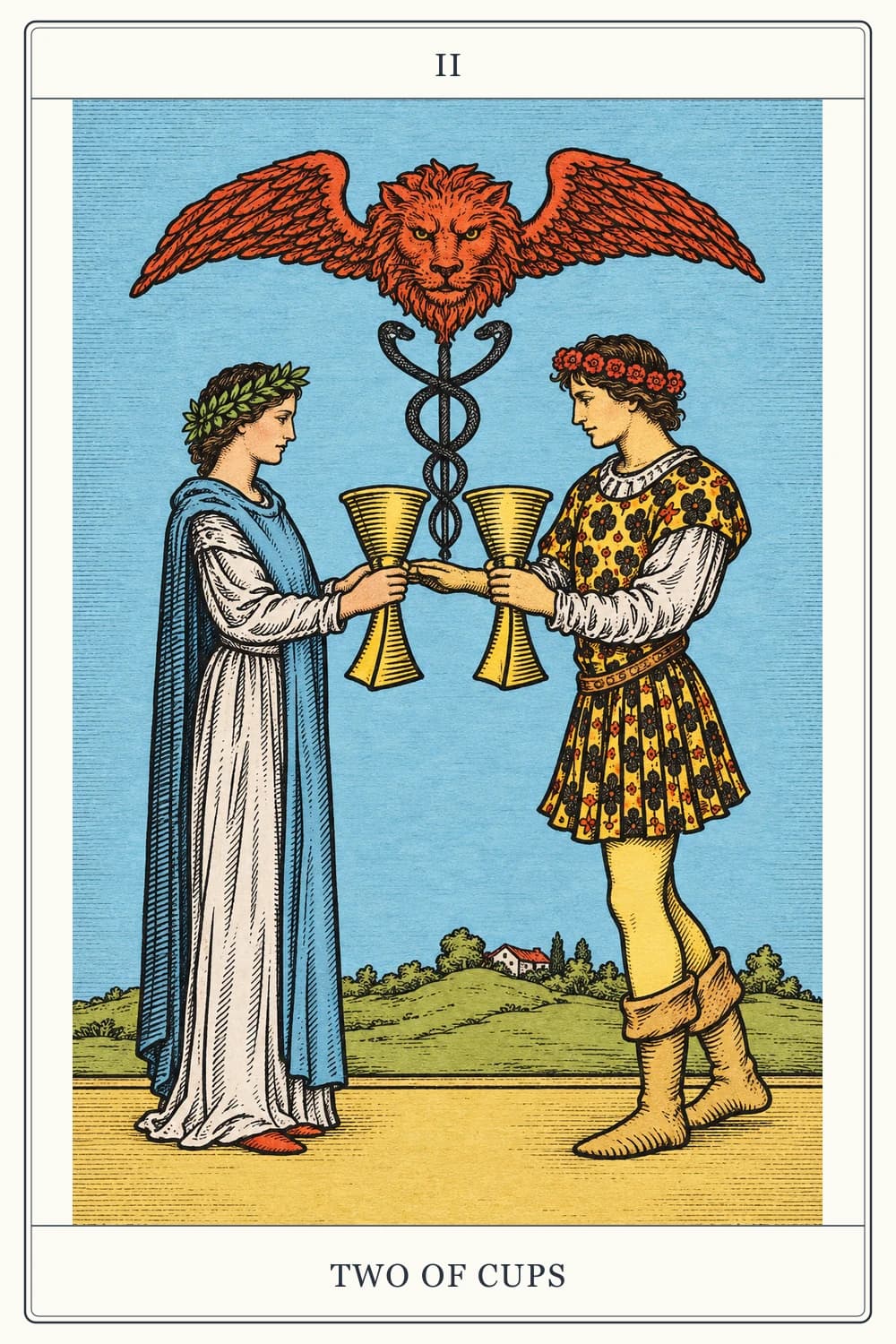
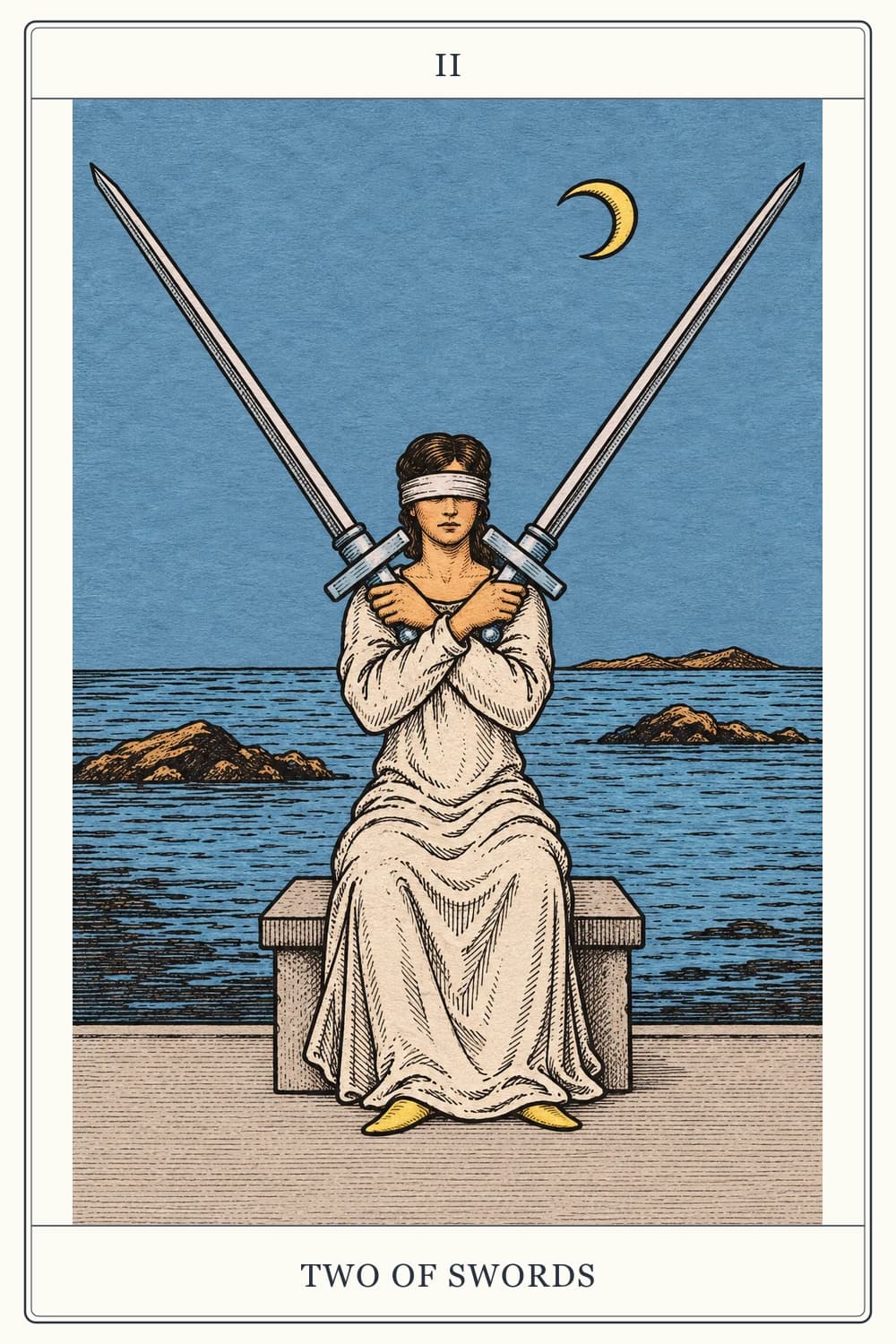
These are alternative one-card teaching examples, not a two-card draw. Keep the role as Situation: what deserves attention now? Question: 'What should we consider while planning our game evening?' You and a friend want to co-host. You are comparing your home with a community room, but the room's availability is unknown. You have not discussed what each person wants from the evening.
Two of Cups shows two people facing each other, each holding a cup. Cups directs attention toward connection; Two suggests an exchange to examine. The card's reference includes cooperation and mutual participation. In Situation, a possible sentence is: 'Our shared plan needs room for both people's preferences.' Ask each other what kind of evening would be enjoyable; the picture does not establish that your wishes already match.
Two of Swords shows one blindfolded figure holding crossed swords. Swords brings thought and decision into focus. The same number now meets a held choice, and the reference suggests checking what would help compare options. In Situation: 'We are considering two venues without knowing whether both are available.' Check the room's availability before continuing the comparison.
The number identifies a useful comparison, while the suit and scene distinguish its subject: an exchange between people or a decision needing information. Neither card says you must invite exactly two guests or wait two days. A response comes from the particular question and facts.
Optional practice
Move Two of Swords to Advice. You now know the community room is unavailable; your home is available, but you have not discussed whether it suits your friend. What needs changing in the response?
See one possible answer
Remove the unavailable room from the comparison. Ask your friend whether the home setting meets their needs before confirming the plan. The pause can make room for that conversation; it is not an instruction to keep comparing a venue that cannot be used. Whether home is a good shared choice remains open until you discuss it.
Bring the clues together in one position
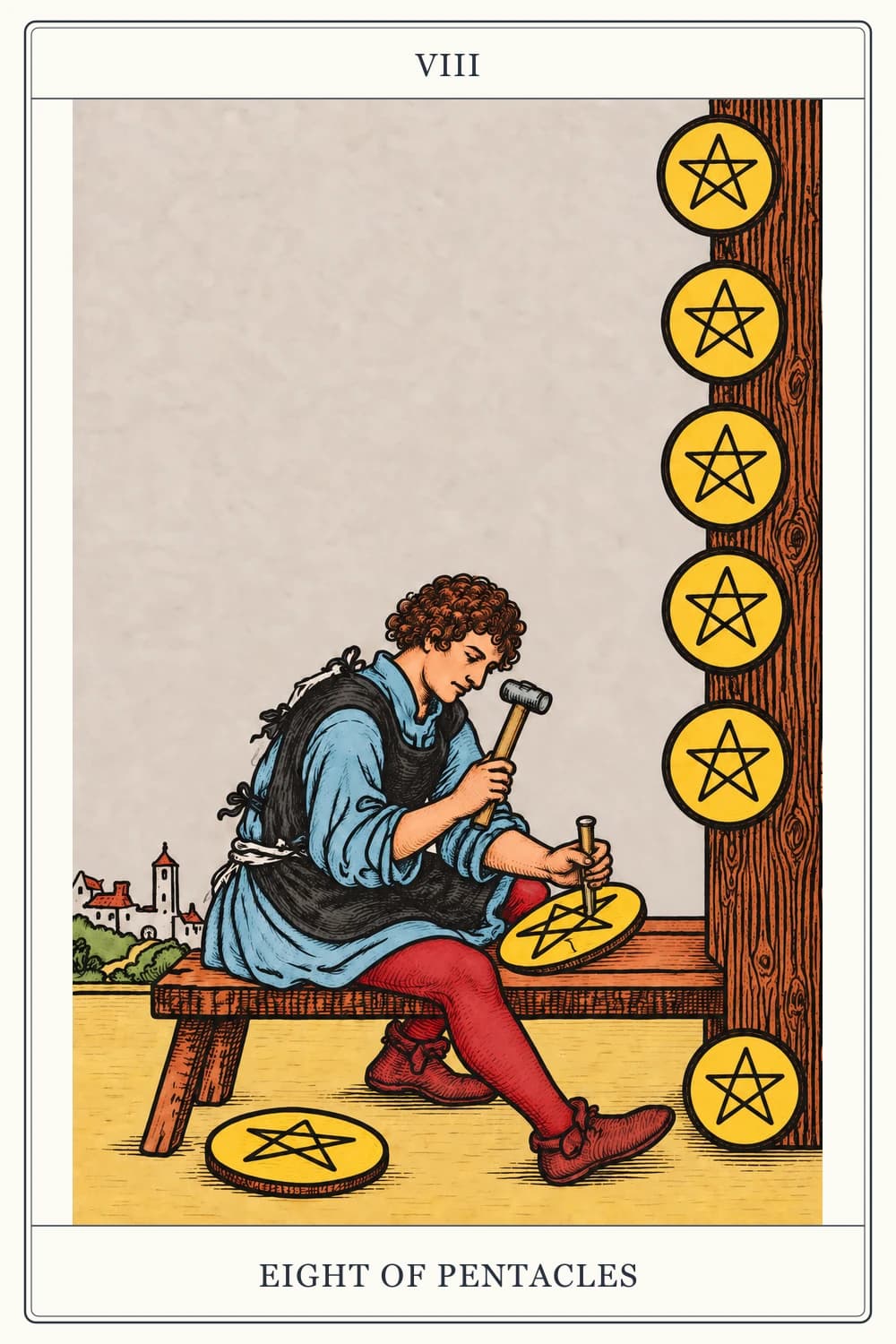
Now ask a narrower preparation question about the evening: 'What could help me explain a game I have never taught before?' For this selected upright example, you own the game, have read the rules once and have ten minutes set aside to prepare. Advice asks for a response you might try.
Suit: Pentacles brings practical materials and skills into view. Number: Eight prompts you to look at the kind of effort shown. Scene: a craftsperson works on one star-marked disc with tools while other pieces hang nearby. The card's reference emphasizes learning through repetition and attention. Together, these clues support practising one concrete part of the explanation.
A position sentence could be: 'Use the available ten minutes to walk through one turn with the pieces and explain one tricky rule aloud.' The time and materials are known facts; neither comes from the Eight. The response fits Advice because it proposes an action. In Situation, the same theme might instead describe the process of learning the game.
A planning note could read: 'Eight of Pentacles in Advice: rehearse one turn, then check after the evening what was easier to explain.' An illustrative later note: 'The first turn was easier to demonstrate. We still looked up a scoring rule. Next time I will include one scoring example within the preparation time.' Practice was useful in a limited way; it did not make every rule clear.
- Write the question, known facts and the position's role.
- Use the suit to identify an area of attention.
- Use the number as a comparison question, then inspect the scene and reference.
- Write a sentence that answers the role and respects the available resources.
- Record what you will try or observe, then add what happened later.
Use Fives and Tens to challenge a shortcut
If 'Five means difficulty' is your starting cue, you still need to identify the difficulty. Competing efforts call for a different question from disappointment about a loss. Likewise, 'Ten means completion' does not tell you whether the result feels satisfying or leaves someone carrying too much.
The contrasts below describe possible themes of individual cards. In an actual reading, first check whether the situation contains that concern. A difficult title or scene is not a reason to invent a loss or overload that you do not know about.
| Rank | Wands reference | Cups reference |
|---|---|---|
| Five | Five of Wands · competing efforts | Five of Cups · loss or disappointment |
| Ten | Ten of Wands · accumulated burdens | Ten of Cups · shared satisfaction |
Find all 40 numbered cards by suit and number
Use a row to compare one rank across four suits, or a column to explore a suit from Ace to Ten. Each name opens that card's picture and full reference. The cards already illustrated above appear again here so this remains a complete lookup table.
For example, to find Eight of Pentacles, follow the Eight row to the Pentacles column. For your own attempt, read its upright or reversed meaning as appropriate, then return to the question and role you assigned. A reversed card is shown upside down; the examples in this article use the upright meanings.
To consolidate the four areas of attention, start the suit lesson below. You can keep this reference open during the exercises; there is no need to memorize the entire matrix first.
Common questions
- Why does another guide give a different meaning for a number?
- Authors use different study frameworks. This guide labels its number cues as Orara's questions for comparing scenes. Read another author's framework on its own terms, then check the individual card and your assigned role rather than mixing every keyword into one interpretation.
Sources and further reading
External references for these reading methods. Orara created the examples on this page.
- Joan Bunning — Minor Arcana structure, suits and elemental associations
- Joan Bunning — Two of Cups: connection and cooperation
- Joan Bunning — Two of Swords: barriers and a held choice
- Joan Bunning — Eight of Pentacles: practice and attention to detail
- Tina Gong / Labyrinthos — another numerology framework for comparison