Tarot court cards: all 16 cards, roles and examples
A court card can suggest a way of learning, acting or taking responsibility. Learn when to read an approach, when a comparison with a person is useful, and how to make either reading specific to your question.
Start here
A Page, Knight, Queen or King appears, and you are unsure whether it represents a person.
In the housemate example, compare a clear request with making room to listen. Notice how Queen of Swords and Queen of Cups can suggest your own preparation without identifying the other person.
Start the conversation exampleOrara editorial · Updated · Our approach
On this page
What is a court card?
Court cards are the Pages, Knights, Queens and Kings in a tarot deck. Each of these four ranks, or named titles, appears in four suits: Wands, Cups, Swords and Pentacles. That makes 16 court cards. They belong to the 56-card Minor Arcana, alongside the 40 Ace-to-Ten cards.
Rank and suit answer different questions. Rank offers a way of engaging with something; suit suggests an area of attention. Wands concerns initiative and creative effort, Cups feelings and connection, Swords thought and communication, and Pentacles practical skills and resources. A Queen of Swords and a Queen of Cups share a rank, but focus their attention differently.
The examples use upright cards, with the pictures the normal way up, and Orara's Rider–Waite–Smith-based artwork. You can follow without a deck. For your own attempt, use the linked card reference or your deck's guidebook, especially if your deck renames the ranks.
Use rank as a question about an approach
Orara uses the questions below to compare ranks. They are study prompts, not fixed personality types or a ladder you must climb. The same person can be curious about one task, act on another and take responsibility for a third. A King does not outrank a Page in the usefulness of a reading.
Add the suit, then check the particular picture and meaning. For example, a Page's curiosity might concern an idea in Wands or a practical skill in Pentacles. The rank gives you somewhere to begin; it does not replace the individual card reference.
| Rank | Starting question |
|---|---|
| Page · learning | What could I explore or learn? |
| Knight · acting | How am I putting this into practice? |
| Queen · attending | What needs thoughtful attention or care? |
| King · taking responsibility | What needs direction or a clear standard? |
Decide whether a person comparison helps
Start with the question and the card's position: the role you assigned it in the reading. Advice asks for a response you could try. A court in Advice is often useful as an approach, such as asking questions or speaking clearly. It need not identify someone you will meet.
A responsibility reading asks what the situation calls on you to do, such as organizing a shared task. This everyday responsibility is different from the card's position in the reading. A person comparison can help when someone has shown a relevant quality. For King of Swords, a colleague who checks agreed details could be a useful comparison: what does their attention to standards contribute? Compare observed behavior, rather than using the card to establish someone's identity or private motives.
For the worked example, you and a housemate share a kitchen. You washed up on the last three evenings, but neither of you has agreed who handles that task. The uncertainty feels tiring, and you cannot take it on every day. You have both agreed to talk for ten minutes tomorrow. Ask: 'How can I prepare for our conversation about washing up?' Use Advice to explore your own preparation.
Compare clarity and care in Advice
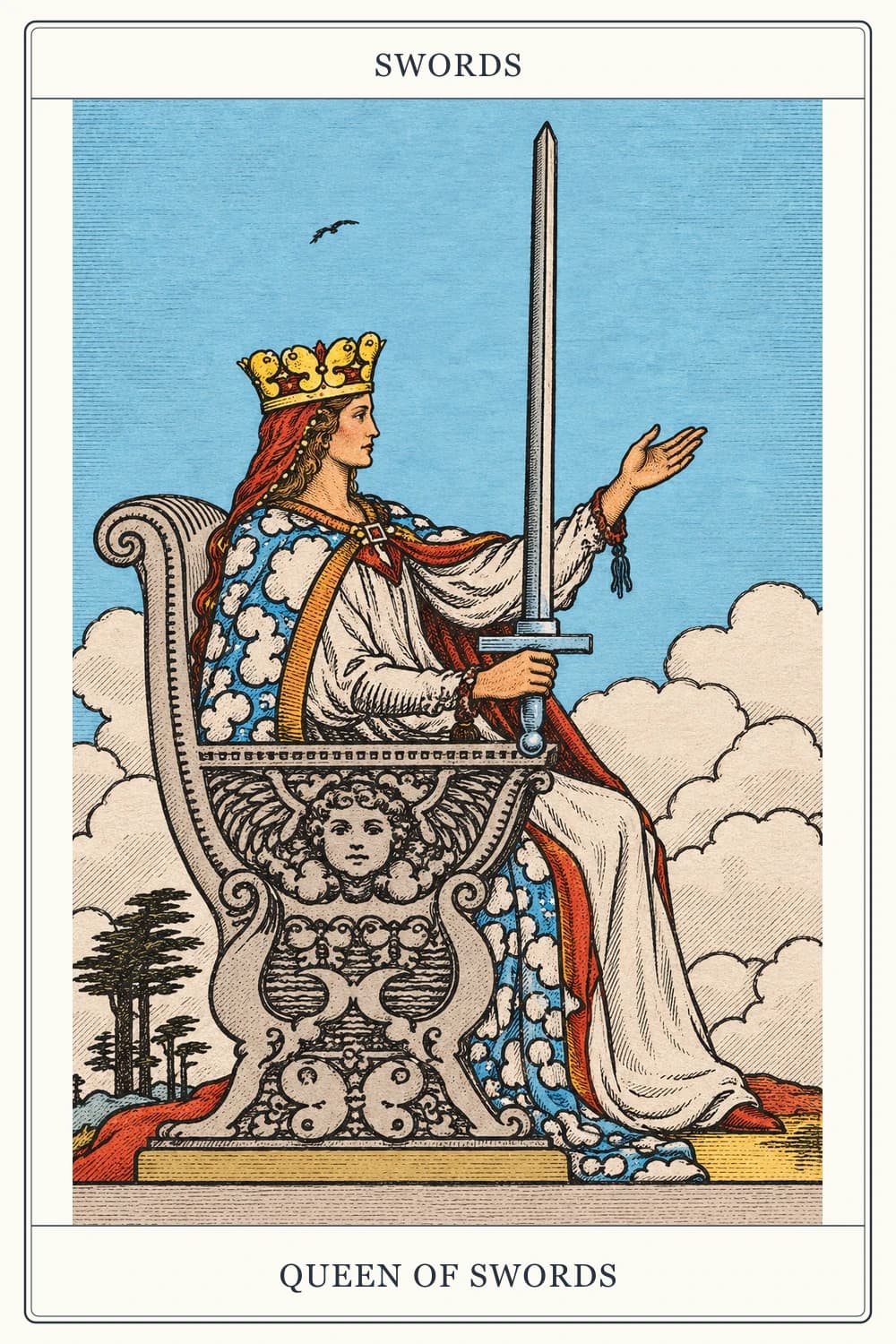
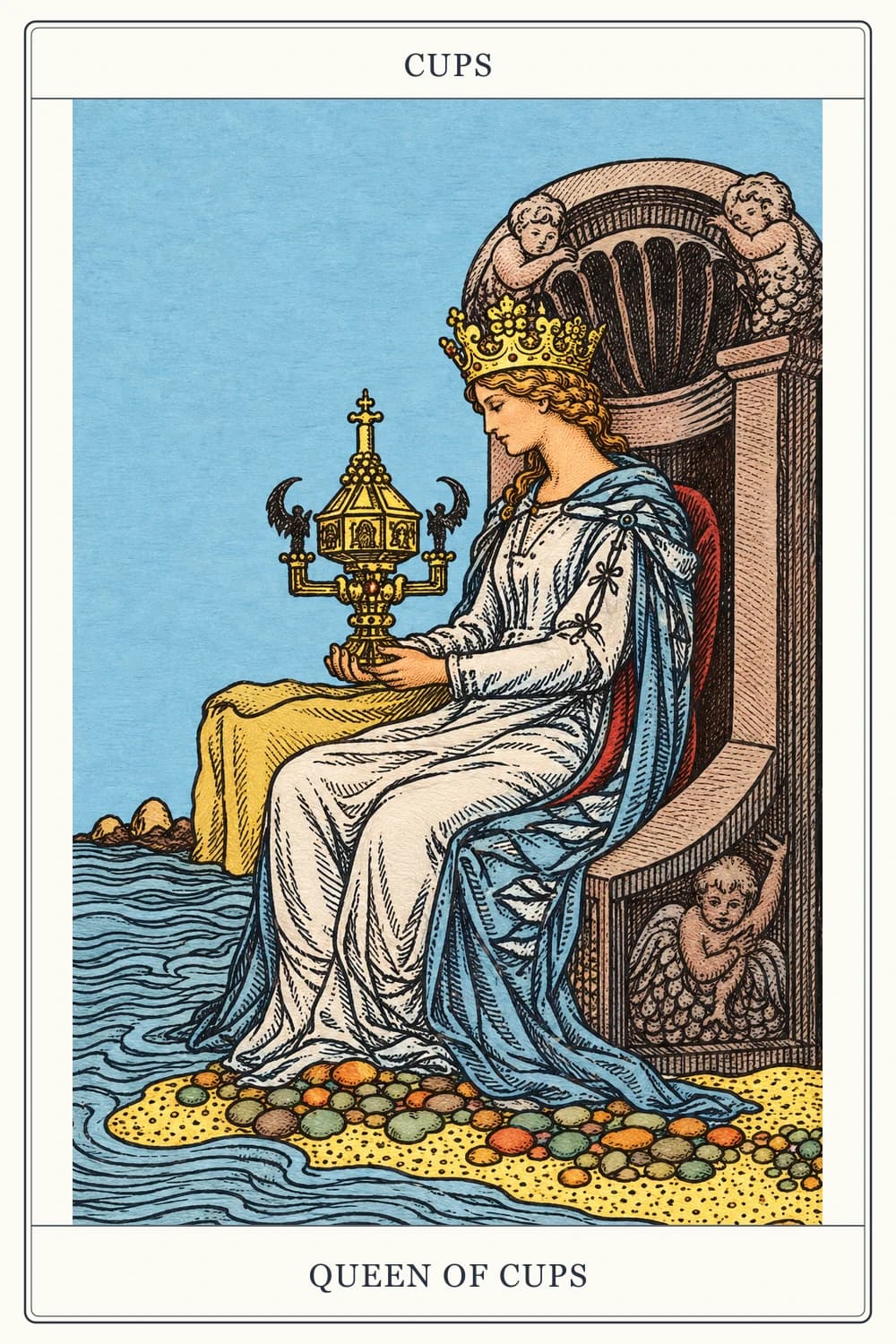
These are two alternative one-card teaching examples. Begin with Queen of Swords. The picture shows an upright sword and an open, outstretched hand. Its traditional associations include honesty and directness. In Orara's rank framework, a Queen gives something considered attention; Swords focuses that attention on words, judgment and boundaries.
In Advice, a possible interpretation is: 'Prepare a clear request while leaving room for a reply.' The known gap is an agreement about washing up. You could bring one observation and one limit: 'I washed up the last three evenings. I cannot do it every day. Can we agree how to divide it?' The open hand supports an invitation to discuss; the sword supports keeping the request clear. Neither gesture supplies your housemate's answer.
Now keep the question and position, but substitute Queen of Cups. The figure looks at an ornate covered cup beside the water. Its associations include care and sensitivity. Advice could become: 'Name how the arrangement feels to me, then ask about their experience.' You might say that you feel tired of the uncertainty and ask how they understood the current arrangement. A feeling is something to discuss, not proof that either person intended unfairness.
Both readings can help. Queen of Swords makes the undefined task and your limit explicit; Queen of Cups gives attention to how the arrangement is experienced. Listening does not require offering to do all the work. If you already have a clear agreement and the problem is that it is not being followed, change the request: refer to the agreement and ask what is preventing it from working.
An initial note for Queen of Swords could read: 'Advice: take a concrete example and ask for a division I can sustain. After tomorrow's talk, record what we actually agree; after a week, check whether the task is clearer.' Keep this note separate from what happens later.
An illustrative later note: 'We agreed to alternate evenings for a week. During the talk, we realized we had different ideas about whether washing up includes putting things away. We still need to define that part.' The request helped surface a detail. The week's trial still needs checking; this note does not establish that the new arrangement works.
Optional practice
Change the facts: the talk is cancelled, your housemate will only exchange short written messages this week, and you still cannot wash up every day. Keep Queen of Cups in Advice. How could care shape a useful response within those limits?
See one possible answer
You could send a short message naming your experience and inviting theirs: 'I feel worn down by not knowing whose turn it is. I cannot wash up every day. How has the arrangement felt to you, and what could you take on?' Acknowledge the reply before proposing a division. Do not assume another meeting is available or solve the tension by offering all the work. Until you both agree, the division remains unresolved.
Compare two Knights within one free weekend
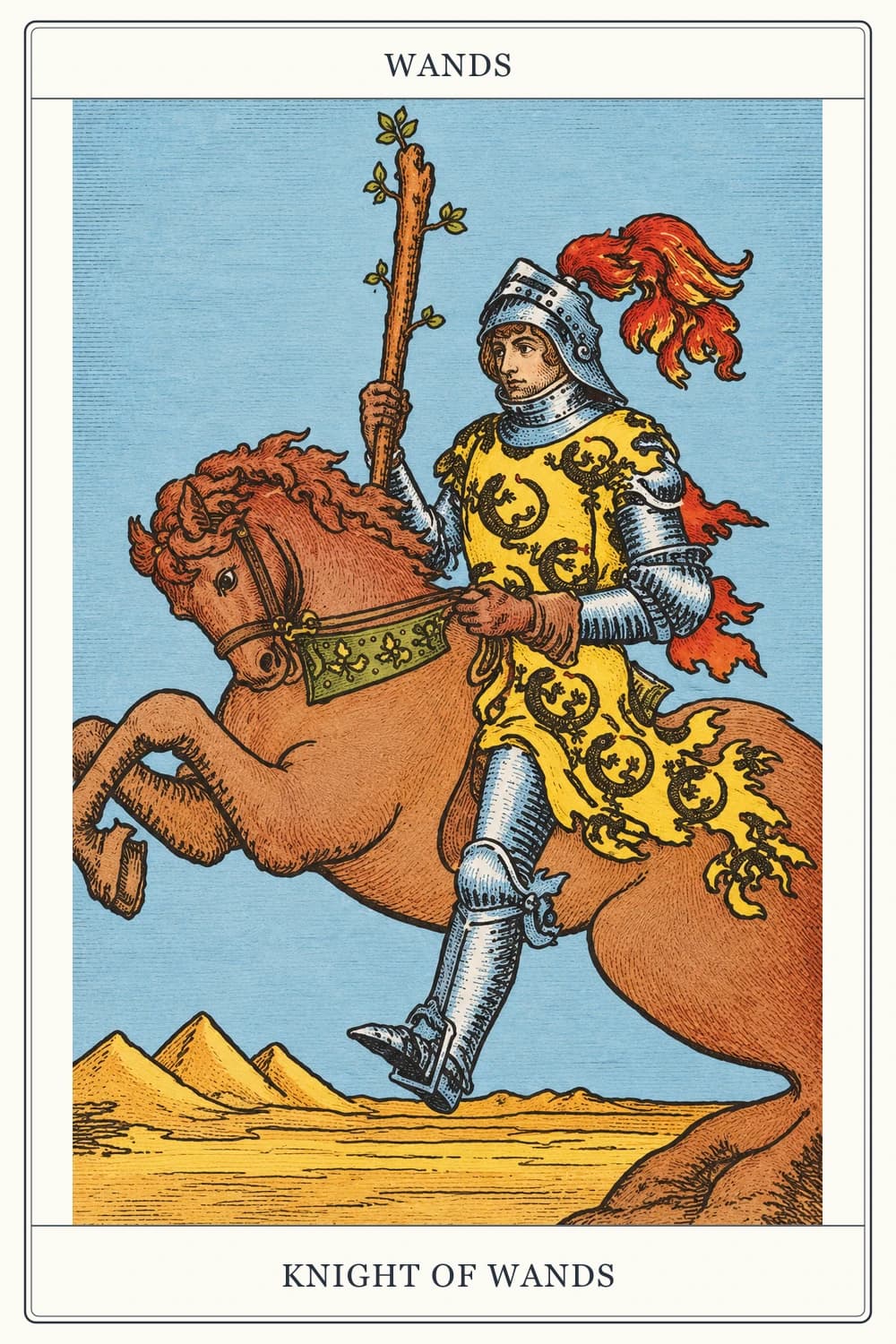
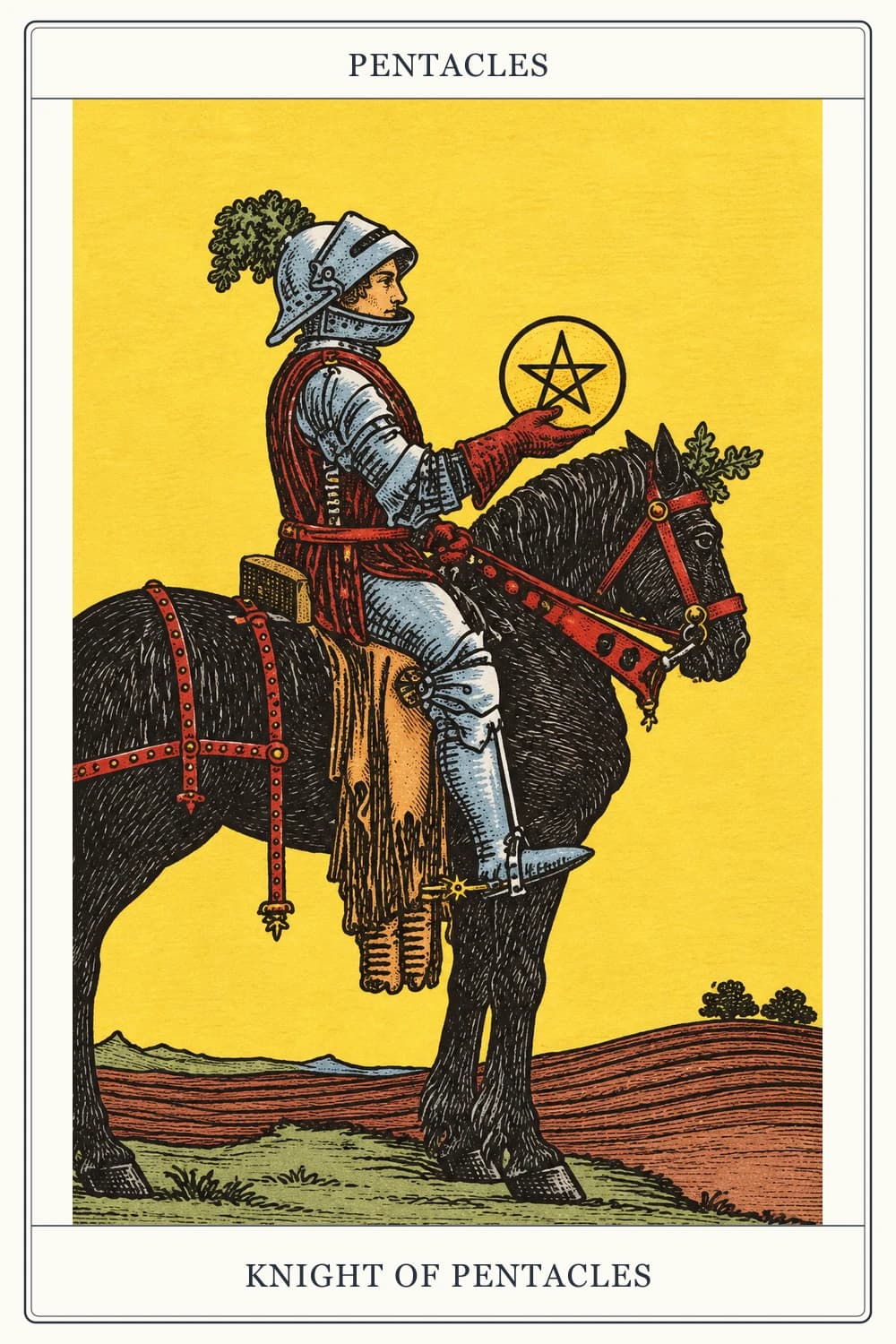
For a separate comparison, ask: 'How could I begin a small collage?' You have paper, scissors, glue and two free hours this weekend. No later session is available yet. Keep Advice as the position and treat these Knights as alternatives.
Knight of Wands holds a wand on a rearing horse. The card's associations include enthusiasm and willingness to try. Here, you could use the available time to make one rough composition before worrying about polish. It is a way to begin an experiment, not a reason to expand it beyond the two hours.
Knight of Pentacles holds a disc on a still horse. Its associations include care and thoroughness. Here, you could choose a small design, prepare the pieces and work through it in order. The steady approach fits inside the same session; it does not require inventing a weekly routine.
Which response helps depends on what is happening. If planning keeps you from making any marks, a rough first attempt may help. If you tend to begin several versions and finish none, limiting the work to one design may help. Both Knights concern action, but the picture and suit distinguish how to act. Neither style is always better.
Optional: add orientation and neighboring cards
Once you can explain an upright court in its position, you can add a reversal method. A reversed card is shown upside down. For example, reading an overused quality in a reversed Knight of Pentacles could raise a question about too much checking. Keep the position fixed and look for supporting behavior; the orientation alone does not establish a problem.
A neighboring card introduces another role to connect, not another label for a person. First explain what the court contributes on its own, then ask how that contribution responds to or complicates the other card. Choose one added method at a time so you can still explain your reasoning.
All 16 court cards: four ranks across four suits
Use a row to compare one rank across the four suits, or a column to explore all four ranks in a suit. For Queen of Swords, follow the Queen row to Swords. Each linked name opens that card's picture and fuller upright and reversed meanings.
The short phrases are Orara's starting prompts. Choose one card, check its reference, then relate a meaning to your question and assigned position. You can keep the table open while practising; knowing all 16 by heart is not a prerequisite.
Common questions
- Does a Queen or King describe a particular gender?
- Court titles do not establish someone's age, gender or identity. In this guide's reflective approach, the qualities are available to anyone. Use a comparison with a person only when their observed behavior makes it useful.
- Does a Page mean I will receive a message?
- Some tarot traditions associate Pages with messages. You can explore curiosity, learning or an invitation through a Page, but the card does not establish that a message will arrive or identify a sender or date.
Sources and further reading
External references for these reading methods. Orara created the examples on this page.
- Joan Bunning — combining suit and rank; approaches beyond age and gender
- Joan Bunning — Page of Wands and the messenger association
- Joan Bunning — Queen of Swords: honesty and directness
- Joan Bunning — Queen of Cups: care and sensitivity
- Joan Bunning — Knight of Wands: enthusiasm and its limits
- Joan Bunning — Knight of Pentacles: thoroughness and its limits