Daily tarot reflection habits
Give each tarot session one purpose and an ending. Follow a short reflection from its first note to a later review, then decide how often you want to return and what to change when the plan does not fit.
Start here
You want a tarot routine that fits the time you actually have.
Think of your next available ten minutes, or a shorter window if that is more realistic. Choose one task from the table and write its stopping point. If you also want to act on the reading, reserve time for that within the same window.
Choose a task and stopping pointOrara editorial · Updated · Our approach
On this page
Choose a time you can actually use
Choose daily practice, a few sessions a week or an occasional review according to the time you have. Start with one upcoming opportunity: 'After breakfast on Monday, I have ten minutes.' Pick a place for your notes and decide what will count as finished before opening the cards.
For a reflection, one card is enough to begin. Use your deck or Orara's Today page, which offers one upright card — its picture the right way up — shared by everyone for the date shown. For your own deck, decide to use upright cards for this exercise before drawing. Keep the card name and date with your note so you can return to this reading even after the daily card changes.
Today notes stay in this browser. For the week-long example below, use one notebook page or document that you can return to on Friday. If a session is missed, keep the existing note and resume with the task you need next; there is no missed draw to replace.
Choose the task and its stopping point
Reflection connects a card with a situation you know. Study checks your understanding of a card's meaning. Review compares an earlier note with what happened. Pick the row that matches your purpose; you do not need to do all three in one sitting.
If you want to learn what a card means, choose study. If you already have a note waiting for an update, review it. Choose reflection when you have a situation to think about and enough context to try a connection. An unclear connection can be the result you record; you do not have to keep drawing until one feels convincing.
| Task | What you do | Stop when you have… |
|---|---|---|
| Reflection | Notice an image detail, check a meaning and connect it to known facts. | One possible interpretation and a question or response. |
| Card study | Attempt a meaning, compare it with a reference and explain the difference. | One confirmed idea or a specific correction. |
| Review | Read the original note, then add an observation from later. | One thing that fit, changed or remains unknown. |
A ten-minute example: returning to a sketch
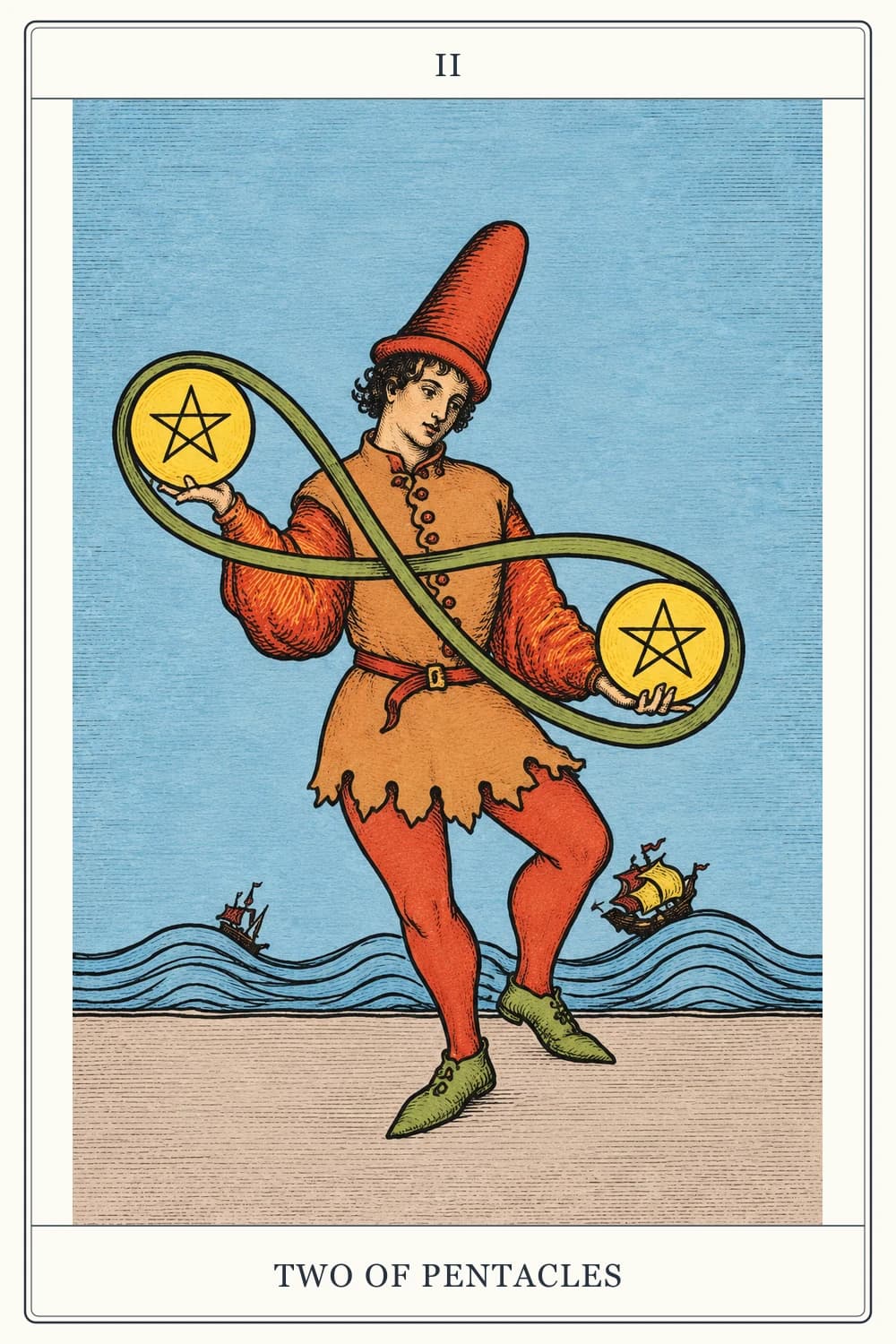
You have ten minutes after breakfast on Monday, an unfinished sketch, and a pencil and paper on the table. Your question is 'How could I use this short time to return to drawing?' You choose reflection and reserve five minutes for the card and note, leaving five to try a sketch. Two of Pentacles is selected here to demonstrate the method; it is not a claim about today's live card.
The figure holds two star-marked discs inside a looping ribbon, with ships on waves behind them. Balancing demands and flexibility are conventional themes. Here, flexibility could mean changing the size of the drawing task to fit the time: 'I could work on one outline instead of trying to finish the whole sketch.' The five-minute limit comes from your plan, not from the card.
Your short note could read: 'Monday, after breakfast. Two of Pentacles, upright. I noticed the two discs held in a loop. Flexibility fits my limited time: try one outline. Question for review: was that small enough to begin without overrunning the ten minutes?' You have reached the reflection's stopping point. Put the card aside and use the remaining five minutes for the outline.
Another reading of balance might suggest sharing time between two projects. That would need a second project you actually want to work on; this situation names only one. If you cannot find a useful connection for your own card, write what remains unclear and stop at your chosen time rather than inventing a problem.
Review whether the routine helped
Choose a review point before you close the first note. In this example, Friday after breakfast has five minutes available. Read Monday's entry and record both what you did and whether the routine fit the time. You can review the same card and note without making another draw.
An illustrative update is: 'I spent five minutes on the note and five on the sketch. I started an outline but did not finish it. Choosing one part helped me begin, and the ten-minute window was enough for that goal.' This gives you a reason to keep the small scope at the next suitable session. It does not yet show that the same routine will fit every morning.
A different result could be: 'I spent all ten minutes reading meanings and never picked up the pencil.' Then the routine crowded out the activity it was meant to support. Next time, you could use the existing interpretation and devote the available time to drawing, or choose a card-study session with no promise to sketch. Decide from the result you actually recorded.
If Friday is unavailable, leave the entry intact and review when a suitable moment appears. You can also pause the routine. A calendar week ending does not require a three-card reading or a longer catch-up session.
Reading worksheet
Adjustable practice plan
My purpose: reflection, card study or review:
My next available time and duration:
Where I will keep the card name, date and note:
What will count as finished:
Time reserved for any action afterward:
When I will review the result:
If I miss the session: keep the note and choose the next useful task.
After review: what I will keep, shorten, change or pause:
Optional practice
Before Monday's session begins, your ten-minute window shrinks to three minutes. You have not drawn a card, the pencil and paper are ready, and your main aim is still to begin the sketch. There is no more free time today. What could you change about the plan and its stopping point?
See one possible answer
You could skip the tarot reflection and use the three minutes to start one line or shape. Stop when the window ends; a finished sketch is not required. If you instead choose to spend the three minutes reflecting, make one short note the whole task and drop the promise to sketch today. Either choice must fit the available time. The original five-minute reflection plus five-minute sketch no longer fits, and no catch-up draw is owed.
Optional: study the card in a separate session
If learning the meanings is your next goal, return to the same card rather than adding a more elaborate reading. Before opening its reference, write one meaning you remember and a detail that prompted it. Then compare your attempt with the upright meaning. The card name beside the illustration opens its reference.
For Two of Pentacles, an initial guess might be 'I must keep every commitment going.' After checking the flexibility theme, a correction could be: 'Balancing demands can involve adjusting a commitment; the image does not prove that I have time for everything.' Keep that correction in your notes and stop. If your first idea was already supported, explain why instead of manufacturing an error.
For a different card chosen by the practice tool, use the same attempt–check–explain sequence. This is a study session with its own outcome. Add it only when learning is what you want to do with the available time.
Sources and further reading
External references for these reading methods. Orara created the examples on this page.