Daily tarot card practice: one card, a note and a check-in
Use one card to explore how you might approach an activity today. This reflective practice ends with a short note and a later observation you can compare with your first interpretation.
Start here
You want to turn today's card into a useful note.
In the keyboard example, ask what would make a five-minute trial useful even if the person chose to stop afterwards. Compare the initial note with the later observation before trying the method yourself.
Follow the Four of Cups exampleOrara editorial · Updated · Our approach
On this page
Choose one situation and one question
Pick an ordinary activity you expect to have time for today. Write down what is already true before looking at the card: the available time, what is ready and what feels difficult. This gives you something specific to interpret the image alongside.
Our example follows a person with thirty minutes to play a keyboard, a familiar tune ready and little enthusiasm for starting. Their question is: 'What could help me decide whether to begin or rest?' The card will offer a perspective on that choice; it cannot establish why they feel uninspired.
You can follow the example without a deck. For your own attempt, use Orara Today or draw one card from your deck. This lesson uses upright cards, meaning the image is the normal way up. With a physical deck, keep the cards that way for this exercise and record how you selected yours.
Reveal your card and find one useful theme
On Today, check the displayed date and calendar, then tap the face-down card to reveal it. Everyone receives the same card for that date, shown upright. Refreshing on the same date keeps that card; a later date can still have a card you have seen before.
First describe two or three visible details without assigning a meaning: a figure's posture, an object or an action. Then read the short interpretation below the card. Use the 'Read about' link with the card's name if you need more context. Today's text comes from the card library; revealing the card does not request an AI reading.
Choose one theme that connects with a fact you wrote down. Complete the sentence 'Because I know ___, this theme makes me wonder ___.' Turn that thought into something small you could try or notice. If no theme fits, write 'I do not see a useful connection today' and keep your image observations as a study note.
Example: the Four of Cups before a practice session
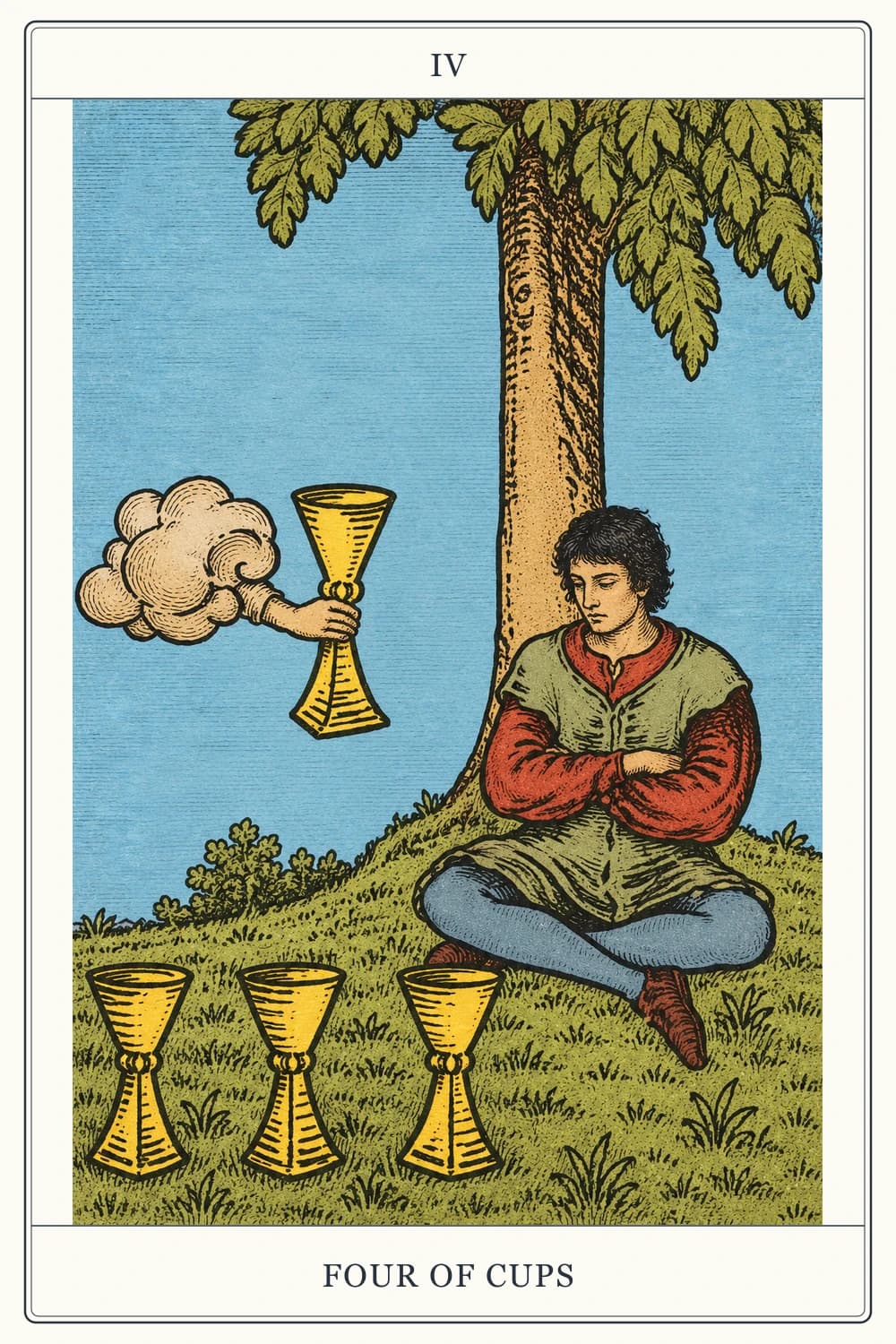
The upright Four of Cups shown here was chosen for this teaching example; your daily card may be different. Look at the seated figure's folded arms, the three cups on the ground and the hand holding out another cup. Those are visible details. Calling the figure bored or thoughtful is already an interpretation.
Joan Bunning's card reference associates the Four of Cups with disengagement and turning inward to reflect. In our keyboard example, disengagement fits the person's reported lack of enthusiasm. The offered cup can suggest considering an available activity: the instrument and tune are ready. It does not establish that playing is the right choice.
A possible connection is: 'Because the tune is ready but I am reluctant to begin, I could try a small amount before deciding about the whole session.' The resulting prompt is 'Would five minutes of a familiar tune help me want to continue?' Five minutes is a practical choice within the known half hour, not a number prescribed by the card.
An alternative is that a pause would be more useful. The inward-looking scene can support that interpretation too. The card cannot decide between reluctance to start and a need for rest. Checking how the person feels, including after a brief attempt if they choose one, gives them more to go on than the symbolism alone.
Initial note: 'Four of Cups, upright; chosen example. Thirty minutes free, keyboard and familiar tune ready, little enthusiasm. The offered cup suggests considering what is available. I will play for five minutes, then notice whether I want to continue or stop. Rest remains an option.' Add your date and card-selection method when writing your own version.
Optional practice
Change one fact: the keyboard is being repaired and no instrument is available today. What part of the interpretation needs changing, and what could the person record without drawing again?
See one possible answer
The claim that playing is an available activity no longer fits. They could write: 'I could not try the tune because the keyboard was unavailable; this tells me nothing about whether starting would have helped.' They might choose rest or another activity, but neither is a test of the original five-minute plan.
Add what happened and revise your first idea
After the activity, describe what you did and noticed before comparing it with the card. Keep the initial note intact and append a separate 'Later' entry. A useful check-in can be two sentences; it does not need to account for everything that happened that day.
Later in our example: 'I played the familiar tune for five minutes. I felt tired and chose to stop. The small start helped me begin, but it did not make me want a longer session.' This supports the limited usefulness of the trial and leaves room for rest. It does not prove that the card identified the cause of the reluctance.
If an interruption prevented the activity, record that instead. You cannot assess a trial you did not make. If you tried it and found no useful connection with the card, say so. The learning is in distinguishing the image, your first idea and the outcome, including where they diverge.
A quick journal note
Date / card / selection method:
Known situation:
Image detail → reference theme → my possible interpretation:
One small response and what I will notice:
Later: what happened / what I would revise:
Detailed journal worksheet
Daily card practice worksheet
Date and calendar:
Card and orientation:
Selection method (Today, drawn or chosen study card):
Known situation and question:
Two or three visible details:
One reference theme:
Why it might fit this situation:
Another possible interpretation:
One small response and what I will notice:
Later: what I actually did and observed:
What did not fit or could not be checked:
One thing learned about this card:
Keep the note where you can return to it
After revealing Today's card, you will see 'Your note for today'. Write your initial note there and add the later observation in the same box. It saves automatically as you type; a brief 'Saved on this device' message confirms success. If saving fails, use 'Try saving again' or copy the text elsewhere.
The note is stored in this browser on this device, including when you are signed in. Today opens the note for its displayed date and has no archive for browsing earlier daily notes. If you want to review after that date changes, keep a copy in a notebook or document. Clearing browser storage also removes the local copy.
Your one-card practice is complete when you have added the observation. For a separate question later, Today's optional 'Start a 3-card reading' opens Clarity, a layout with Situation, Obstacle and Advice roles. It supplies an editable question inspired by the card. Draw selects three fresh cards; today's card need not appear, and your daily note is not copied into the question.
Sources and further reading
External references for these reading methods. Orara created the examples on this page.