How to learn tarot without memorizing 78 definitions
Start with one picture and an idea you can check. Follow Three of Pentacles from a first impression to a useful interpretation, then learn to explain it again in your own words.
Orara editorial · Updated · Our approach
On this page
Notice a detail before looking up the meaning
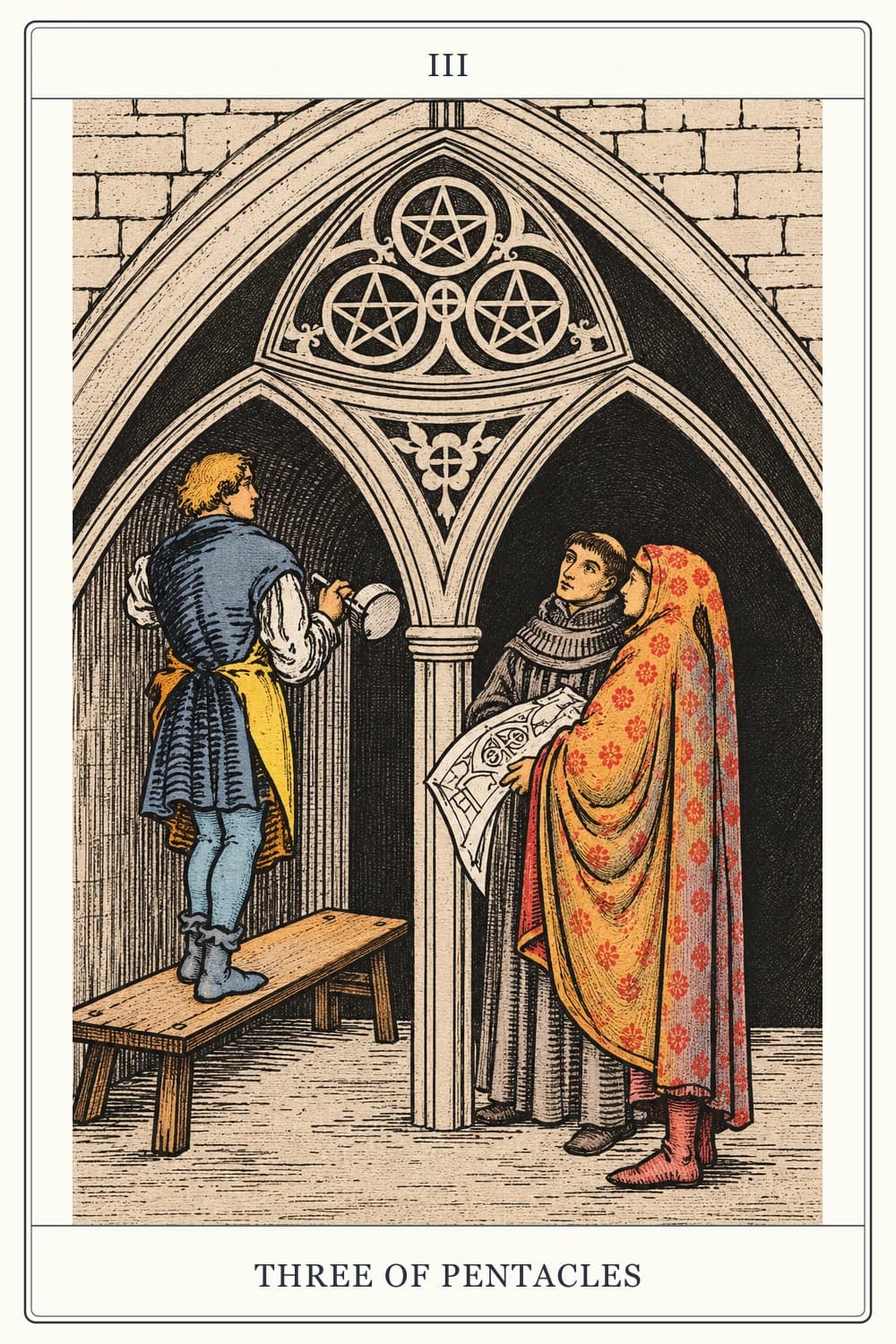
Use the pictured Three of Pentacles for this study example. It is upright, with the picture the normal way up. You can follow without a deck; keep a notebook or document beside you.
One person stands on a bench, facing two others; one of them holds a drawing. Three patterned discs, called pentacles, appear in the stonework above. ‘Three people are looking at the work’ describes the scene. ‘They are cooperating’ adds an interpretation.
Suppose your first guess is: ‘This card means I have to work with a team.’ The group explains where the idea came from. Write the sentence down before checking it: which part does the picture support?
Keep the useful idea and revise the claim
Open the card’s linked name above and read its upright meaning. Orara’s reference describes learning through practice, feedback and people bringing different skills. Joan Bunning’s reference also includes teamwork, planning and competence. These associations give you more than one way to explore the scene.
Keep the idea of working together, but change ‘I have to work with a team’ to ‘Different skills can contribute to one task.’ The first version makes cooperation compulsory. The second describes a possibility you can test against your situation.
The drawing offers another starting point: planning the work. If your own first guess differs from the reference, identify the detail behind each idea. Keep what you can explain, label a personal association as yours, and leave a question open if the connection is still unclear.
Give the meaning a question and a role
Now ask: ‘What could help me make this opening paragraph clearer?’ You have a draft, and a colleague has offered to read one paragraph. Give the card the position Advice: its job is to suggest a response you could try.
The shared-work theme could become: ‘Ask my colleague where the main point becomes unclear, then try one revision.’ The picture and reference suggest bringing perspectives together. The offer makes that possible, and a reader’s account may reveal something your own rereading misses.
Planning also fits the card: you could check the paragraph’s structure yourself. Try the outside perspective first here because someone is available to read it. If nobody were available, self-review would be a more practical use of the planning theme. Whether a comment helps remains something to find out.
- Name the question, the card’s role and the facts it must respect.
- Choose a reference theme and connect it to a visible detail.
- Explain one possible response and why it fits better than an alternative.
Keep a short note, then explain it again
A study note can preserve the change in your thinking: ‘Three of Pentacles: I first wrote “I have to work with a team.” The group supports shared work, but the reference also includes planning. I’ll try the offered paragraph feedback and see what the reader finds unclear.’
Next time, look at the picture before reopening the reference or your note. Explain a theme and a possible use aloud or in writing, then compare. Can you give a reason, rather than just recall a keyword?
A later note might say: ‘I remembered teamwork, but forgot why it needn’t mean finding a team. Looking back at the drawing helped me recover planning as another approach.’ That gives you something specific to revisit; identical wording is unnecessary.
When you add another card, repeat the picture-and-reference check with its own scene. There is no need to finish the deck before trying a reading, and you can keep using references as you learn.
Try the same process with another card
Orara’s Find the meaning practice opens with Full deck selected. A session has up to five questions; use whichever card appears. Look at its picture and form a reason before choosing an answer.
Read the feedback and compare it with your reason. If you are stuck, ‘Show hint’ offers a nudge and ‘Show the answer’ reveals it. Once it is shown, ‘Read the reference’ gives more detail and a link to the card library. A correct choice is a starting point: can you explain why it fits?
Keep your study note in your own notebook or document. The practice saves exercise progress, not the note you write beside this guide. Sign in to save progress to your account and check the save status; without sign-in, it is a temporary draft in the current tab. See how learning progress is saved if you want to continue on another device.
Try one question. Finish with a detail you can point to and a meaning you can explain.
Practice: change the available help
Keep Three of Pentacles in Advice, but no one can read your draft this week. You have ten minutes now. Suggest a response using its planning theme and explain how it fits these facts.
See one possible answer
Write the paragraph’s intended main point in one sentence, then check whether the paragraph supports it. Mark one place to revise. The drawing and planning theme suggest organizing the work, and this review needs no helper. You still haven’t tested what another reader understands.
Reading worksheet
One-card study note
Card / orientation / date:
Detail I noticed:
First guess and why:
Reference theme / source:
What I changed, and why:
Question / position / known facts:
Possible use and alternative:
Next session, before checking: what could I explain?
After checking: what needs another look?
SourcesJoan Bunning · Learning the Tarot
This reference explains the traditional associations used here. The study example and exercise are Orara’s own.
External references · learntarot.com