Should you ask tarot the same question again? A review method
Another set of cards can offer another perspective without settling the original uncertainty. Use your first record to decide whether to clarify it, act on available information, ask a distinct question or stop for now.
Start here
You want another reading but are unsure what it would add.
In the class example, compare the initial note with the organiser’s reply and the home trial. Which new fact makes a different comparison possible, and what remains unavailable despite the cards?
Compare the first note with the later evidenceOrara editorial · Updated · Our approach
On this page
Name what you want another reading to do
Before drawing again, finish this sentence: “I want another reading because…” You might need a clearer explanation, have learned something new or simply wish the answer felt more reassuring. Those are different needs. A new selection changes the cards; it does not establish which account of the situation is true.
Keep the original question, cards, interpretation and proposed response available. If your reading was outside Orara, use your own notebook or document. If part of the record is missing, mark it unknown rather than reconstructing a convenient earlier answer.
Wanting reassurance does not make your first attempt a failure. You can pause, name what remains uncertain and choose a next step without another draw. This guide offers a review method, not a diagnosis or a rule about how often everyone must read.
Separate a changed task from a changed reaction
The passage of time alone does not tell you what a new reading would add. Look for a changed fact, an observation from something you tried, or a distinct question you can explain. A different study or reflection task can also have a purpose without new external facts; write that purpose before choosing more cards.
You do not have to draw again when something changes. Information may already settle the practical issue. If cards could help examine a remaining trade-off, name the options and limits first. A more hopeful wording of the same request for certainty still leaves the certainty unavailable.
| Reason for asking again | What the review calls for |
|---|---|
| I dislike the cards. | The reaction changed; the facts may not have. Keep the first record and consider a plausible alternative interpretation. |
| I do not understand Advice. | Check that card’s meaning and its assigned role. Clarifying the existing cards does not require a new selection. |
| I tried the proposed action. | Append what happened, including a partial result. Decide whether an unanswered task remains after that review. |
| A reply changes the available options. | Record the reply and check its practical limits. You can make an ordinary decision or frame a new comparison. |
| I want certainty about someone’s motives. | The motive remains unknown unless you have relevant evidence. A different card cannot supply their private explanation. |
Example: a drawing class overlaps a fixed commitment
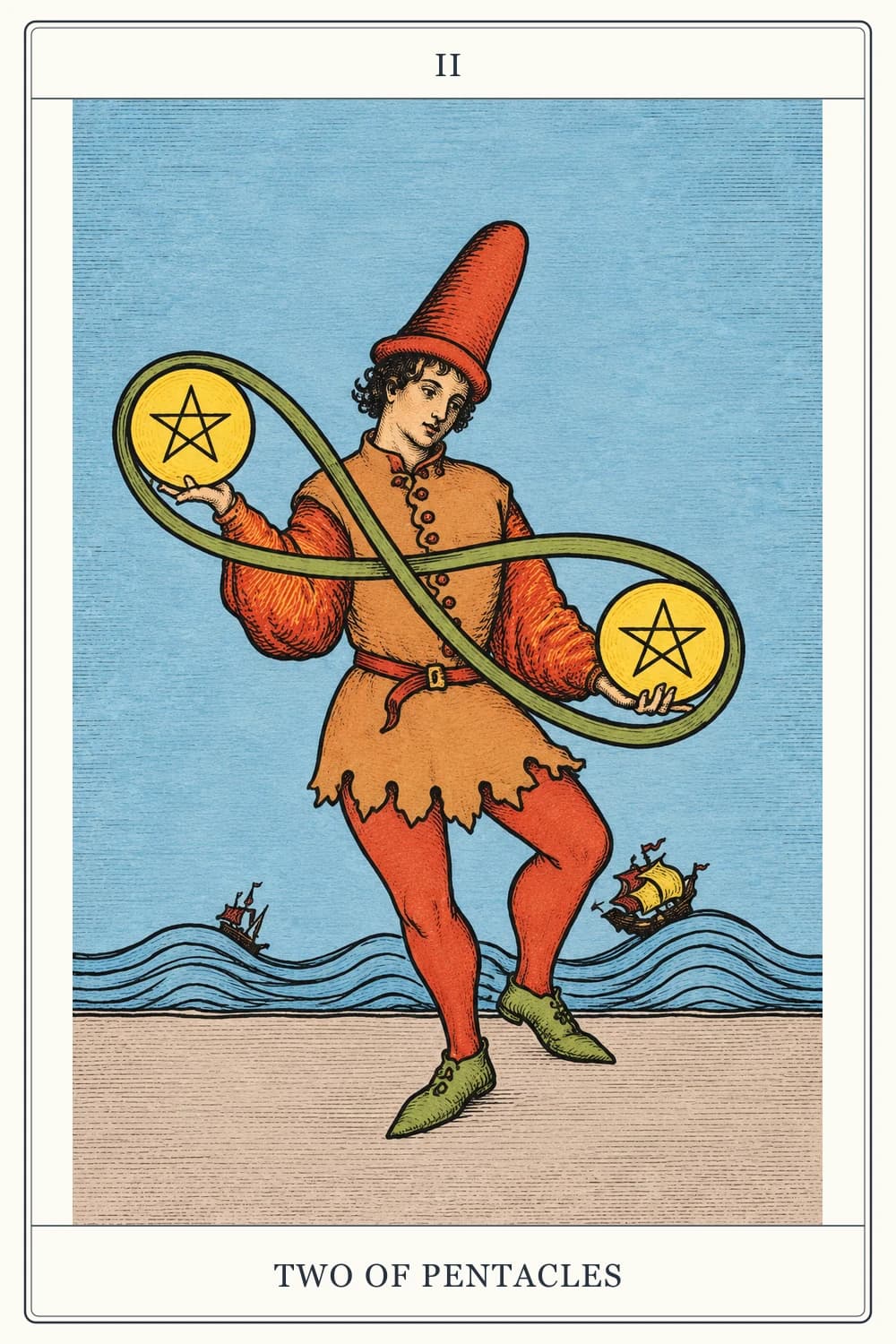
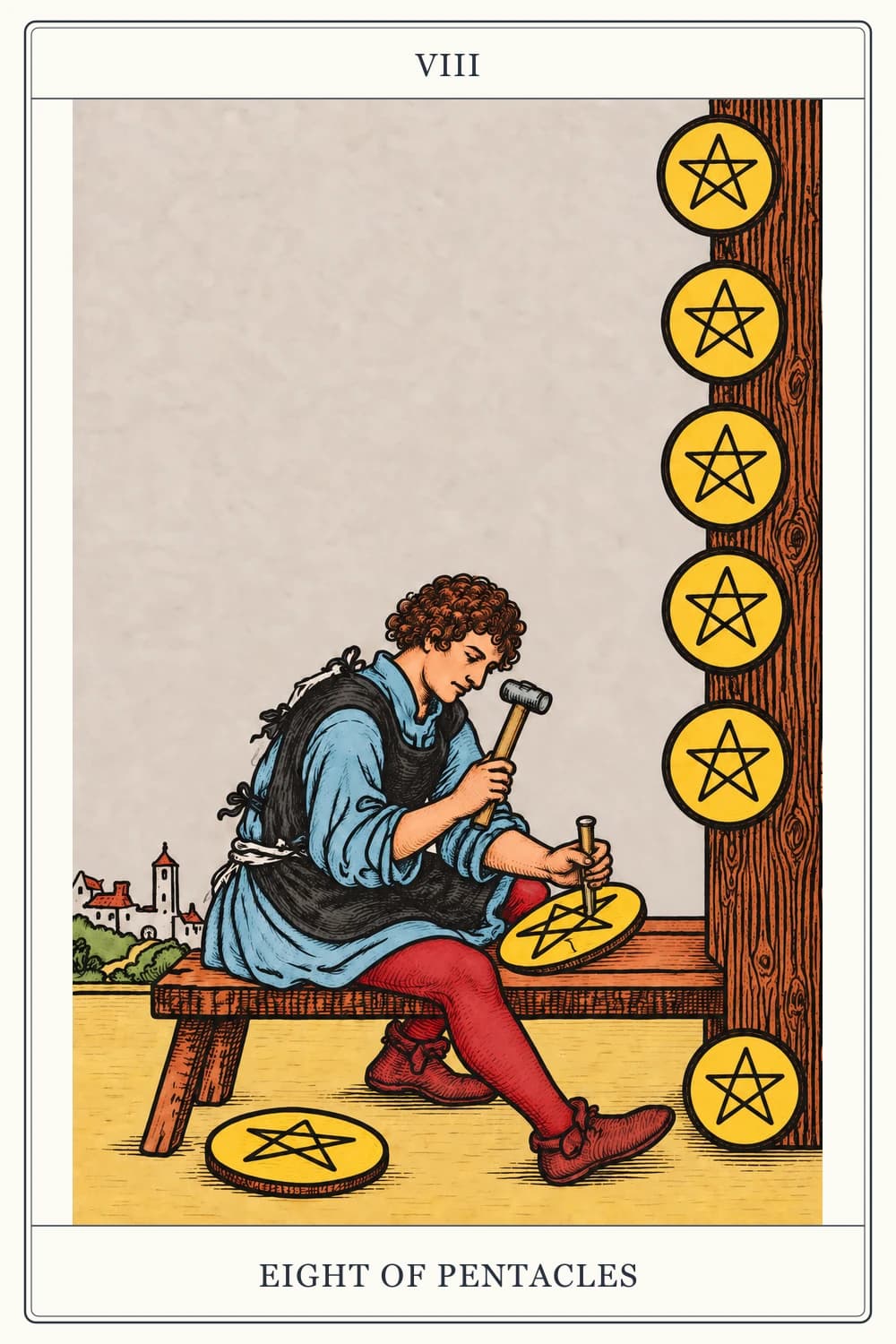
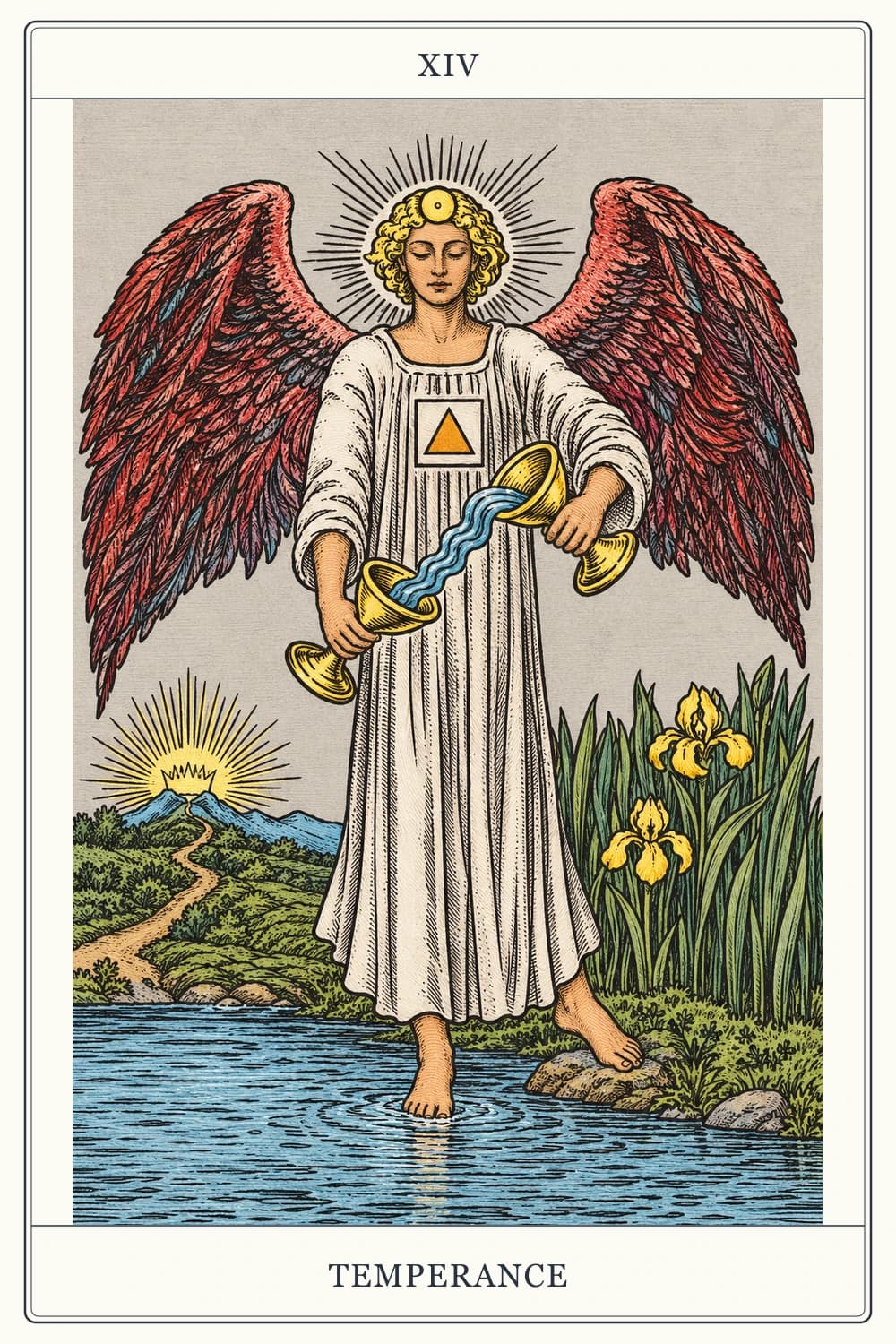
These are selected teaching cards in an invented example, not a live draw. On Monday, you ask: “What could help me make room for a weekend drawing class?” The advertised online class meets Saturday, 10–11, exactly when you have an immovable commitment. Sunday, 10–11, is your only available weekly drawing window. You have paper and pencils and could practise at home; you do not yet know whether another class time exists.
Use Clarity: a three-card spread, or layout, with Situation, Obstacle and Advice in that order. A position is a card’s assigned role. All three pictures are upright, the normal way up. The linked card names provide meanings if you want to inspect them; the explanation below supplies the reasoning for this example.
Situation — Two of Pentacles. A figure holds two star-marked discs inside a looping ribbon, with ships on waves behind them. These discs are called pentacles. Joan Bunning’s juggling and flexibility themes offer a way to examine competing demands. Here: “Drawing has to fit beside a commitment that cannot move.” The overlap is already a fact; the picture does not prove you can juggle both at the same hour.
Obstacle — Eight of Pentacles. A craftsperson works on one pentacle with a hammer and chisel while others hang nearby. Bunning associates it with diligence, learning and detail. In Obstacle, consider what the desired training needs: actual practice time. “I cannot participate in the advertised practice hour.” This does not turn diligence into a bad trait or establish that you are a perfectionist. More effort cannot create an extra Saturday hour.
Advice — Temperance. A winged figure pours water between two cups, with one foot in water and one on land. Bunning’s moderation and balance themes suggest adjusting the arrangement. Here: “Ask whether a compatible class time exists before committing.” One message to the organiser can check that possibility. The card does not promise a Sunday session or require you to negotiate away the fixed commitment.
Connected interpretation: “Learning to draw must fit around a fixed demand, and practice needs an available hour, so I will check another arrangement before enrolling.” This joins the three roles. If Temperance feels too cautious, drawing immediately for a more encouraging answer adds no information about the timetable.
Another possible use of Temperance is to combine a class with home practice. Keep that as an idea to check. A one-hour class would fill your sole one-hour window, so adding a separate practice session would exceed the stated time. Do not call both options available together without changing the facts.
Record the first response before the later information
Initial note, Monday: “Saturday class overlaps a fixed commitment; Sunday 10–11 is my only drawing window. Selected upright Clarity cards: Two of Pentacles / Situation; Eight of Pentacles / Obstacle; Temperance / Advice. Interpretation: check a compatible arrangement. Response: message the organiser about another time. Within Sunday’s hour, try twenty minutes of home drawing. Review next Monday: what did the reply establish, and could I use the trial time?”
Illustrative later note, next Monday: “The organiser confirmed that I can join the next Sunday 10–11 online session, with feedback during the hour and no required extra homework. I have the required materials and can afford the fee. Yesterday I used two minutes to set out paper and eighteen to draw one object. I completed one attempt but had no outside feedback. Saturday remains unavailable.”
The reply establishes a new class option; the trial supplies one observation about home practice. Neither came from drawing more cards. The trial does not prove that an hour every week will be easy, and the organiser’s description does not tell you how useful the feedback will feel. Keep these limits beside the new facts rather than rewriting the initial note to say that Temperance predicted Sunday.
Choose whether a new comparison would help
The original timetable problem has changed. You can now compare Option A, the Sunday class, with Option B, home practice in the same Sunday hour. If you still need to weigh the difference, ask: “What matters most when choosing between the Sunday class and home practice?” Decision’s roles are Option A, Option B and What matters most. That is a different task from asking the first question until a preferred answer appears.
You can also decide without another reading. For example: “Feedback matters more to me than setting my own pace, so I will try the class and review the first session afterward.” That priority is a choice you state, not something the first cards proved. Record the choice and leave the class experience unknown until it happens. This example does not supply or draw a second set of cards.
Optional practice
After this review, a new fixed obligation fills next Sunday’s entire hour. The Saturday conflict remains, and no other drawing time is available next week. Can you still choose either drawing plan for that week? What should your record and next response change?
See one possible answer
Neither plan fits next week’s stated time. Record that the new obligation makes both unavailable and defer the drawing session; do not invent a shorter opening, another day or a way to move the commitment. Check later weeks’ actual availability before considering a booking. Keep the home trial as a past observation, not evidence that time must exist now. More cards cannot restore the missing hour.
How Orara handles a linked return to a saved question
Opening a History entry lets you reread it and add notes without drawing again. Its section A new reading for this question offers a separate way to draw new cards and compare them with that record. Orara requires at least seven days from the original saved reading, or the latest saved linked return if later. Before that, the section shows an availability date instead of Draw new cards.
That interval belongs to this linked return feature. It is not evidence that an interpretation becomes true or a new reading becomes useful after seven days. The linked flow keeps the original layout so the roles can be compared. The class-to-home comparison above changes the task and layout; it should not be confused with redoing the original Clarity question.
A visible Draw new cards link is an option, not a prompt that you must use it. Review the original note first. If a saved entry is unavailable, check its account or browser location before relying on History to recover it.
Finish the review with one ordinary next step
Your result can be a clearer interpretation, a request for information, a small trial, a decision or an unresolved question. Write which one you chose and what you will check next. A review that ends without another draw is complete.
The main action below opens History. Open the relevant saved entry and read its original question and text before adding the later note. If you kept the record elsewhere, use that instead. Keep this worksheet in your own notes; it does not create an entry or prefill your journal.
For health, legal, financial or immediate safety decisions, use appropriate information and qualified support. A repeat reading cannot supply the evidence or assurance those decisions need.
Reading worksheet
Review before another draw
Original date, question, layout, cards and orientations:
What I knew then:
Original interpretation and proposed response:
Why I want another reading now:
What I actually did or observed:
New facts or options, with their source:
What remains unknown or unavailable:
Can clarification or an ordinary action address this?
My next response, including a decision to stop:
If a distinct task remains, its question and limits:
Review point and what I will check:
Sources and further reading
External references for these reading methods. Orara created the examples on this page.