How to ask tarot questions for clarity: examples and a first try
A useful tarot question gives you something specific to explore. This guide uses a reflective approach: separate what you know from what you wonder, choose a question and try a response you can review.
Start here
You have a concern but do not know what to ask.
Write the concern as it comes to you. Underline anything it assumes: a guaranteed result, someone else's reaction or a judgment about you. Use the example to choose a task you can explore.
Follow a concern into a focused questionOrara editorial · Updated · Our approach
On this page
Give the concern a specific task
Begin with an ordinary concern, even if it sounds vague. In this invented example, yours is: “Will my sketchbook turn out well?” You have paper, a pencil and a mug to draw, with two 15-minute slots free this week. You spent your last available session browsing examples; the first page is still blank. You do not yet know what a short drawing attempt will be like.
The concern asks for a verdict on a future result, while “well” has no agreed meaning. The immediate task is smaller: make a first attempt and learn what is difficult. A possible question is: “What could help me begin a sketchbook practice in the time I have?” It preserves the wish to draw while leaving several responses open.
Check the request behind the wording. “How can I prove I am good at drawing?” starts with “How” but still demands a preferred conclusion. The revised question allows you to discover that the task needs simplifying, that a technique needs practice or that the available time is insufficient. You can influence an attempt without taking responsibility for every constraint.
- Name one situation and list the facts that limit it: time, materials, commitments or agreements.
- Separate an unknown from a judgment. “I have not tried a short session” is different from “I am bad at this.”
- Choose what you want to explore: an aspect of the situation, a possible response or a trade-off between real options.
- Write one question and test it: could you accept an answer other than the one you hoped for?
Choose roles that answer the question
A spread is a layout of cards. Each position assigns a role: the particular question that card addresses. Choose these roles before drawing so you can tell whether your interpretation stays within the question.
For the sketchbook question, use Orara’s Clarity layout. You want to examine one situation, its friction and a possible response, so Situation, Obstacle and Advice fit. If you were comparing a weekend class with home practice, roles for Option A, Option B and What matters most would make the comparison clearer. Decide which task you mean before choosing the layout.
With your own deck, write the three Clarity roles beside the cards. The example below uses upright cards, meaning the pictures are the normal way up. Their linked names open the card references; read the upright meaning when checking a theme. A reference supplies associations to consider, while the known facts determine whether an interpretation fits.
| Clarity position | What to examine in this example |
|---|---|
| Situation | How can I describe this unfinished beginning? |
| Obstacle | What might be making the first attempt harder? |
| Advice | What response fits the time and materials I actually have? |
Follow the question through one reading
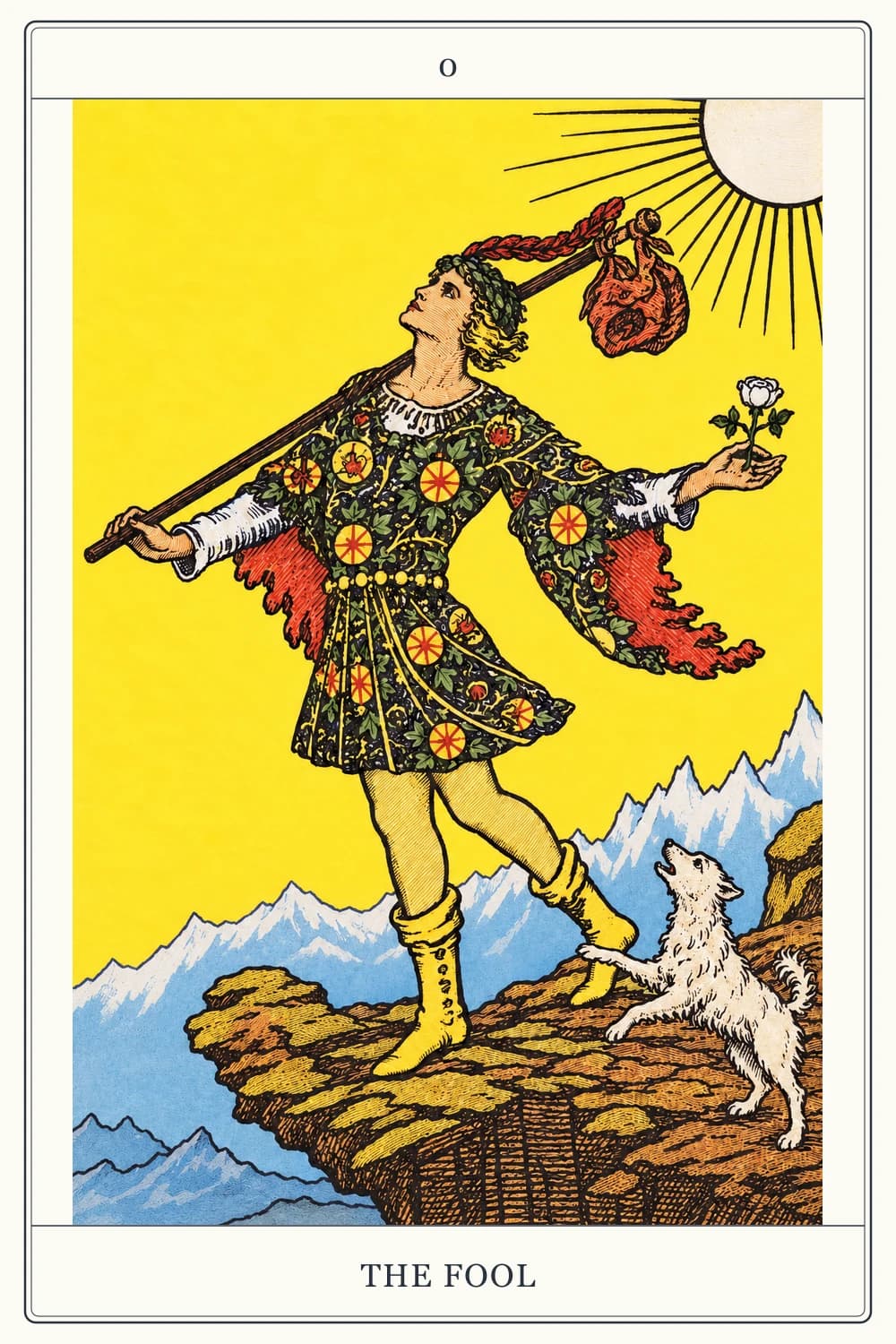
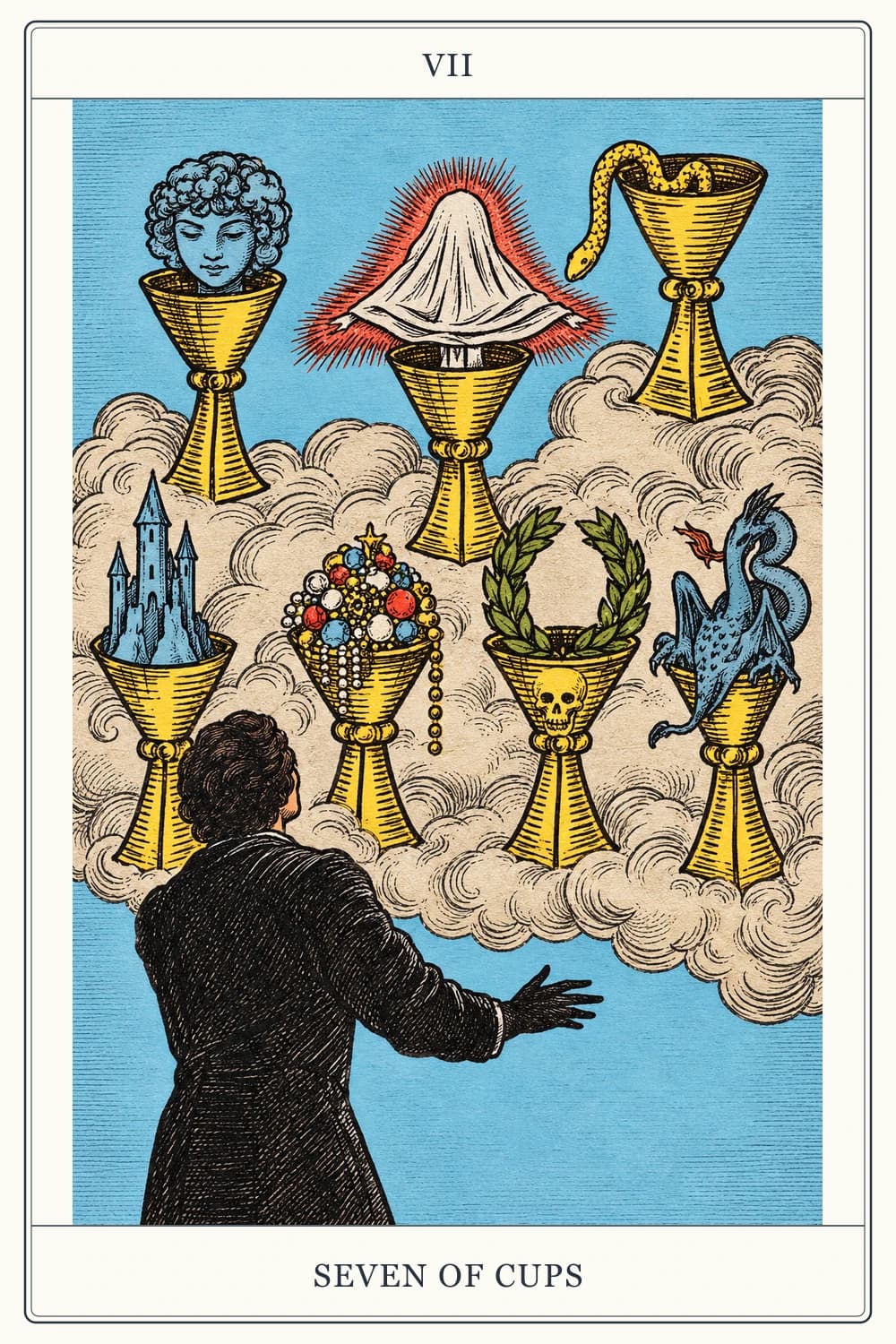
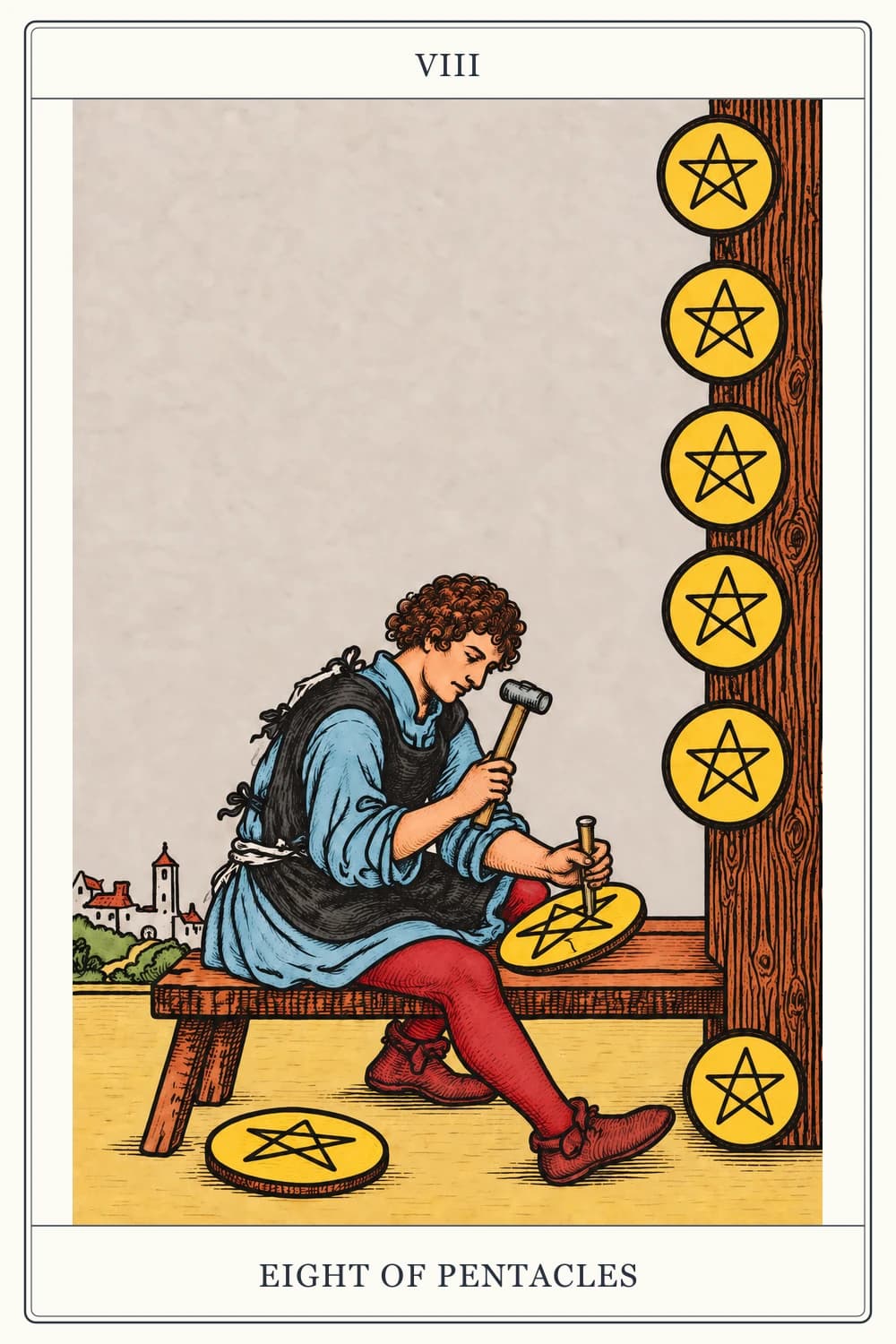
These cards are selected to illustrate the sketchbook question, rather than drawn for you. Keep the same facts: materials and two short slots are available; browsing took the last session; the page is blank. Read each card through its role before joining the ideas.
Situation — The Fool. A figure with a small bundle stands near a cliff edge, with a dog beside them. Beginning and exploration are reference themes. Here: “I am at an unfamiliar beginning and can learn from a first attempt.” The unfinished page supports that reading; the card does not establish talent or the quality of a future sketchbook.
Obstacle — Seven of Cups. A figure faces seven cups containing different images, including a castle and jewels. Options and imagined possibilities are reference themes. Here: “Comparing possible pages may be taking the place of drawing one.” That interpretation fits the known browsing. It remains a possibility, since browsing can also be useful research.
Advice — Eight of Pentacles. A seated craftsperson works on a star-marked disc, with similar discs beside them. These are the pentacles in the card’s name. Diligence and attention to detail are reference themes. In Advice, try focused practice: use ten minutes of the next available slot to draw the mug’s outline, then use any time left to note what was difficult. Stop at the 15-minute limit.
Joined together: “An unfamiliar beginning has stayed among imagined possibilities; one focused attempt could show what I need to practise.” This answers what could help you begin. It leaves the original question about eventual quality open. The ten-minute limit and mug come from the stated situation and chosen response, rather than instructions hidden in the cards.
Optional practice
Before you draw, confirmed commitments take both free slots. There is no other practice time available this week. Your concern is still the blank sketchbook. Rewrite the question and name a response that respects this change. Would the same three cards justify keeping the ten-minute drawing plan?
See one possible answer
One possible question is: “What expectations about starting the sketchbook can I reconsider while no practice time is available this week?” Leave the first page unstarted for this period and revisit the plan when time becomes available. The same cards cannot create a spare ten minutes. A reading, if you choose one, would explore the revised question; it would not establish that indecision caused the delay. The known scheduling limit needs no draw to confirm it.
Keep the question beside the action and later result
For the original sketchbook case, an initial note could read: “Question: What could help me begin a sketchbook practice in the time I have? Selected upright example: Fool / Situation; Seven of Cups / Obstacle; Eight of Pentacles / Advice. Possible reading: browsing may be replacing an attempt. Response: draw the mug’s outline for ten minutes in the next free slot. Review afterward: did I start, did it fit the slot, and what was difficult?”
An illustrative later note: “I drew for ten minutes and stopped within the slot. Placing the handle was difficult. I made an outline but left the shading unfinished.” The attempt gave you something concrete to learn from. It supports trying a bounded session; it does not prove that browsing was the only obstacle or predict how the finished sketchbook will look.
An alternative matters too: if the earlier browsing had identified a technique you needed, continuing with one relevant example might have helped. Record what the browsing produced before calling it avoidance. Keep the first interpretation beside the later observation so you can change the explanation when the evidence changes.
Use the worksheet in your notebook or document. The main action at the end opens Clarity setup. To follow this upright example, clear Include reversed cards. Enter your own question if useful, check that Clarity is selected and draw your own cards. The teaching cards here are not preloaded, and the worksheet is not saved by opening the setup.
Reading worksheet
Question-building worksheet
One situation:
Facts and limits I already know:
What remains uncertain:
My original concern:
What that wording assumes or asks the cards to establish:
My revised question and why it fits:
Chosen layout and position names:
Cards, orientations and selection method:
Interpretation and another plausible explanation:
A response using only available time and resources:
When I will review and what I will check:
Later: what happened, what changed and what remains unknown:
Compare eight rewrites and what each changes
Use these original examples when your concern takes a different form. A rewrite changes the task you bring to the reading. It does not make the original request answerable by changing its first word. Add your own situation and limits before drawing.
| Starting concern | A question to explore | Why the rewrite helps |
|---|---|---|
| Will my sketchbook turn out well? | What could help me begin a sketchbook practice in the time I have? | Replaces a vague future verdict with a first attempt. |
| Why does everything go wrong? | Which part of this delayed project deserves attention first? | Names one situation instead of treating every difficulty as the same problem. |
| When will I feel ready? | What would a small first attempt let me learn? | Explores an experience you could try instead of requesting a date. |
| How do I make them agree with me? | How can I explain my view and make room to hear theirs? | Focuses on your participation while leaving their response open. |
| What are they hiding? | What have I observed, and what could I ask rather than assume? | Gives you a question to take to the person; a card cannot verify their private motives. |
| Why am I so bad at this? | What part of this task could I practise or ask for help with? | Turns a judgment about you into a specific learning question. |
| Should I take the weekend class? | What trade-off matters between taking the class and practising at home? | Names two real options to examine while leaving the decision with you. |
| How can I prove my plan is right? | Which assumption in my plan deserves another look? | Allows evidence that could change the plan. |
Adapt one of six prompts to your situation
Choose the prompt that matches what is uncertain, then replace the general wording with your actual task. For the sketchbook case, “What deserves attention before my next attempt?” could become “What deserves attention before my first 15-minute sketching session?” Keep the known materials and time limit beside it. Choose one prompt for one reading.
- When a plan feels settled: Which assumption in this plan deserves another look?
- When you are about to begin: What deserves attention before my next attempt?
- When the plan feels too large: How could I adjust it to the time and help available?
- When you cannot change a constraint: What response remains available within it?
- When support may matter: What specific help could I ask for, without assuming it is available?
- When you are filling gaps with guesses: Which assumption should I check outside the reading?
Get a missing fact from a source that can verify it
“Is the evening class running on Tuesday?” needs the organiser or current schedule. “What matters to me when choosing a class?” is a reflective question. Write down which kind of answer you need. You can use tarot to consider a preference, but the schedule still needs checking before you plan around it.
Stop at the worksheet if it has already clarified the next step. You may need to ask someone, check a document or wait for an available slot. If you want to redraw only to obtain reassurance, return to the original question and record before deciding whether anything has changed.
Common questions
- Do I have to write a question in Orara?
- No. The setup accepts an open draw, and the optional question field allows up to 500 characters. If you leave it empty, choose a focus for yourself, such as one project or conversation, and keep the layout’s roles clear. You can keep a longer account of the facts in your own notes.
- Can a yes-or-no concern become a reflective question?
- Yes. Identify the concern beneath it, such as preparation, a comparison or a conversation, and ask about that task. For example, “Will they agree?” can become “How can I explain my request clearly?” Their eventual answer still comes from them. If you need a verified fact, get it from a source that can check it.
Sources and further reading
External references for these reading methods. Orara created the examples on this page.