How to read tarot cards: a beginner's guide
Start with one card and a question about something you can try. Learn what to look for in the picture, how to use a card meaning and why your circumstances matter when choosing an interpretation.
Start here
Already have a deck and a question?
Keep a guidebook or card reference beside you and follow the six steps for one card. If you are new to the deck, begin with the explanation below.
Go to the six reading stepsOrara editorial · Updated · Our approach
On this page
What happens in a tarot reading?
A tarot reading connects drawn cards with a question or situation. The pictures and their traditional meanings offer ideas to consider; the question gives those ideas a purpose.
People use tarot for different reasons. In this guide, we use it for reflection: finding a way to approach an everyday situation, then checking what helps. You can follow the speech example without a deck.
Find your way around the deck
A standard tarot deck has 78 cards. The 22 Major Arcana have individual names, such as The Fool and The Hermit, and themes such as beginnings or seeking understanding. The other 56 cards are the Minor Arcana, arranged in four suits, or families.
Wands commonly concern initiative and creativity; Cups, feelings and relationships; Swords, thoughts and conflict; Pentacles, practical work and resources. Each suit runs from Ace through Ten, then Page, Knight, Queen and King. Those last four ranks are called court cards and can suggest ways of acting as well as people.
These groups help you navigate the deck. For a first reading, look up the card you draw rather than trying to learn all 78 meanings.
Begin with a situation
Suppose you are preparing a short speech. You have drafted the opening but haven’t read it aloud, and you have time for one rehearsal. Ask: “What would help me prepare?”
This gives you something to explore and try. “Will everyone like it?” would ask for an audience’s reaction before it happens. Keep the question and the facts beside you: they will help you choose between possible meanings.
Give your card a job
A spread is a layout that assigns a job to each card. Each place is called a position. Orara’s Single Card spread has one position, Focus: what deserves your attention about this question?
Use a physical deck and its guidebook, or open the Single Card setup. For this first reading, use an upright card, with the picture the normal way up. A reversed card is upside down; some readers interpret it differently. In Orara, uncheck “Include reversed cards” before drawing.
Read one card in six steps
Keep your question and facts beside you. In this one-card reading, Focus asks what deserves your attention. Look up the card’s meaning in Orara’s card library or your deck’s guidebook.
- Write your question and the facts you already know.
- Draw one card. With a deck, shuffle and take the top card without looking at its face first. In Orara, select Single Card and press “Draw 1 card”.
- Describe something visible in the picture before deciding what it means.
- Read the upright meaning in your reference. Choose a theme that could relate to the question.
- Turn that theme into a possible answer for Focus. Compare another plausible interpretation: which fits the facts better?
- Write what you will try or observe, and when you will look back. If you cannot explain the connection, record what remains unclear.
Focus — Eight of Pentacles
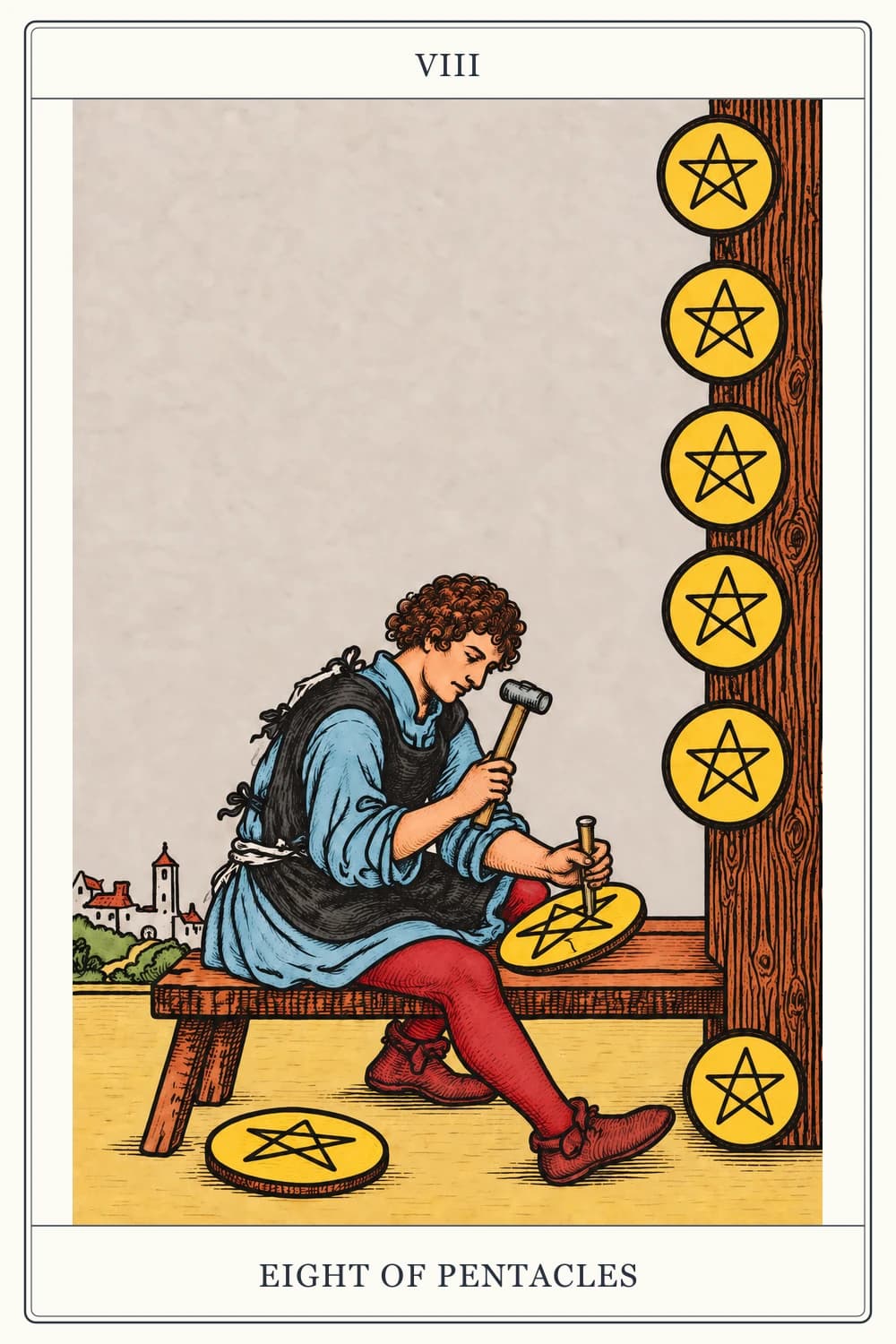
For the speech question, suppose you draw Eight of Pentacles upright. This is a hypothetical reading using the pictured Rider–Waite–Smith tradition. Focus asks what deserves attention during preparation.
A craftsperson works on a star-marked disc, called a pentacle, while other pieces hang nearby. The card is traditionally associated with developing a skill and attending to details. For a speech, practice could mean reading the opening aloud; attention to detail could mean editing a sentence.
You haven’t tried saying the draft yet, and there is time for one rehearsal. Read it aloud once and mark where you stumble. That attempt can show you which sentence needs attention. If you had already rehearsed and found one confusing sentence, editing it would be a better use of the same theme.
The card does not establish that the whole speech needs rewriting or promise that the audience will enjoy it. Its theme has helped you choose a preparation step. If the speech were about to start, the rehearsal suggestion would no longer fit.
Keep a note, then look back
Before the speech: “Eight of Pentacles, upright, in Focus. The craftsperson suggests practice. I’ll read the opening aloud once, because I have a draft but haven’t tried saying it.”
Afterward, you might add: “Reading aloud exposed a long sentence, which I shortened. I still spoke too quickly. Next time I’ll time the opening.” Keep both notes: the second shows what helped and what still needs work.
For your own reading, a short journal template can help separate the question, interpretation and later observation.
Try explaining your choice
What did you see, which meaning did you use, and why did it fit the question? Answer those three points in your own words. A reading becomes useful when you can explain the step from the card’s theme to your response.
When you want to add cards
A larger spread gives cards different jobs. In Clarity, Situation describes the concern, Obstacle explores a difficulty and Advice suggests a response. Learn to connect those roles once you are comfortable explaining one card.
Common questions
- What if my deck’s picture is different?
- Describe what is actually on your card and use that deck’s guidebook. Another artist may express the same card differently.
- What if my own association differs from the guidebook?
- Write them separately: “The guidebook says…; the picture reminds me of…”. Explain how either idea relates to the question. A personal association can be useful without being a traditional meaning.
- Does a frightening card mean something bad will happen?
- An alarming image is not evidence of a future event. Read its explanation before applying the name literally. If the reading upsets you, put the cards down; another draw is not needed to cancel it.
Ready for another example? Try the short lesson and compare your interpretation with its feedback.
Practice: change the question
Keep Eight of Pentacles in Focus. You are learning to sew and ask: “How can I improve this tote bag?” One seam is uneven; you have spare fabric and ten minutes. Suggest one step and explain why it fits better than replacing the sewing machine.
See one possible answer
Practise the uneven seam on spare fabric. The card’s theme of skill-building gives the idea; the seam identifies what to practise, and the materials and time make it possible. Replacing the machine assumes an equipment problem that has not been established.
SourcesJoan Bunning · Learning the Tarot
These references explain the deck and traditional associations used here. The examples and practice questions are Orara’s own.
External references · learntarot.com