Situation, Obstacle, Advice tarot spread: a complete Clarity example
Clarity separates a situation, its friction and a response you could try. Learn to make Advice answer the actual obstacle, using a complete three-card example with known materials, limited time and a later review.
Start here
One task stays unfinished and you want a response you can try.
In the photo-album example, separate the twenty-minute limit from the rule that every page must be settled first. Ask which one the proposed Advice can change, then follow the recorded attempt.
Follow Clarity through one photo-album pageOrara editorial · Updated · Our approach
Clarity at a glance
- Situation
- Obstacle
- Advice
Use when: You want to understand a situation and find a possible next step.
Choose another approach if: You want to compare two options side by side.
Example questions
- What is making this feel stuck right now?
- What am I not seeing about this situation?
- What could I try next?
On this page
Choose Clarity for one difficulty and a response
A spread is a layout of cards, and each position assigns a role. Situation–Obstacle–Advice is called Clarity in Orara. It fits a question about one task or interaction you can describe: what you are dealing with, what complicates it and what response might help. This guide uses the cards as prompts for reflection on those known circumstances.
Choose the question and roles before drawing. Situation describes a perspective on the present task; Obstacle examines friction; Advice proposes an approach. These are three different jobs in one reading. Keep the known facts beside the cards so each interpretation has something specific to address.
| Position | Question it answers |
|---|---|
| 1 · Situation | What am I dealing with in this question? |
| 2 · Obstacle | What may be making that situation harder? |
| 3 · Advice | What response could address that friction within my actual limits? |
Check what kind of obstacle you actually know about
An obstacle may involve time, a missing resource, an agreement or a rule you are applying. Start with what is known. “I have twenty minutes” is a limit. “Every page must be perfect before I can finish one” is a standard you can examine. They can both matter, but changing the standard does not create more time.
The card supplies a theme to consider. It cannot establish that a difficulty is your fault, reveal another person’s motive or turn an unconfirmed fact into a known one. Ask which observation supports your reading of the friction. Leave the explanation open if you cannot find one.
Prepare the reading and give Advice a practical test
Advice becomes useful when you can explain what to do, which obstacle it addresses and what resources it uses. A theme such as patience could mean slowing down one part of a task, changing a demanding standard or leaving something unresolved until information is available. Choose the use that fits the facts.
You can follow the selected cards below without a deck. For your own first attempt, choose an upright-only method: the pictures are the normal way up. A reversed card is upside down and can use a different reference meaning. With a physical deck, shuffle, take three cards without looking and place them upright from left to right as Situation, Obstacle and Advice.
In Orara, Start Clarity opens setup. Check the selected layout, clear Include reversed cards, then use Draw 3 cards. Keep a notebook or document open for your question and record. Read an unfamiliar card’s upright meaning through its linked name or your deck’s guidebook, then connect one theme to the assigned role.
Example: finish one draft page of a photo album
In this invented example, you are planning six two-photo pages. Twelve selected photographs are printed, rough page arrangements are in place, and the caption notes are ready. Blank paper and a pencil are available. You have two twenty-minute sessions this week; other commitments fill the remaining time.
You keep rearranging all six pages because you have set a rule that every layout must be settled before you finish any one page. For this attempt, a finished draft page means placing its current two photos on paper and copying their captions from the notes. It does not mean binding the album or finalising the other five pages.
Question: “What could help me finish one draft page of this album?” The following upright cards are chosen for teaching, rather than drawn for you. Keep the current first pair of photographs and the available materials and time fixed while reading.
| Position | Annotated card |
|---|---|
| 1 · Situation | Two of Pentacles in Situation |
| 2 · Obstacle | Eight of Swords in Obstacle |
| 3 · Advice | Strength in Advice |
1 · Situation — Two of Pentacles
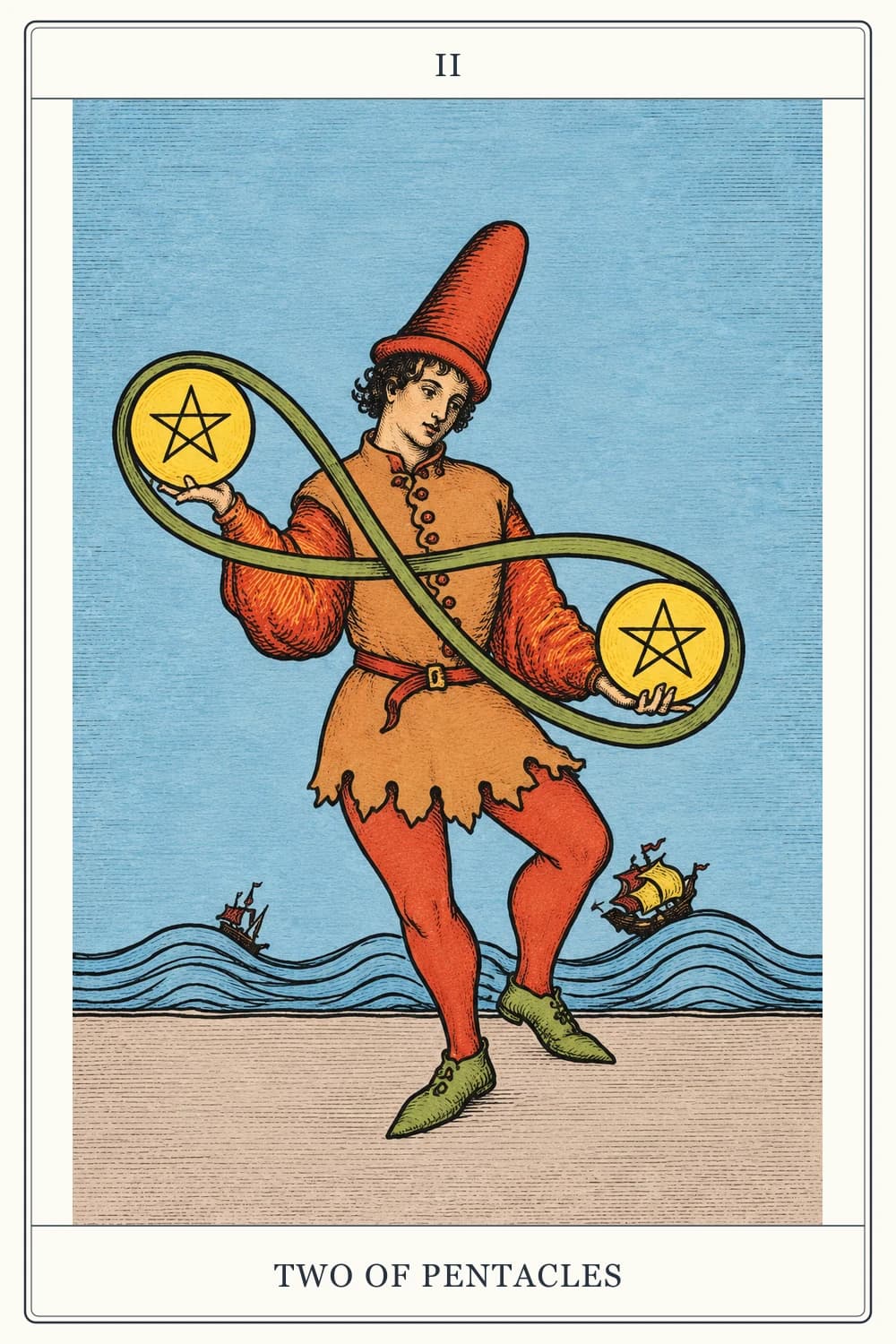
Illustrative card · Situation
Two of Pentacles — read the card meaningA figure holds two star-marked discs inside a looping ribbon, with ships on waves behind. The discs are called pentacles. Juggling demands and flexibility are reference themes. In Situation: “I am fitting the album around other commitments, with two short sessions available.”
The calendar supplies the time limit; the card helps you consider how to work within it. This role describes the task you are approaching. It does not establish that you can finish six pages in the available time or that you should take time away from another commitment.
2 · Obstacle — Eight of Swords
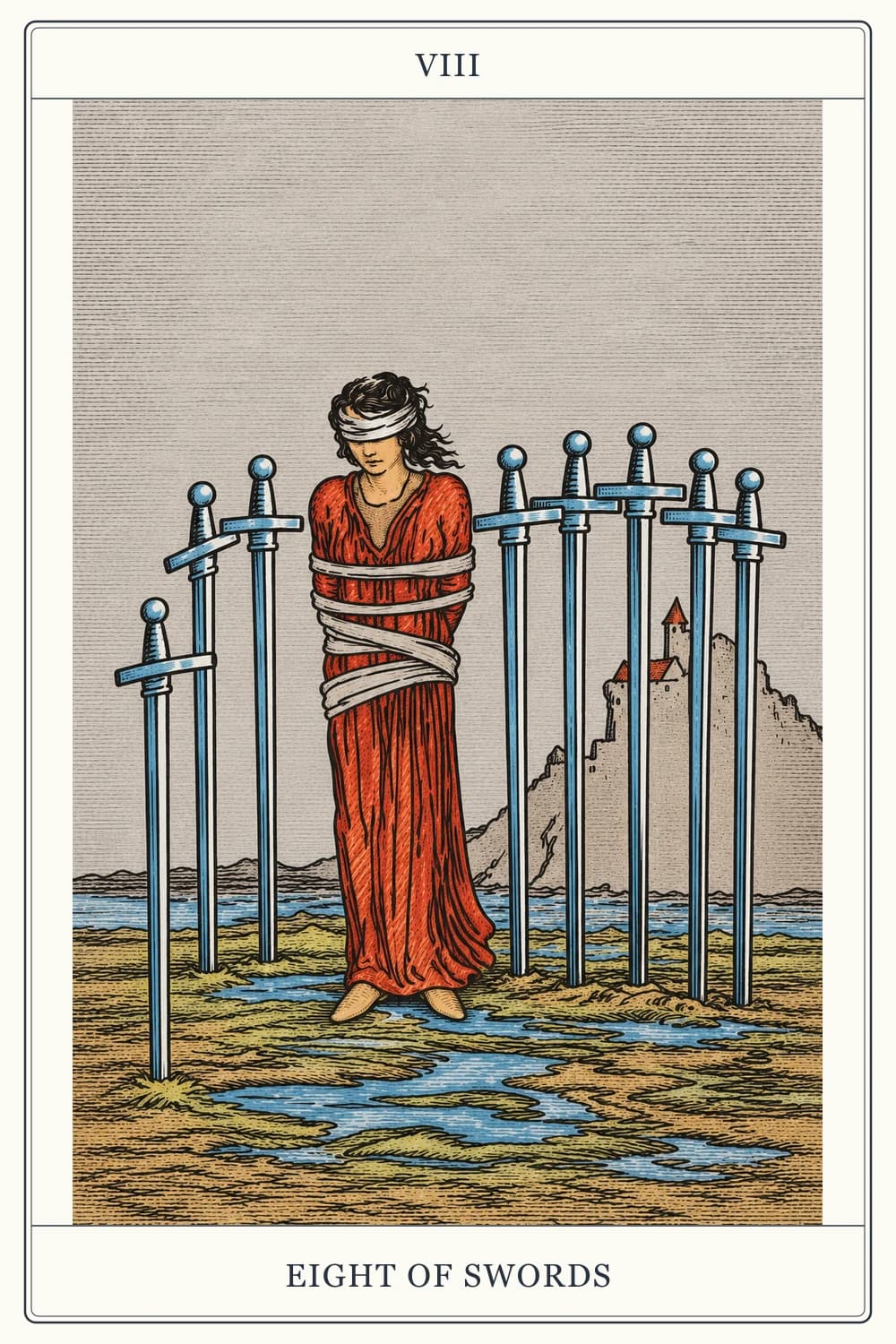
Illustrative card · Obstacle
Eight of Swords — read the card meaningA blindfolded figure with bound arms stands among eight swords. Restriction and confusion are reference themes. In Obstacle: “My rule that every layout must be settled keeps me from completing one page.” Your repeated rearranging and stated rule support this particular interpretation.
The twenty-minute session remains a real constraint. It is different from the standard you have set for all six pages. In this case the photos, paper and caption notes are already available, so a smaller draft is possible. If a required caption were missing, adjusting the standard alone would not supply it.
3 · Advice — Strength
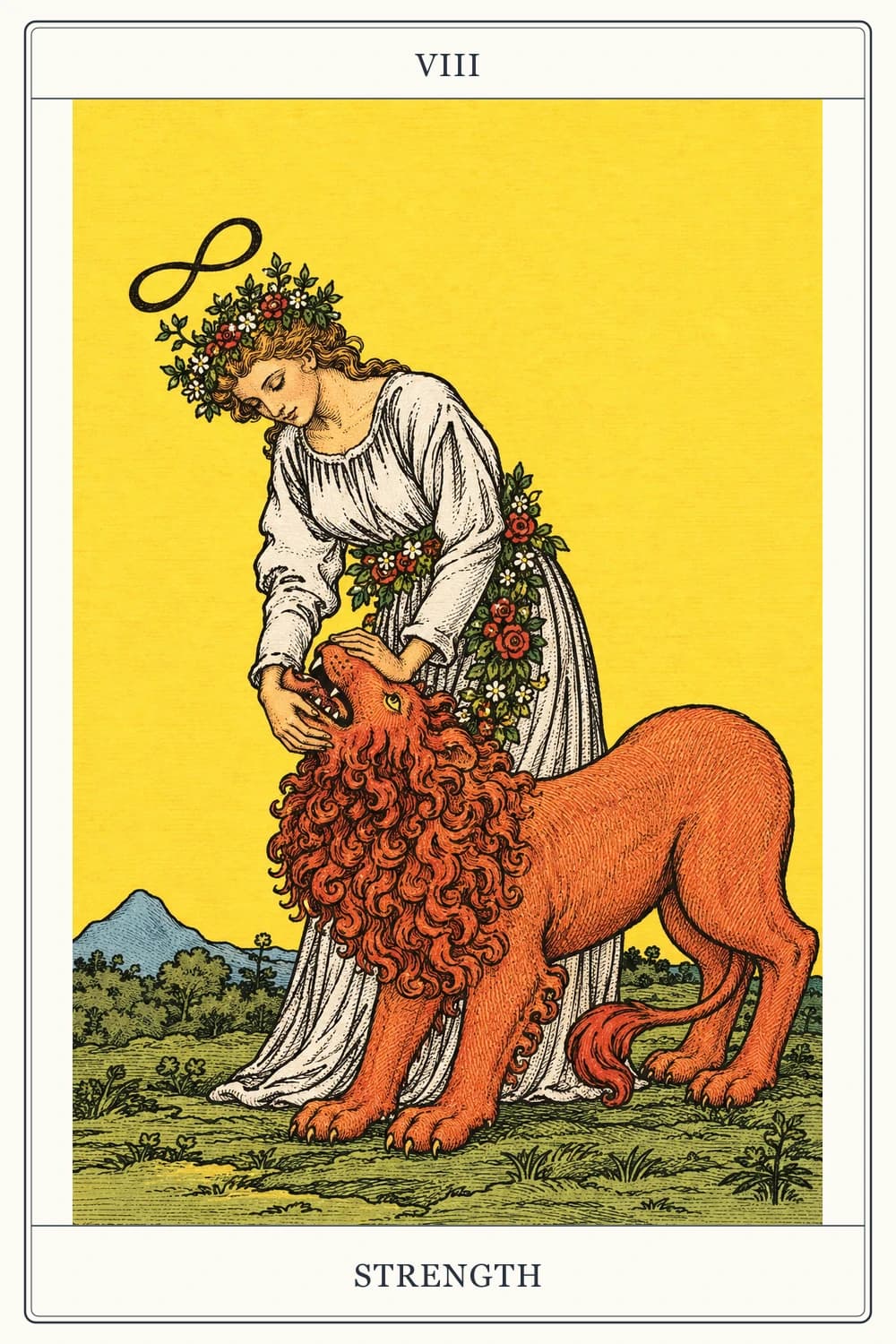
Illustrative card · Advice
Strength — read the card meaningA figure rests hands around a lion’s open mouth. Patience and gentle control are reference themes; Orara’s upright entry also describes a steady, considerate response. In Advice: “Stay with one workable page while allowing the others to remain rough.”
This answers the all-pages-first rule with a smaller task. Use the current first pair of photographs and their ready captions. Try a plain arrangement rather than reopening every page. The known materials make this response available, while the session sets the stopping point.
A pause or a slower pace could also express patience. If you cannot continue usefully, stop and record what remains. Strength does not require you to push through the whole album, extend the session or describe an unfinished attempt as a personal failure.
Connect the roles, try a response and review it
A connected reading could say: “I have limited sessions for the album; trying to settle every page first keeps one page unfinished, so patient work on the current pair could make a draft possible.” Situation sets the conditions, Obstacle identifies the rule to examine and Advice offers a response to that rule.
For the first twenty-minute session, keep the current two photos on one blank page and write their captions from the notes. Leave the remaining page arrangements rough. At the end, check whether that draft meets the definition you set: the pair is placed and both captions are present and checked against the notes. Record any missing part instead of carrying on beyond the time you have.
Before the session, a note could read: “Question: What could help me finish one draft page of this album? Selected upright example: Two of Pentacles / Situation; Eight of Swords / Obstacle; Strength / Advice. Twelve photos and caption notes ready, six rough pages, two twenty-minute sessions. Rule: settle every layout before finishing one page. Response: keep the current first pair, copy its captions and leave the others rough. Review at the end of the first session: is that draft page complete?”
An illustrative later note: “At twenty minutes, the two photos were placed and their captions copied and checked. I left this draft arrangement in place. One of six draft pages is complete; five remain rough. The album is not bound, and I have not checked whether someone else understands the captions.” This records the result of one bounded attempt. It does not show that the remaining pages will take the same time.
If the page had remained unfinished, record what interrupted it or took longer than expected. Use that observation to revise the next attempt. If a scheduled session disappears, the available time has changed; keep that fact rather than attributing the whole delay to the original rule.
Optional practice
Keep the same first pair and all three cards. One caption note now turns out to lack a verified date. Accurate dates are required for this draft, and you cannot verify it during either available session. How should the Strength response change, and what must remain unfinished?
See one possible answer
You can prepare the photo arrangement and copy the caption information that is verified, marking the missing date as unknown in the draft. Do not guess it, switch to a different pair to avoid the stated task or call the page complete. The missing information is now part of Obstacle alongside any demanding standard. Strength can support patient preparation and leaving the date unresolved until it can be checked; it does not provide a source, helper or extra time.
Use the worksheet for your own Clarity reading
Keep the worksheet in your notebook or document. Opening Clarity setup does not save this note or preload these teaching cards. For your own draw, keep the three role names visible and use each card’s linked reference when you need it.
Reading worksheet
Clarity reading worksheet
Date and one question:
Known facts, requirements and available time:
1 · Situation — card, orientation, picture detail and interpretation:
2 · Obstacle — card, orientation, picture detail and interpretation:
Which known fact supports the obstacle; what remains uncertain:
3 · Advice — card, orientation, picture detail and proposed response:
How Advice addresses Obstacle within Situation:
Another plausible interpretation or reason this response may not fit:
One action using only available time and resources:
Definition of a complete attempt and review point:
Later: what I actually did, observed and left unfinished:
What needs checking or changing before another attempt:
Common questions
- Does Obstacle always mean something I need to change about myself?
- No. It may involve a missing fact, unavailable resource, fixed limit or another person’s decision. Explain the friction using what you know. A response can include asking, preparing a partial draft or leaving a requirement unresolved.
- Can I ignore Advice if it does not fit?
- Yes. Check the reference and the facts, then revise or decline the proposed response. Advice is an interpretation to consider. Keep a known constraint even when the card’s theme suggests an appealing action.
Sources and further reading
External references for these reading methods. Orara created the examples on this page.