Your first three-card tarot reading
Give three cards different jobs, then connect them into one reading. Follow a return to drawing through Past, Present and Future, choose something to try and look back at what happened.
Orara editorial · Updated · Our approach
On this page
Start with a situation and a question
Suppose you used to sketch regularly, but stopped when evenings became busy. You have paper and a pencil ready, and twenty minutes available on Saturday. Ask: ‘What is shaping my return to drawing?’
Keep those facts beside the question. They will help you decide which card meanings fit. You can follow this example without a deck, or use the method for a situation of your own.
Give the three positions different jobs
A spread is a layout that gives each card a job. Each place is called a position. In Orara’s Timeline, Past explores an earlier influence, Present examines what is happening now, and Future considers a possible direction as the situation develops.
With a physical deck, mark three spaces from left to right: Past, Present, Future. Keep a notebook and your deck’s guidebook nearby. For this first attempt, use upright cards, with their pictures the normal way up. Reversed cards are upside down and may be interpreted differently.
In Orara, open Timeline and uncheck ‘Include reversed cards’ before drawing. The question field is optional; you can keep the question in your notes. Future will help you explore a possibility, not establish what is going to happen.
Draw, then read one position at a time
Shuffle your deck and take three cards without looking at their faces first. Lay them in the assigned spaces and turn them upright for this exercise. In Orara, press ‘Draw 3 cards’ after checking the options.
For each card, describe a visible detail, check an upright meaning and write a sentence answering its position. Use your guidebook or the card library when a meaning is unfamiliar.
For our drawing example, suppose the cards are Eight of Pentacles in Past, Two of Pentacles in Present and The Fool in Future, all upright. This is a hypothetical reading. The following pictures and meanings let you work through it here.
Past — the practice you bring
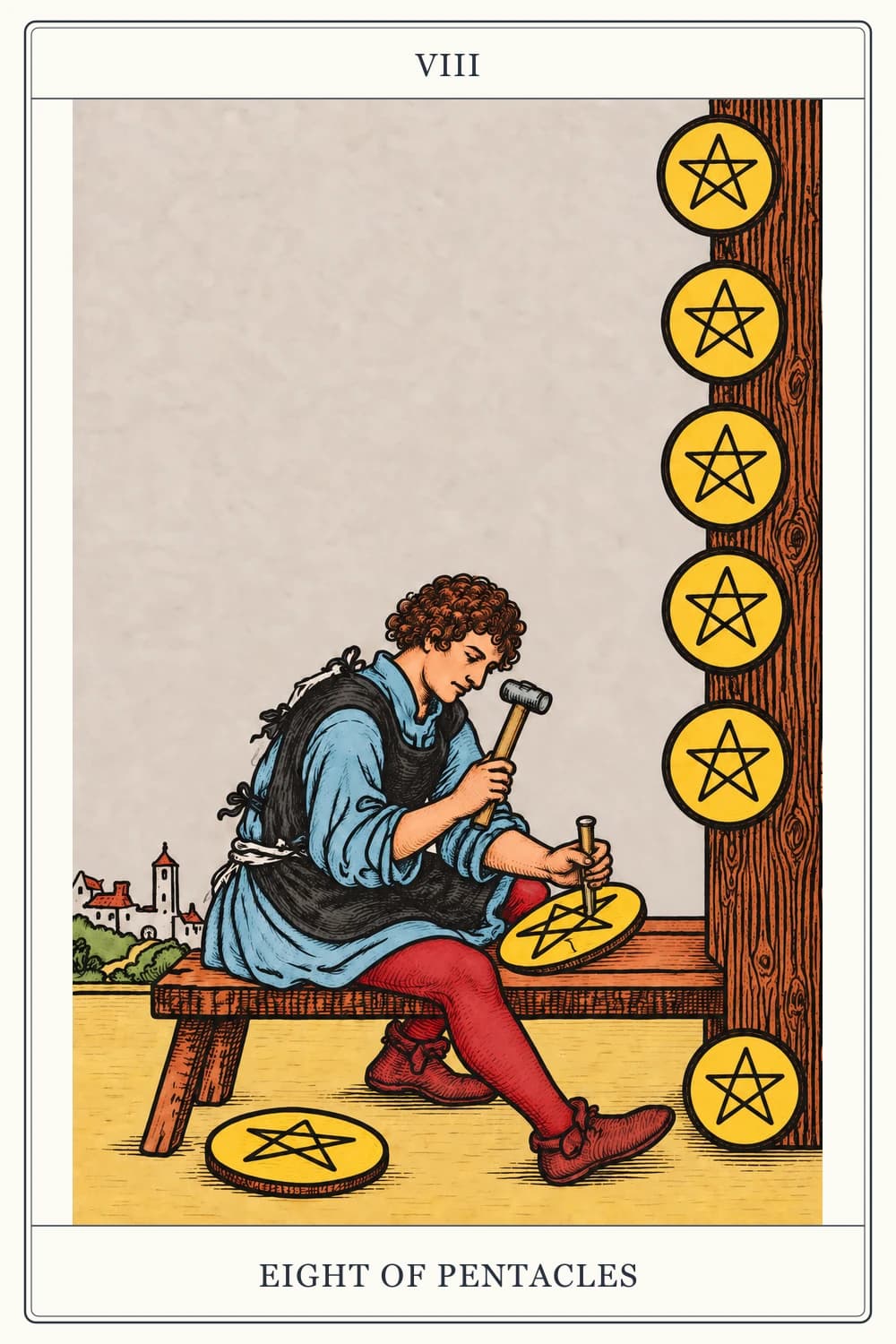
Illustrative card · Past
Eight of Pentacles — read the card meaningA craftsperson works on a star-marked disc, called a pentacle, while other pieces hang nearby. Eight of Pentacles is traditionally associated with developing skill through repeated work. In Past, ask what earlier practice contributes to this return.
You used to sketch regularly, so a sentence could be: ‘I have drawing practice to return to.’ The theme frames something you already remember. It leaves open how much of that skill feels familiar when you pick up the pencil again.
Present — making room alongside other demands
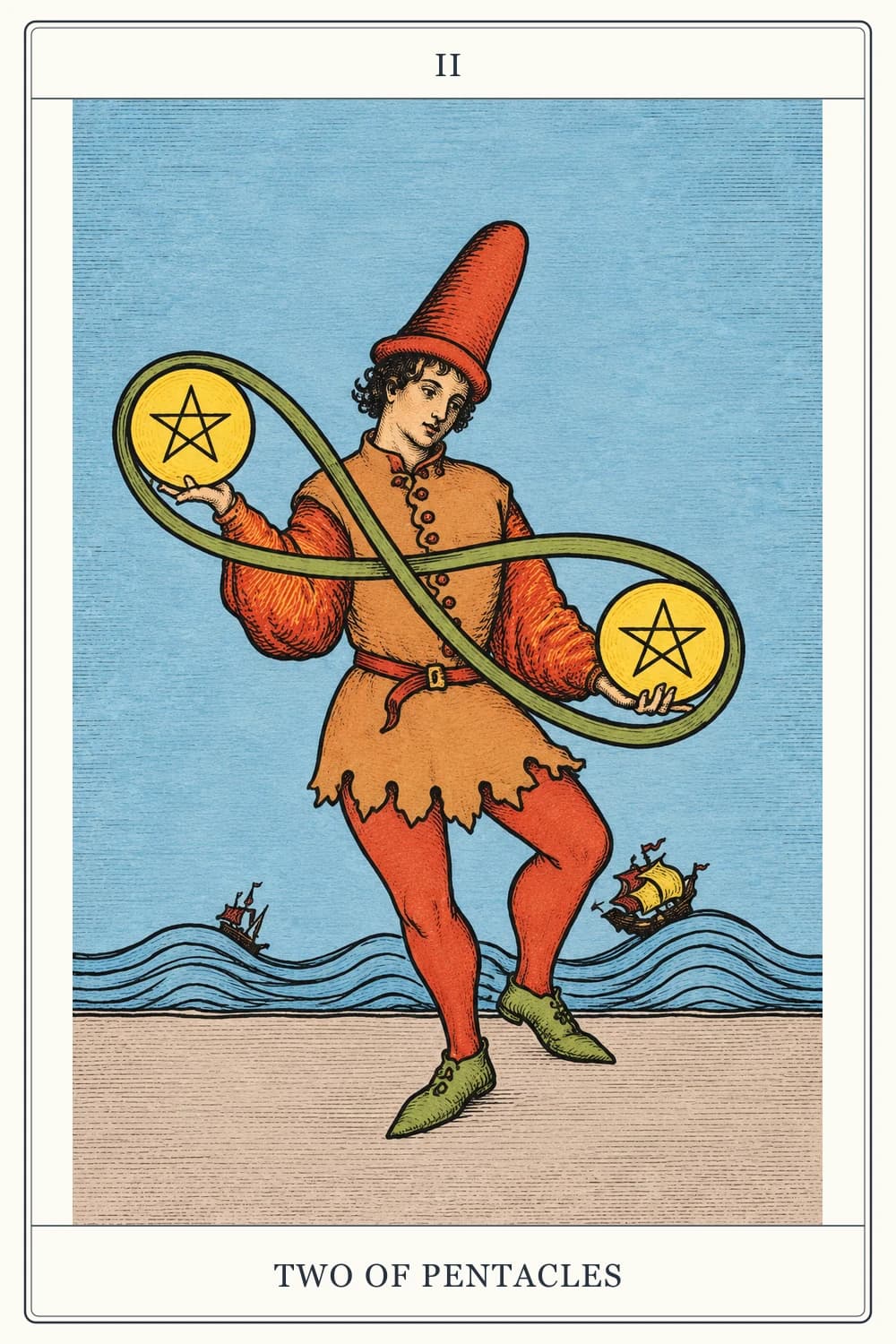
Illustrative card · Present
Two of Pentacles — read the card meaningThe figure holds two pentacles inside a looping ribbon. Two of Pentacles is associated with juggling demands and staying flexible. In Present, it draws attention to how drawing fits into your life now.
Your evenings are busy, but Saturday has a short opening: ‘Drawing needs to fit alongside my existing commitments.’ The schedule gives you a reason to choose this theme. Another situation might call for a different use of flexibility.
Future — an exploratory return
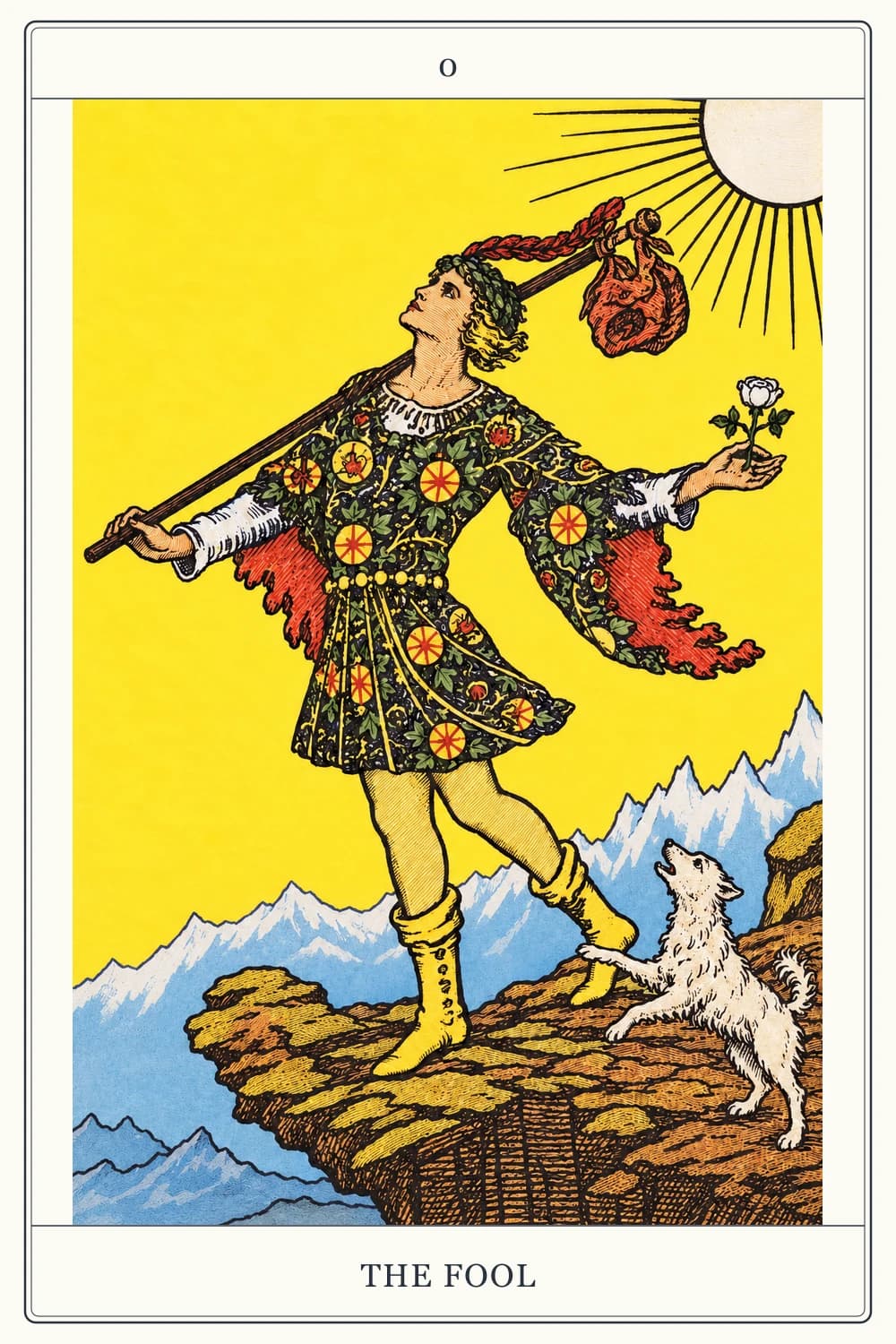
Illustrative card · Future
The Fool — read the card meaningThe Fool carries a small bundle near a cliff edge, with a dog beside them. Beginnings and openness to experience are traditional associations. In Future, consider what kind of next phase could grow from the situation you have described.
‘If I make room for drawing, the return could begin as an experiment.’ Ready materials and Saturday’s opening make that direction plausible. The card leaves the result open: a finished picture and a lasting habit are still things you would have to discover through experience.
Connect the three contributions
Let Past supply what carries forward, Present qualify it and Future describe what could open up: ‘I have practice to return to, but drawing now shares time with other commitments. With a little room for it, my return could begin as exploration.’
The connection explains more than the keywords ‘practice, balance, beginnings’. Earlier experience gives you something to draw on; the current demands shape the scale of the return; The Fool keeps that return open to discovery.
You can then choose a way to explore it: sketch one nearby object on Saturday and look back on Sunday evening. That is your response to the reading. It is more specific than the possible direction described by Future.
Compare a different context: your evenings are free, but you abandon sketches whenever they look imperfect. Two of Pentacles’ flexibility could now concern adjusting expectations: ‘I have practice behind me, but rough results interrupt my return. If I allow an unfinished sketch, I could start exploring again.’ That version needs the new fact about abandoning sketches; the original situation gave you a time constraint.
Keep a short note, then look back
Before Saturday: ‘Past / Eight of Pentacles: earlier practice. Present / Two of Pentacles: fit drawing around commitments. Future / The Fool: an exploratory return is possible if I make room. I’ll try one nearby object on Saturday and review on Sunday evening.’
Later, you might add: ‘The slot shrank to ten minutes. I started a sketch but didn’t finish. A small start was manageable; my time estimate was wrong. Next time I’ll choose a simpler object.’ Keep this beside the original note so you can see both the useful part and the mismatch.
Use your own notebook or document, or save the completed Orara reading to your account and wait for ‘Saved to your account’. The storage guide explains how to find it again and how older browser entries transfer.
Check your own connection
Before reading Orara’s summary, try writing your own connected interpretation. Then compare the reasoning. Different wording can work if each card’s contribution is clear.
- Keep the question, facts and three position names beside the cards.
- For each card, distinguish a visible detail, a reference meaning and your position sentence.
- Connect all three sentences and explain how Present changes what you carry forward from Past.
- Describe Future as a possible direction and name what it depends on.
- Choose a response or something to observe, and decide when to look back. If a connection is unclear, record the gap.
What situation would you like to explore? Bring your question and known facts, then give the three positions their jobs.
Practice: change the future condition
Keep the same three cards and the earlier drawing practice. Before Saturday, a fixed commitment takes the whole twenty-minute opening. No other free time is confirmed. Rewrite the connection. What remains possible in Future, and what can you no longer promise?
See one possible answer
One answer is: ‘I bring earlier drawing practice, but my current commitments leave no confirmed time to use it. An exploratory return remains possible when I can make room; its timing is undecided.’ Past still contributes experience and Present changes the condition for Future. Note that the slot is unavailable and revisit the plan when your availability changes; the cards do not supply a replacement session.
SourcesJoan Bunning · Learning the Tarot
These references explain the traditional associations used here. The Timeline example and practice question are Orara’s own.
External references · learntarot.com