Tarot card meanings for career: apply them to a work task
A broad theme such as effort or cooperation becomes useful when you connect it to a specific task. Learn to choose a work interpretation, explain why it fits and check the response against the actual requirements.
Start here
A card's general meaning feels too broad for a work situation.
Write one requirement for a task in front of you. Use the report example to see how a card's theme can guide attention while the brief determines what needs doing.
Follow Eight of Pentacles through a report checkOrara editorial · Updated · Our approach
On this page
Use the suit to find a starting question
A suit is a family of cards: Wands, Cups, Swords or Pentacles. Their traditional associations offer different starting points for a work question. A report, for example, can involve both practical skills and clear communication, so its topic does not require a Pentacles card.
The table turns those broad associations into questions you can examine. For a specific card, look at its picture and read its linked card-library entry or your deck’s guidebook. A suit gives you an area to consider; the individual card adds detail. The example below uses one upright card, with the picture the normal way up.
| Suit and broad theme | A possible work question |
|---|---|
| Wands · initiative and action | What approach could I try on this task? |
| Cups · feelings and relationships | What do we need to understand about working together? |
| Swords · reasoning and communication | Which claim or wording needs checking? |
| Pentacles · practical skills and resources | What time, tools or practice does this task need? |
Read Eight of Pentacles against a concrete brief
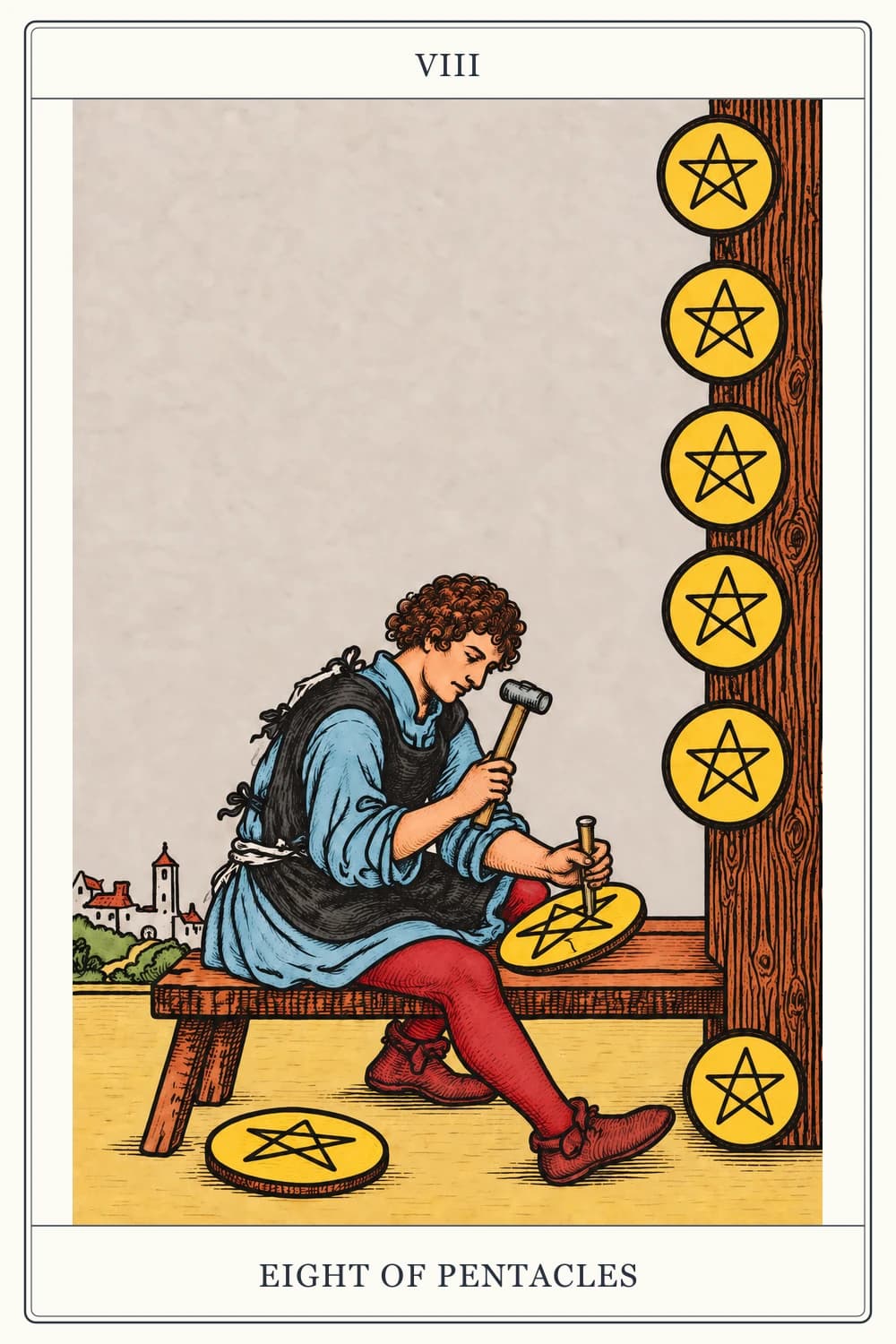
This invented example concerns a chart for an internal weekly report. Your source spreadsheet lists 12 completed tickets for Team A and 18 for Team B during 1–7 October. The written brief requires the reporting period, the unit and one factual finding supported by the figures. The draft chart has neither the period nor the unit. Its caption already says, “Team B completed six more tickets than Team A.” Your last two revisions changed the colours. You have 15 minutes before handoff.
Ask: “What should I check before sharing this report?” The selected Eight of Pentacles shows a seated craftsperson using a hammer and chisel on a star-marked disc. Similar discs hang beside the figure. Attention to detail and diligence are reference themes; Orara’s upright entry also emphasizes building a skill through repetition and feedback. The repeated pieces connect the picture to careful practice.
A position is the role assigned to a card in a reading. Here, use Next step to ask what manageable response you could try. One interpretation is: “Use focused care to close the gaps in the brief.” The card’s theme prompts careful work; the written brief determines which work is useful. Neither the suit nor the picture tells you which labels are missing.
The check below uses the actual brief and source. It explains why adding labels deserves attention before another colour change. The caption already matches the figures, so careful work includes recognizing what is complete.
| Requirement | Evidence in this example | Check or response |
|---|---|---|
| Reporting period | The source covers 1–7 October; the chart omits it. | Add the period to the chart. |
| Unit | The source counts completed tickets; the chart gives no unit. | Label the figures as completed tickets. |
| One supported finding | 18 − 12 = 6, matching the existing caption. | Keep the finding after checking it against the source. |
Record the response and check what it achieved
Use the available 15 minutes to compare the chart with the source, add the missing labels and check the three requirements. Stop at handoff and record any remaining gap. This response fits both the diligence theme and the known omissions. The source and brief are available for the check.
An initial note could read: “Eight of Pentacles, upright, in Next step; selected example. Theme: careful, focused work. Known gaps: period and unit; caption matches 18 − 12. Response: check the source and add the labels within 15 minutes. Review at handoff: which requirements are met, and what remains unchecked?” Keep this note before recording the result.
An illustrative later note: “At handoff I had added ‘1–7 October’ and ‘Completed tickets’ and rechecked the caption. All three stated requirements are present. I have not tested whether a colleague understands the chart.” The check supports a limited conclusion about this brief. Approval and reader comprehension still need their own evidence.
Consider a plausible alternative: repeated revisions can be useful when they fix real errors. If the labels were already correct but the figures had not been checked, careful work would mean checking the calculation. The response follows the remaining requirement, rather than treating all repetition as either diligence or a problem.
Reading worksheet
Work meaning worksheet
Date and work question:
Card, orientation and assigned role:
Visible detail and reference theme:
Known task, requirements and available resources:
My interpretation and why it fits:
Another plausible interpretation or missing fact:
Response within the time and support available:
When I will review it and what I will check:
Later: what I actually did and observed:
What remains unresolved:
Optional practice
Change the brief: it now asks for completed tickets per person. You still have only the team totals of 12 and 18, no team headcounts, and 15 minutes. Nobody can supply headcounts before handoff. Keep Eight of Pentacles in Next step. What can you responsibly do, and what must remain unresolved?
See one possible answer
A per-person figure needs each team’s headcount. Record and communicate that missing input and leave the requested comparison unresolved. You cannot assume equal team sizes or invent rates. If you share the existing chart as background, label it as team totals and state that it does not answer the new per-person question. Careful work here means making the data limit clear, rather than adding labels and claiming the new brief is met.
Optional: see how another role changes the meaning
Work Focus uses three roles: What you can use, What’s in the way and Next step. The table places the same Eight of Pentacles in each role as an alternative, using the original report facts before the labels were added. It is a comparison, not a draw with three copies of the card.
The resource reading notices work and materials already available. The obstacle reading notices where effort is going. The Next step reading selects a response. The obstacle interpretation fits the stated colour changes and missing labels; it does not establish a personality trait such as perfectionism.
For your own attempt, start with a task and its known constraints, then choose a question. The work-question guide below offers prompts; the Work Focus guide shows a complete three-card example. The main action opens the layout’s setup. To follow the upright method here, clear Include reversed cards. Review the roles above or in the full guide before drawing. Use each card’s linked reference for an unfamiliar meaning, then keep your work note in a notebook or document to review the actual response.
| Work Focus role | Eight of Pentacles in this report example |
|---|---|
| What you can use | You have a draft to work on and source figures to check it against. |
| What’s in the way | Repeated appearance changes have left required labels unfinished. |
| Next step | Compare the draft with the source and brief; add the missing labels. |
Sources and further reading
External references for these reading methods. Orara created the examples on this page.