Work Focus tarot spread: turn available resources into a next step
Find a workable next step for one piece of work. Use three cards to examine what you can use, what is getting in the way and how to respond, then test that response against the task’s real requirements.
Start here
You have an unfinished task and need a next step that fits the actual requirements.
In the help-article example, find what the colleague has agreed to check. Follow the feedback: what can one limited review improve, and what still prevents the article from being complete?
Follow a draft through a limited review and correctionOrara editorial · Updated · Our approach
Work Focus at a glance
- What you can use
- What's in the way
- Next step
Use when: You want to find a workable next step in a project or role.
Choose another approach if: You need employment-law, financial, or investment advice, or a verdict on leaving a job.
Example questions
- What can I bring to this project more deliberately?
- Where is my effort getting stuck at work?
- What small step could help me move this project forward?
On this page
Name the task and what completion requires
Choose one piece of work: a draft, a presentation or a process you need to improve. Write what exists, what is still required and any fixed deadline. List the time, access and support you actually have. “A colleague can review one section today” is a resource; “someone will probably help” is an unconfirmed possibility.
This guide uses tarot to reflect on how you approach that task. The reading cannot establish a manager’s intentions, grant permission to delay work or decide whether you should leave a job. Ask about something you can examine or try, such as “What small step could help me finish the help article I am drafting?”
Give resources, friction and action separate roles
A spread is a layout of cards; each position gives its card a role. Work Focus uses What you can use, What's in the way and Next step. Interpret all three for the same task, then ask how an available resource could help with the identified difficulty.
The middle card can prompt a question about workload or process. Check it against what has happened before treating the theme as an explanation. The last card suggests an action to consider, not a promise that the work will be finished.
| Position | What to establish |
|---|---|
| 1 · What you can use | A skill, tool, document or confirmed support that is available for this task. |
| 2 · What's in the way | A difficulty supported by the work record, or a question you still need to check. |
| 3 · Next step | A limited response that uses the resource, addresses the difficulty and fits the real requirements. |
Prepare the cards and define a useful check
You can follow the selected cards below without drawing. For your own reading, keep a notebook or document and a card reference available. Write your question and task facts before selecting cards. Decide what you will inspect after the proposed step: a completed requirement, a reviewer’s observation or a remaining blocker.
This example uses upright cards, with the pictures the normal way up. A reversed card is upside down and can use another reference meaning. With a physical deck, choose the upright-only method before shuffling, take three cards without looking and place them upright from left to right in the named roles.
In Orara, Start Work Focus opens setup. Check the layout, enter your question if useful, clear Include reversed cards, then select Draw 3 cards. Describe a visible detail, consult the upright meaning through the card’s linked name or your deck’s guidebook, and explain how one theme fits the assigned role and your task. Check the proposed action against your time and obligations before choosing it.
Example: prepare one help-article section for review
In this invented example, it is Friday, 23 October 2026. You are drafting a two-section help article about exporting a project list from your team’s app. The outline is approved, and you have performed the process three times in a test workspace. You have access to that workspace and know how to capture screenshots.
The completion checklist requires current screenshots and a colleague’s practical check of the instructions in both sections. Both screenshots and both checks are still missing. The article is due at 16:00 on Monday, 26 October. One colleague has agreed to test one section today from 10:30 to 10:40; no second review is arranged yet.
You have 10:00–10:30 for reading, preparation and sending that section, plus 14:00–14:10 to inspect the feedback and make a small correction. You have been switching between the article and two nonurgent requests, although those requests can wait until after 11:00 by agreement. The article is the agreed priority during the morning window.
Question: “What small step could help me finish the help article I am drafting?” The three upright cards were selected for teaching. The work, feedback and later note below are also illustrative.
| Position | Annotated card |
|---|---|
| 1 · What you can use | Eight of Pentacles in What you can use |
| 2 · What's in the way | Ten of Wands in What's in the way |
| 3 · Next step | Three of Pentacles in Next step |
1 · What you can use — Eight of Pentacles
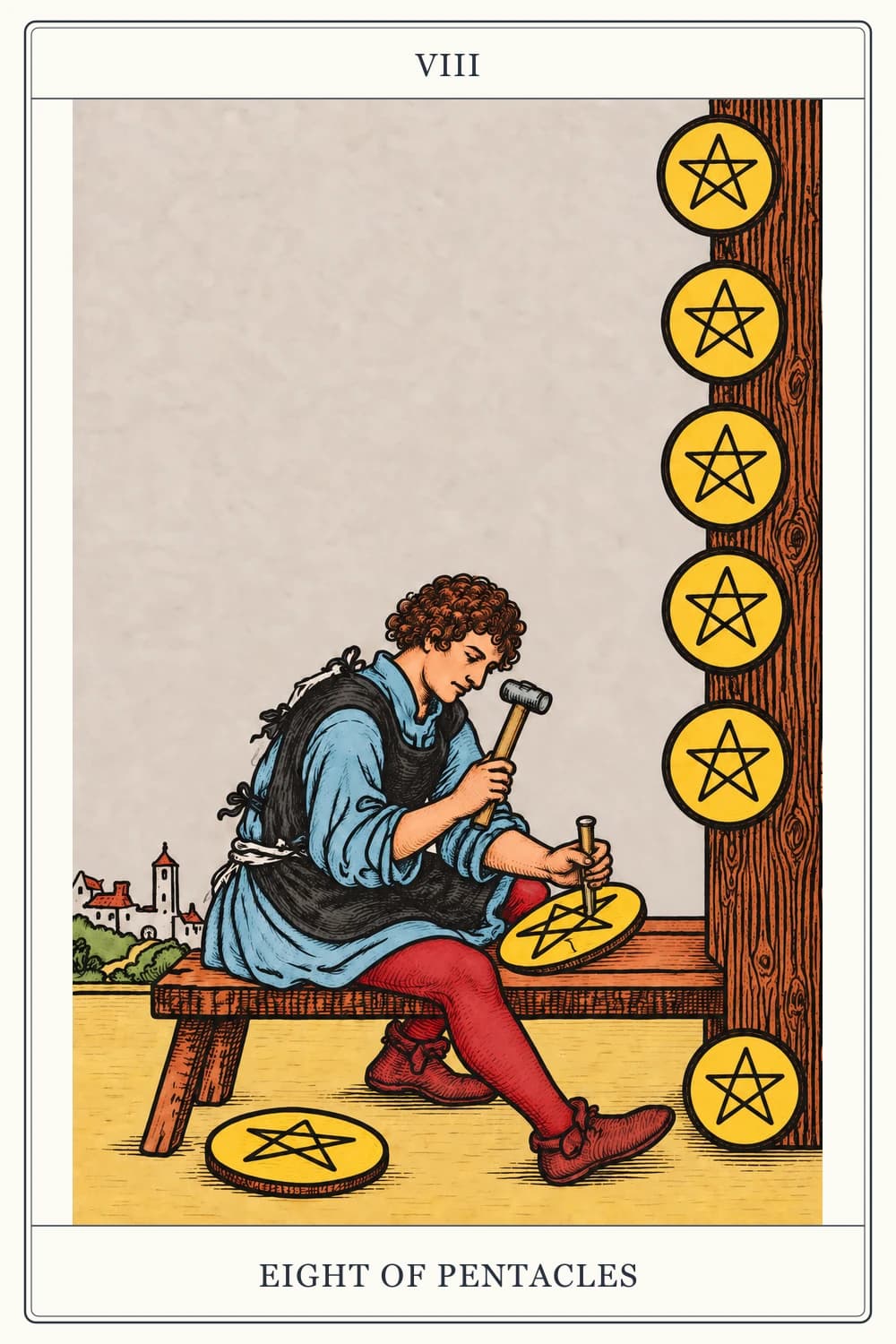
Illustrative card · What you can use
Eight of Pentacles — read the card meaningA craftsperson sits at a bench, working on a star-marked disc while similar pieces hang nearby. These discs are called pentacles. Joan Bunning’s reference associates this card with diligence, knowledge and attention to detail; Orara’s upright entry emphasises practice and feedback. In What you can use: “I can apply my experience of the process to one careful draft.”
The experience comes from your three earlier exports, not from the card’s appearance. The approved outline, test access and screenshot skill make a limited attempt possible. They do not establish that a new reader can follow your wording or that your draft is already accurate.
2 · What's in the way — Ten of Wands
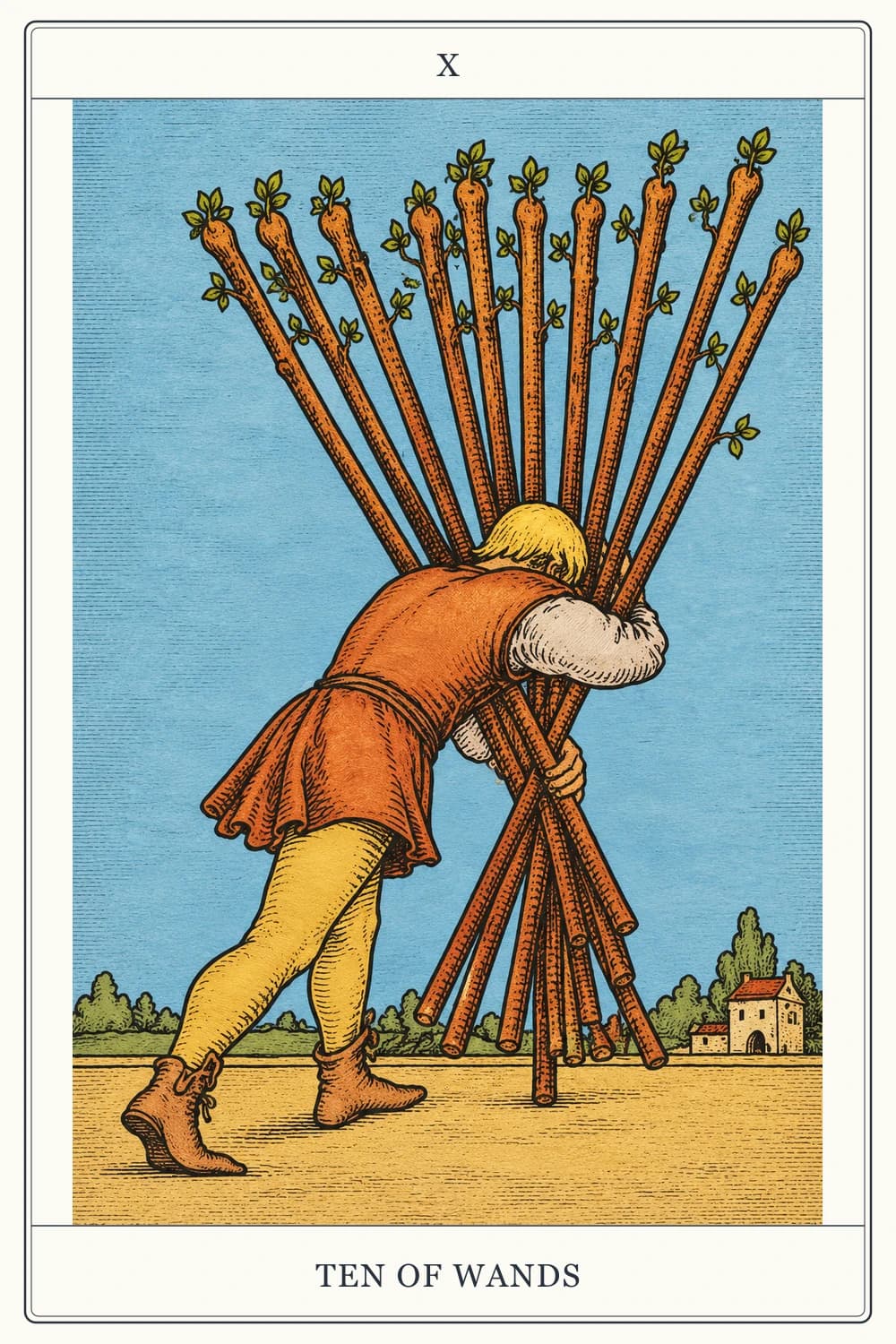
Illustrative card · What's in the way
Ten of Wands — read the card meaningA figure bends forward while carrying a bundle of wooden wands toward distant buildings. Burden and trying to do too much are associations in Bunning’s reference. In What's in the way: “I am treating three tasks as simultaneous priorities, even though two have an agreed later time.” The known switching between requests supports examining that load.
You can leave those two requests for their agreed time and use this window for the article. That choice follows from the priority agreement. The card does not make a genuinely urgent request optional, establish that a colleague is causing the delay or diagnose why you keep switching.
3 · Next step — Three of Pentacles
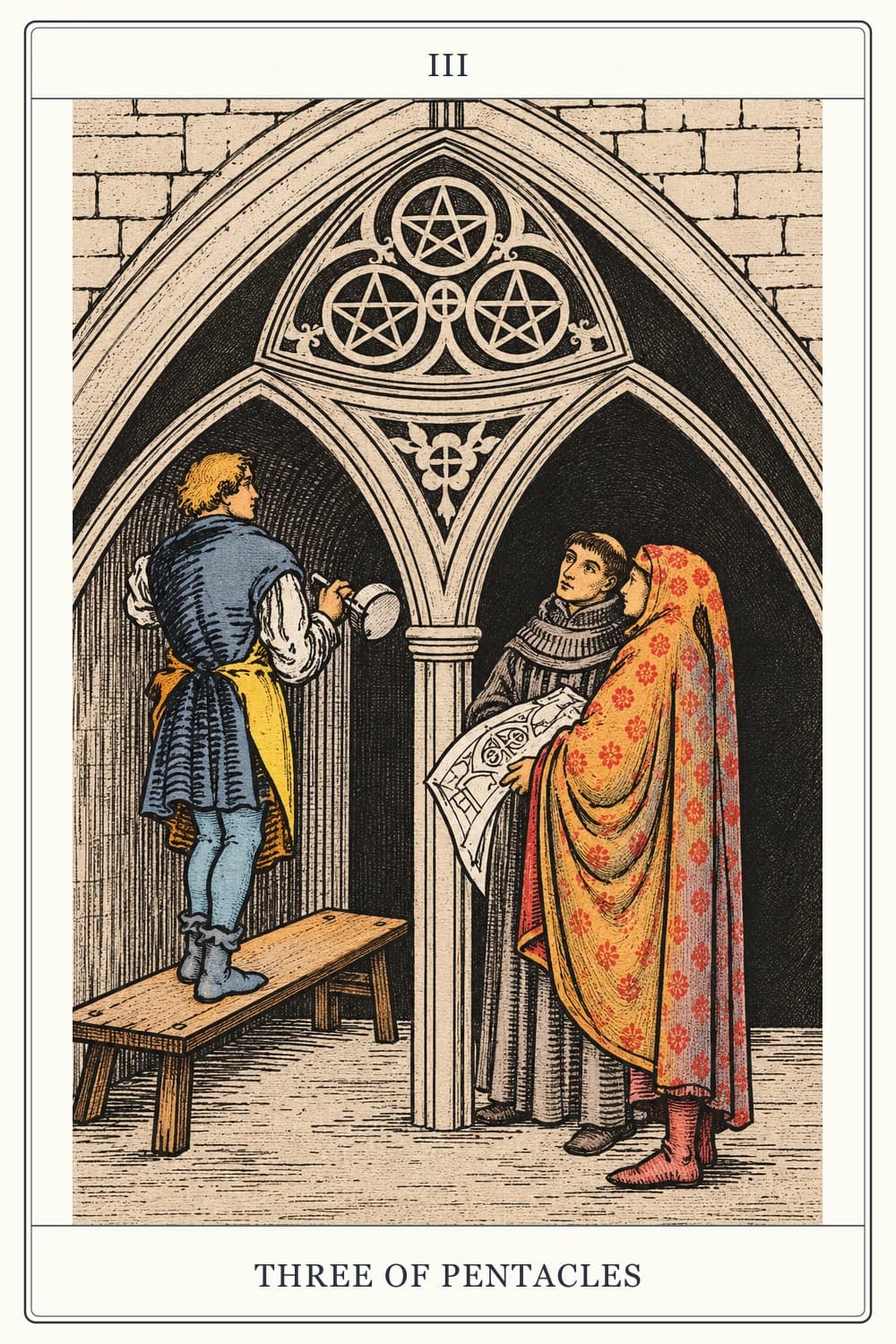
Illustrative card · Next step
Three of Pentacles — read the card meaningA craftsperson stands on a bench inside a stone building while two other people examine the work and a drawing. Bunning’s reference connects the card with teamwork, planning and competence; Orara’s upright entry also names feedback. In Next step: “Prepare one section for the colleague’s agreed practical check, with a specific question.”
The colleague can test only one section in the available slot. Ask them to follow that section in the test workspace and flag the first place where the instruction or screenshot leaves them unsure. Their feedback can reveal a reader’s difficulty; it does not supply a full review of the other section or approval to publish the article.
Use the review to change the draft, then record what remains
A connected interpretation could say: “My experience gives me material for a careful draft, switching between tasks is fragmenting the agreed work window, and a limited practical review can show what one section still needs.” Eight of Pentacles identifies something usable, Ten of Wands identifies a difficulty in applying it and Three of Pentacles gives the response a collaborative form.
A different response could use the planning theme in Three of Pentacles to map all remaining checks before asking for feedback. That would fit if the review requirements were unclear. Here the checklist is known and a short review slot is confirmed, so preparing one section uses an opportunity already available. Neither reading makes the whole article complete.
Use 10:00–10:05 for the reading and note, 10:05–10:25 to draft the first section and capture its screenshot, and 10:25–10:30 to send it with the review question. If the section is not ready, say what is missing rather than presenting it as ready. The two deferred requests remain scheduled after 11:00.
Initial note, 23 October: “Question: What small step could help me finish the help article I am drafting? Chosen upright cards: Eight of Pentacles / What you can use — practised process and available tools; Ten of Wands / What's in the way — switching into requests that can wait; Three of Pentacles / Next step — one prepared section for the confirmed check. Use the half-hour as planned. At 14:00, review what the colleague could follow and what remains unverified.”
In the illustrative result, you send the first section and its screenshot by 10:30. The colleague reports: “I reached Export, but I could not tell which project the instruction referred to. The screenshot cuts off the project selector.” They did not test the second section. The check exposes a project choice the draft had left implicit.
Later note, 23 October, 14:10: “I added a step naming which test project to select and recaptured the screenshot with the selector visible. The narrow review exposed a specific gap. The revision has not been checked again; the second section still lacks its screenshot and practical review. The article remains unfinished.” This records a useful correction without claiming that the whole procedure is now verified.
The task advanced because a specific check produced information you could use. Record the remaining checks against the actual deadline; a reading cannot reserve another review slot or extend that deadline.
Optional practice
Keep the same cards and 10:00–10:30 window, but remove the confirmed review slot: no colleague or other reviewer is available before the article’s deadline. You have also lost app access until after that deadline. You still have the outline and draft. Verified instructions, current screenshots and a colleague’s practical check remain required, and the deadline is unchanged. What limited step is possible, and what cannot be claimed?
See one possible answer
Compare the draft with the approved outline and list which requirements are complete, incomplete or blocked. Record the missing app access, screenshots and practical checks, then draft a request to clarify how the unresolved requirements will be handled. Keep the article’s status incomplete. Planning can still express the Three of Pentacles theme, but there is no available collaborator or app session to use now. Do not invent a substitute reviewer, a self-test without access, permission to publish or an extended deadline. The reading leaves the completion problem unresolved.
Keep the planned step beside the evidence it produces
Keep the question, cards and initial reasoning in a notebook or document. Append a dated observation after the check instead of rewriting the original expectation. Opening Work Focus setup does not preload these teaching cards or save this worksheet.
A useful entry distinguishes “sent for review,” “feedback received,” “revised” and “verified.” Use whichever status the evidence supports. The compact note is enough to begin; the detailed worksheet adds space for requirements, permissions and unfinished checks.
A quick journal note
Date / question / task and deadline:
Available resources / required checks / limits:
What you can use / What's in the way / Next step — cards and interpretations:
Chosen response / time allowed / what would count as progress:
Review date: what I did and what the check showed:
Current status / unfinished requirements:
Detailed journal worksheet
Work Focus reading worksheet
Date and question about one piece of work:
What exists and what completion requires:
Deadline and actual time available:
Resources, access and confirmed support:
Priorities or permission to defer other tasks:
What you can use — card, orientation, image detail and interpretation:
What's in the way — card, orientation, image detail and supporting facts:
Next step — card, orientation, image detail and proposed response:
How the three roles connect:
Another interpretation and when it would fit:
Chosen action, scope and available time:
What needs another person’s agreement or verification:
When to review and what evidence to inspect:
Later date: what I did, received or observed:
What changed and whether the revision was checked:
Remaining requirements, blockers and current task status:
Sources and further reading
External references for these reading methods. Orara created the examples on this page.