New Chapter tarot spread: find your place after a change
A new chapter can begin inside a familiar part of life. This spread helps you notice what has ended, what still supports you and how to take part differently without needing the whole future mapped out.
Start here
A familiar role or arrangement has changed.
Write what has ended and what you would like to keep. Follow the organizer-to-participant example to see why Leave behind can apply to a responsibility while Support preserves a connection.
Explore a new role in a familiar communityOrara editorial · Updated · Our approach
New Chapter at a glance
- Leave behind
- Support
- First step
Use when: You are already moving through a change and want to find your footing.
Choose another approach if: You need the cards to decide whether to make a major life change.
Example questions
- What could help me find my footing in this new chapter?
- What expectation can I loosen as this chapter ends?
- What support might I look for while I adjust?
On this page
Begin with a change you can name
Use a transition already happening: a course ending, a move or a responsibility you have handed over. Write what has changed and what you would like to keep. This gives the reading a real starting point.
Ask “How can I find my place now that my role has changed?” You can explore your response before knowing how the new arrangement will feel. A card is not a reason to invent an ending or abandon an existing commitment.
Separate an ending from everything around it
A spread gives each card a position, or assigned role. New Chapter uses three positions to distinguish what is changing from what can continue. Something familiar may belong in Support even when another part belongs in Leave behind.
| Position | What to consider |
|---|---|
| 1 · Leave behind | A role, expectation or habit that no longer fits the change. |
| 2 · Support | A resource, relationship or practice you can actually draw on. |
| 3 · First step | An initial way to participate in what comes next. |
Read the symbols in relation to the change
A striking card can name a theme without predicting an event. Death, used below, is read through the traditional theme of an ending; it does not forecast a death. Keep the actual transition beside the image as you interpret it.
For your own reading, write the question in a notebook or document. Shuffle a physical deck, take three cards without looking and place them upright, pictures the normal way up, in the order shown above. Or open New Chapter setup, clear Include reversed cards and select Draw 3 cards.
Use each card’s linked name, the card library or your deck’s guidebook for its upright reference. Connect a visible detail and a theme to the assigned role. You can also study the selected example below without a deck.
Example: move from organizer to participant
You have handed over organizing a community film club. The new organizer has agreed to handle the next event and asked for your existing checklist. You still enjoy the films and the people, but catch yourself drafting announcements and planning how to lead the discussion.
Ask “How can I find my place now that I am a member rather than the organizer?” Death, Six of Pentacles and The Fool are chosen upright for this teaching example. The handover is agreed; how you will experience the new role remains open.
| Position | Annotated card |
|---|---|
| 1 · Leave behind | Death in Leave behind |
| 2 · Support | Six of Pentacles in Support |
| 3 · First step | The Fool in First step |
1 · Leave behind — Death
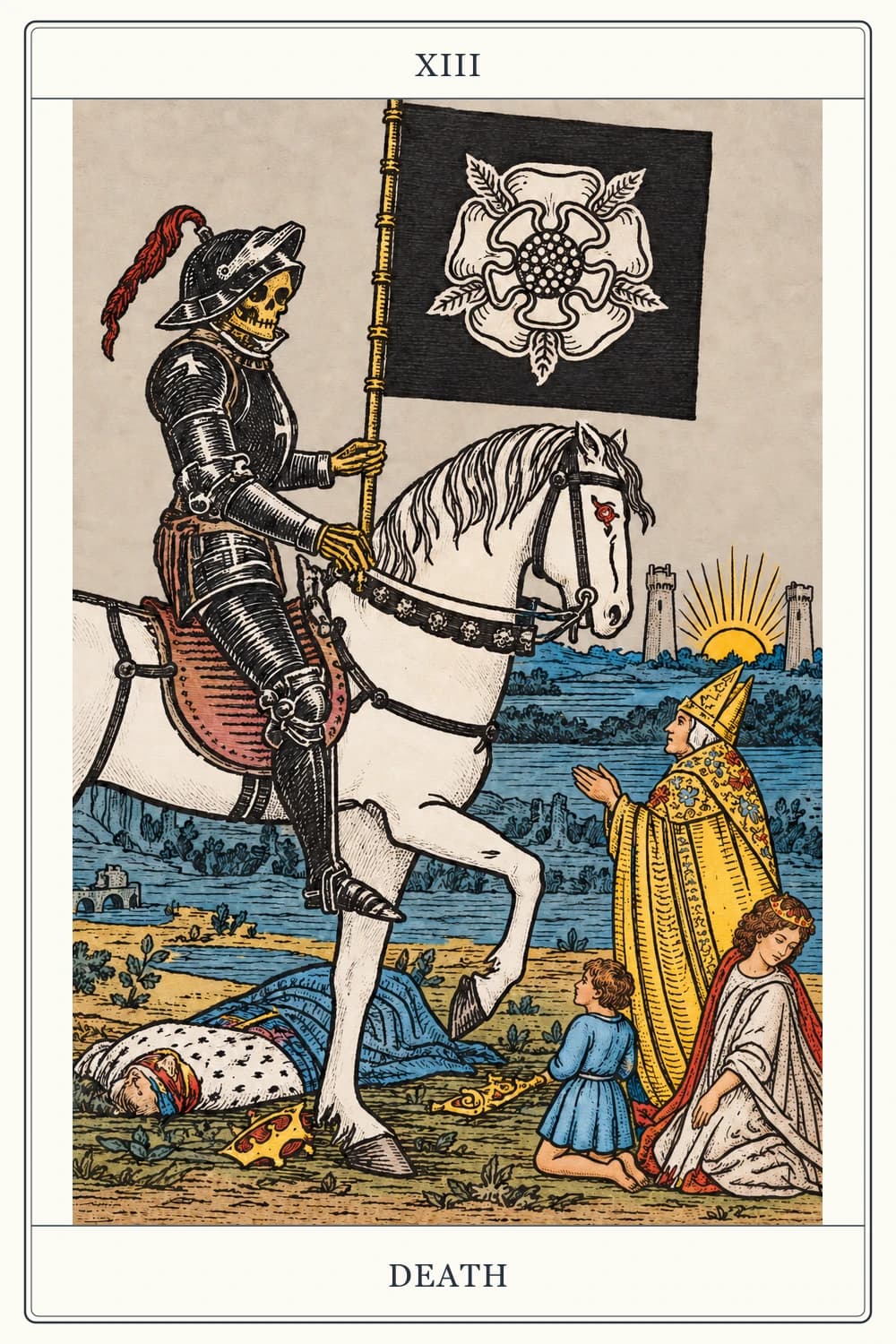
Illustrative card · Leave behind
Death — read the card meaningA skeletal rider carries a black flag past people on the ground, while the sun appears between distant towers. Joan Bunning connects Death with endings and transition. In Leave behind, that theme can help you name precisely what is ending.
Here, it is the expectation that you must make every event happen. The planning habits you have noticed still belong to the old role. You can let that responsibility end while keeping your interest in the club. Leaving the community entirely would be a different choice, unsupported by your stated wish to remain involved.
2 · Support — Six of Pentacles
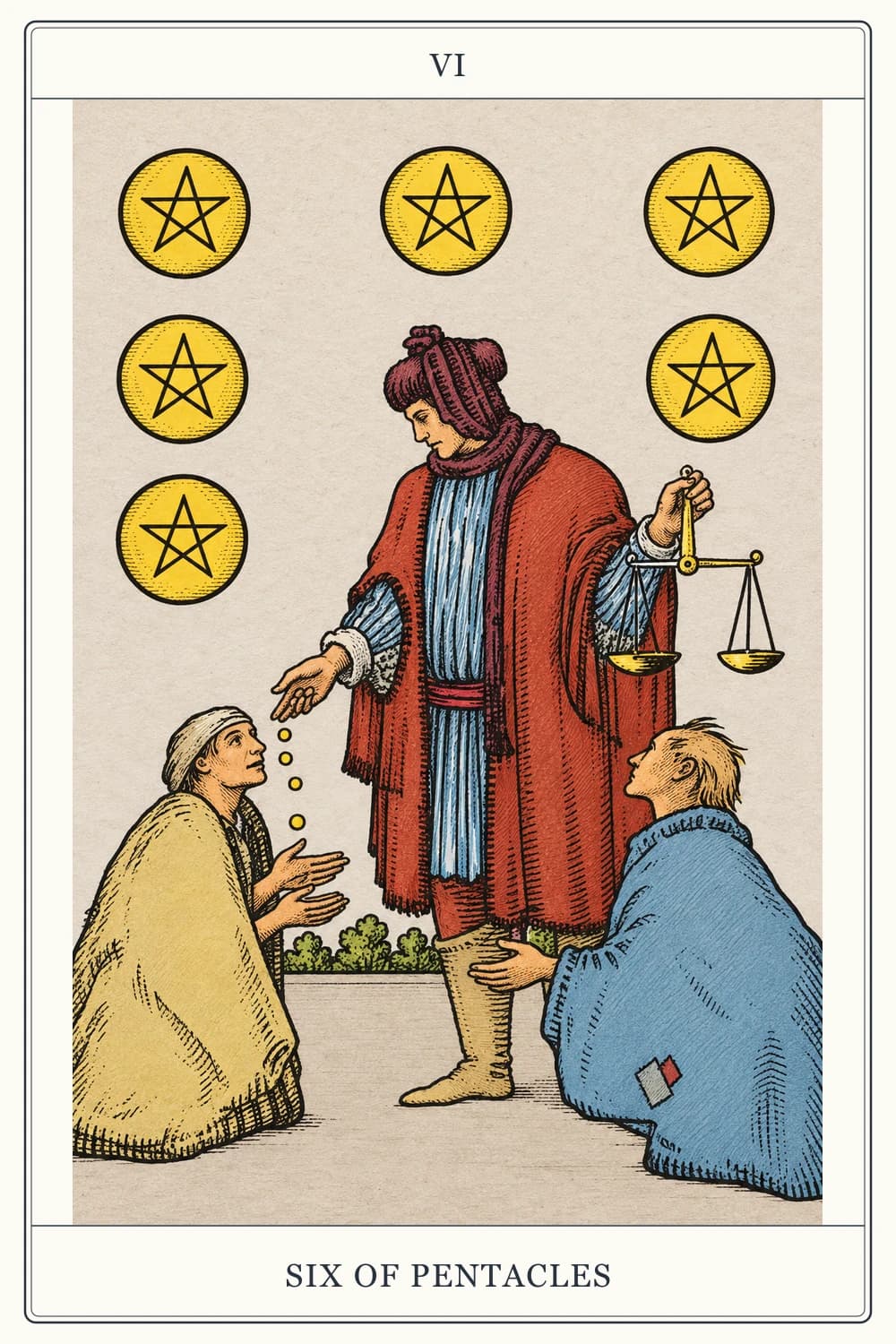
Illustrative card · Support
Six of Pentacles — read the card meaningA figure holds scales and gives coins to one of two kneeling people. Bunning’s reference explores giving and receiving resources, knowledge and power. In Support, look at both sides of the exchange.
You can share the requested checklist, and you can receive the benefit of someone else organizing. The new organizer’s agreement makes that support concrete. Passing on useful knowledge can help the handover; continuing to approve every decision would keep you in the role you meant to leave.
3 · First step — The Fool

Illustrative card · First step
The Fool — read the card meaningA traveller carries a small bundle near a cliff edge, with a dog beside them. Bunning associates The Fool with beginnings and spontaneity. In First step, consider what it would be like to arrive without your familiar script.
Go to the next event as a participant. Bring a question you are curious about instead of a discussion agenda. You know how to run the club, but being there without running it is a new experience. This modest first step lets you discover what you enjoy in that role.
Try the new role before judging it
The cards connect as “Let the organizing role end, allow support to flow both ways and try being a participant.” Share the checklist, then let the agreed handover guide what you take on at the next event.
Initial note: “Death / Leave behind: responsibility for every detail. Six of Pentacles / Support: share the checklist and let someone else host. Fool / First step: attend with one question, no agenda. Review after the event: where did I enjoy participating, and where did I reach for the old role?”
Illustrative later note: “I felt awkward during a pause I would usually fill. Someone else started the conversation, and I enjoyed following it. I still missed being the person who knew the plan. Next time I want to notice that feeling before volunteering to take over.” The new role can be worthwhile before it feels familiar.
Optional practice
Change one fact: the new organizer has agreed to book the venue but has not agreed to lead the discussion. Does the same first step still rest on a complete handover?
See one possible answer
No. Discussion leadership is unresolved, so clarify who will do it before treating that responsibility as transferred. You could agree to lead once with a clear boundary or help arrange another facilitator, if someone agrees. Support must come from an actual arrangement; the cards cannot supply it.
Record what changes and what continues
Use your own notebook or document to keep the first intention and later experience together. Look for an adjustment you want to make, including a decision to slow down or clarify support. You do not have to declare the transition complete after one attempt.
The setup starts a fresh reading; it does not preload these example cards or save this worksheet.
A quick journal note
What has changed / what I want to keep:
Leave behind / Support / First step — cards and interpretations:
My response:
Later: what felt different, familiar or still unresolved:
Detailed journal worksheet
New Chapter reflection note
Date and question:
The change already happening:
What I want to keep:
Leave behind — card, image detail, theme and what no longer fits:
Support — card, image detail, theme and an available resource or agreement:
First step — card, image detail, theme and a possible first experience:
How the roles connect:
Another interpretation and when it would fit:
My response and any agreement to check first:
When to review:
Later experience, mixed feelings and what to reconsider:
Sources and further reading
External references for these reading methods. Orara created the examples on this page.