Month in Review tarot spread: learn from a completed month
Use a completed month as the evidence for your reflection. Learn to connect three cards with what happened, choose an expectation to loosen and keep a useful practice without turning the next month into a forecast.
Start here
A month has ended and you want a useful conclusion from it.
In the volunteer example, compare the three September session notes before reading the cards. Which facts support changing how extra tasks are accepted, and which questions remain open?
Follow a monthly review into a separate later observationOrara editorial · Updated · Our approach
Month in Review at a glance
- Lesson
- Release
- Carry forward
Use when: You want to reflect on a month that has ended.
Choose another approach if: You want a forecast of next month or proof that an experience had a destined meaning.
Example questions
- What can I learn from the month I have just lived?
- What expectation am I ready to loosen after this month?
- What would I like to carry into the next month?
On this page
Choose a completed month and write down what happened
Start with the month’s dates and a few events you can describe. Use notes or your calendar when available, and label uncertain memories as uncertain. “I stayed fifty minutes instead of the thirty planned” is an observation. “They expected me to stay late” is an explanation that needs more evidence.
This guide uses tarot as a prompt for reflection on those events. The cards cannot supply missing memories or establish why something happened. Choose one part of the month, such as a volunteering routine, rather than trying to explain every experience. Events after the final date belong in a separate follow-up.
Give Lesson, Release and Carry forward distinct jobs
A spread is a layout of cards, and each position assigns a role. Month in Review uses Lesson, Release and Carry forward. Read each card against the same completed period, then connect the roles: what did the experience show, what expectation might change and what remains useful?
Release can mean loosening a habit or standard. It does not erase an event or settle whether you should leave a group. Carry forward identifies a practice worth keeping; it does not guarantee that the same help or conditions will be available again.
| Position | Question to ask |
|---|---|
| 1 · Lesson | What could I learn from these events, and which observation supports it? |
| 2 · Release | What expectation or habit might I loosen in light of that experience? |
| 3 · Carry forward | What useful practice can I retain while making that change? |
Prepare three cards and a place to keep the review
You can follow the chosen cards below without a deck. For your own review, keep a notebook or document and a card reference available. Write the period, question and known events before selecting cards. Record each card’s name and role beside its interpretation.
This example uses upright cards, with the pictures the normal way up. A reversed card is upside down and can use another reference meaning. With a physical deck, choose the upright-only method before shuffling, take three cards without looking and place them upright from left to right as Lesson, Release and Carry forward.
In Orara, Start Month in Review opens setup. Check the layout, enter your question if useful, clear Include reversed cards, then select Draw 3 cards. Use a card’s linked name or your deck’s guidebook to find its upright meaning. Describe a visible detail, choose a reference theme and explain how it answers the position using your known events.
Example: review three volunteer sessions in September
In this invented example, you are reviewing 1–30 September 2026 on 1 October. You sort donated books as a volunteer and want to continue. Your dated session notes are available; they contain the observations below. The three upright cards were selected for teaching, rather than drawn for you.
On 6 September, a teammate demonstrated the sorting categories using a written sheet, and you completed one box within the planned thirty minutes. On 13 September, you used the same written category sheet and completed one box within thirty minutes. On 27 September, after the first box, you accepted an extra mixed box without asking about its time or instructions. You left after fifty minutes with the extra box partly sorted.
Your last note includes the expectation “I should accept extras immediately to be useful.” You do not know whether anyone else expected this. A next visit is already arranged for 4 October, with thirty minutes available, but its task has not been agreed. That visit is outside the month being reviewed.
Question: “What can I learn from the volunteer sessions I completed in September?” Keep the three September records distinct from any interpretation and from the October response you may propose.
| Position | Annotated card |
|---|---|
| 1 · Lesson | The Hermit in Lesson |
| 2 · Release | Eight of Cups in Release |
| 3 · Carry forward | Six of Pentacles in Carry forward |
1 · Lesson — The Hermit
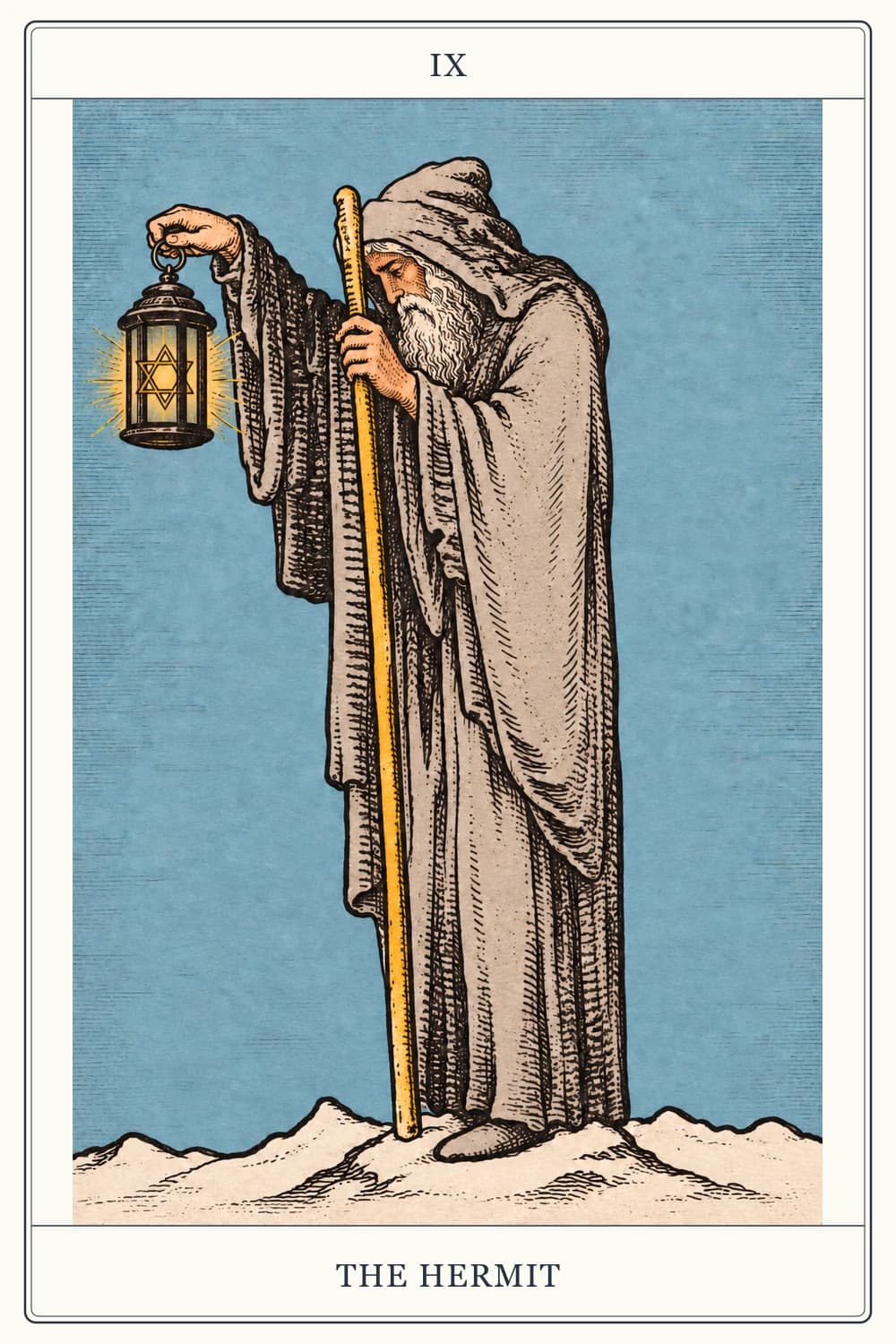
Illustrative card · Lesson
The Hermit — read the card meaningA cloaked figure stands on snowy ground, holding a lantern and a staff. Joan Bunning’s reference associates The Hermit with reflection, searching and guidance. In Lesson, the reflective theme supports looking closely at the three records: “A clear procedure appears useful when I choose a task.”
The demonstration and written category sheet were present at the two sessions completed within the planned time. That makes clear instructions worth retaining as a working lesson. It does not prove they were the only reason those sessions fitted, or that the mixed box would take the same time. The third record leaves its difficulty and time requirement uncertain.
2 · Release — Eight of Cups
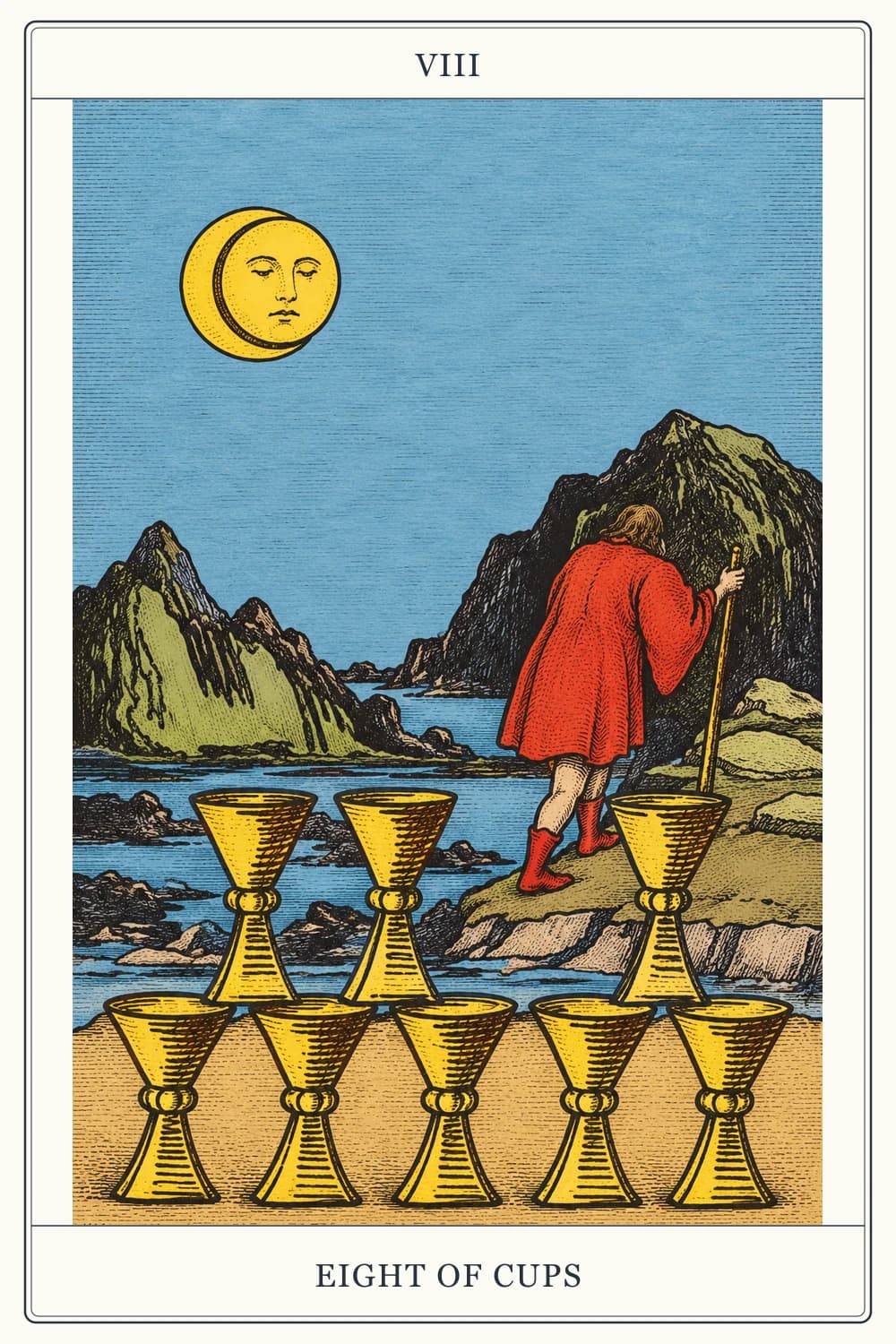
Illustrative card · Release
Eight of Cups — read the card meaningA figure with a staff walks toward hills, leaving eight cups beside the water. Moving on and letting go are associations in Bunning’s reference, which also discusses changing an old pattern. In Release: “I could loosen the expectation that I must accept extra work immediately.” The expectation is stated in your note, and the unexamined extra task accompanied a longer visit.
This interpretation changes the way you agree to work. It does not require leaving volunteering: you have said you want to continue, and the first two records include useful contributions. If you were considering leaving for other reasons, those reasons would need their own examination. The departing figure alone cannot decide that question or cancel a task you have already agreed to do.
3 · Carry forward — Six of Pentacles
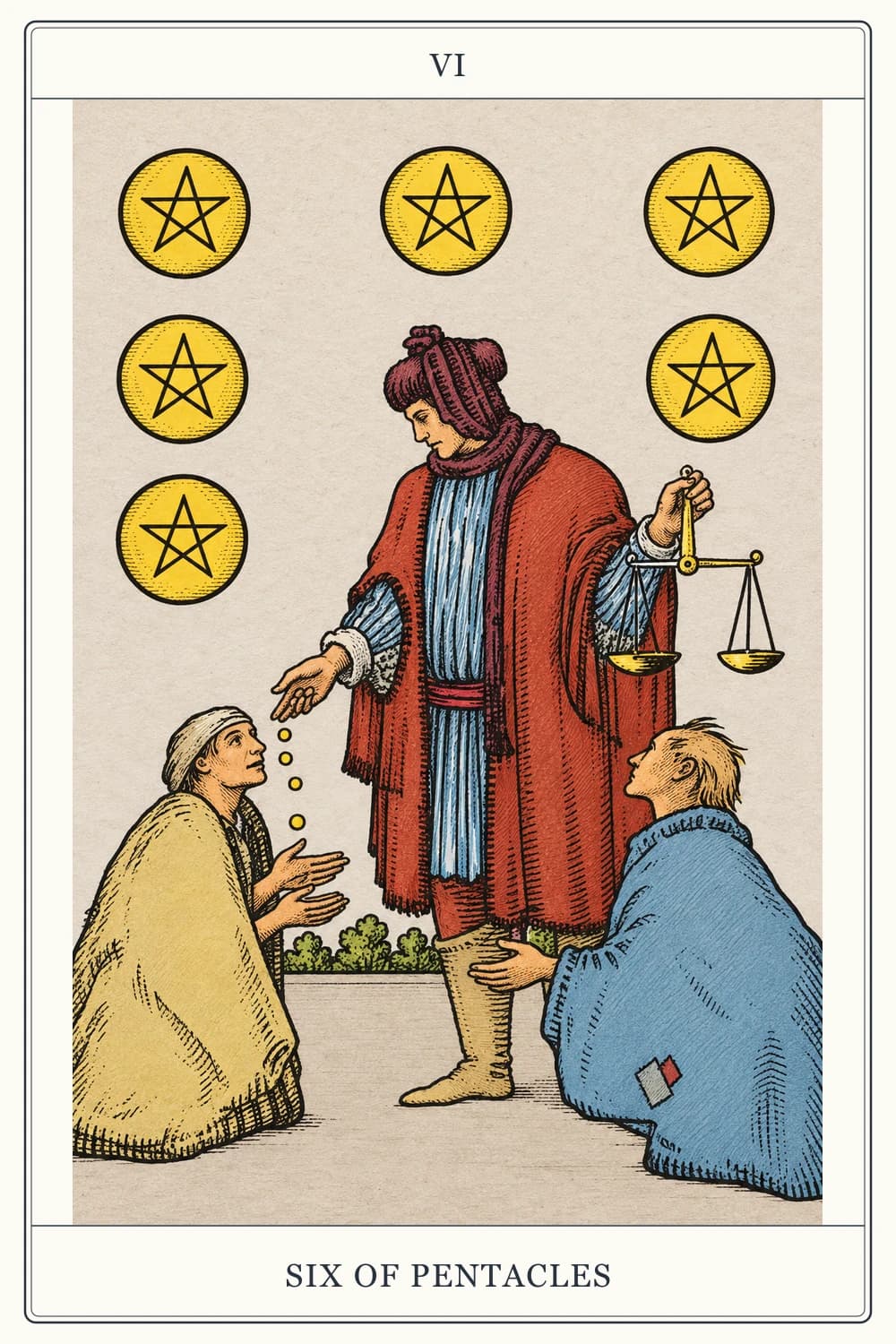
Illustrative card · Carry forward
Six of Pentacles — read the card meaningA standing figure holds scales and gives coins while two people kneel nearby. The star-marked discs shown above the scene are called pentacles. Bunning’s reference examines giving and receiving resources or knowledge; Orara’s upright entry also emphasises clear expectations. In Carry forward: “Keep useful instruction and make the terms of my contribution explicit.”
You received a demonstration and used a category sheet in September. Asking what a task involves preserves that practical exchange while changing the habit of agreeing immediately. At the October visit, state the thirty-minute limit and ask which task could fit, what instructions are available and how long it is expected to take.
An estimate is information to assess, not a promise. Help provided in September does not establish that an instructor or a suitable task will be available in October. You can leave a new task unaccepted when its requirements remain unclear. That keeps the giving-and-receiving theme grounded in what people can actually offer.
Connect the monthly conclusion with a checkable response
A connected reading could say: “The September records make clear instructions worth keeping; accepting extras without checking their scope made my contribution harder to bound, so I can ask about instructions and time before agreeing.” Lesson examines the experience, Release questions the stated expectation and Carry forward keeps cooperation with clearer terms.
Initial review note, 1 October: “Period: 1–30 September 2026. Question: What can I learn from the volunteer sessions I completed in September? Selected upright example: The Hermit / Lesson; Eight of Cups / Release; Six of Pentacles / Carry forward. Two boxes completed in separate thirty-minute visits with a known procedure; third visit lasted fifty minutes and the extra box remained unfinished. Working lesson: check the procedure. Loosen: accept extras immediately. Keep: instruction and clear terms. At the arranged October visit, state my thirty minutes and ask about task, instructions and estimated time before accepting. Afterwards record the reply, what I agreed and the actual time.”
An illustrative later entry, 4 October: “The coordinator offered a box using the familiar category sheet and estimated twenty minutes. I stated my thirty-minute limit and accepted that box. Sorting took twenty-five minutes, and I left within thirty. I did not accept another task. Asking gave me an estimate and a defined task; the estimate was five minutes shorter than the actual sorting time. I have not tested this approach with an unfamiliar procedure.”
The later entry describes one new arrangement and its limits. It neither changes what happened in September nor proves that every future visit will fit. If the conversation produced no clear task or estimate, record that reply and what you did instead. You do not need to turn an unavailable arrangement into evidence that cooperation was guaranteed.
Optional practice
Keep the September facts, three cards and thirty-minute October limit. At the next visit, the only offered task uses an unfamiliar procedure. You have not accepted it. No written guide or instructor is available during the visit, and the coordinator cannot estimate its duration. How should Carry forward change the response? What remains true about September?
See one possible answer
State your limit and leave this new task unaccepted while its requirements are unknown. Do not invent an instructor, a familiar alternative task or more time; do not guess that the work will fit thirty minutes. Carry forward can preserve the practice of asking for clear terms even when no workable arrangement results. Record what was unavailable and that this task was not tried. The September demonstration and category sheet remain facts about that month; they never established that the same support would be available at every later visit.
Keep the month’s evidence and later follow-up separate
Keep the original monthly review in your notebook or document and append any later response with its own date. Opening Month in Review setup does not save this worksheet or preload its teaching cards. A review can also be complete with an unresolved question; you do not have to commit to an action.
When using the worksheet for a different month, start again with that period’s events. Carrying a useful practice forward does not carry the old facts into a new month. If your next task is planning a coming week, use a separate weekly intention with its own dates and known commitments.
A quick journal note
Month / review date / question:
Known events and uncertain memories:
Lesson / Release / Carry forward — cards and interpretations:
Connected conclusion and its evidence:
Possible response / what needs checking:
Later date: what I tried, observed or left unresolved:
Detailed journal worksheet
Month in Review worksheet
Month start and end / date of review:
Question about one area of that month:
Events and records I can describe:
Uncertain memories, causes or missing information:
Lesson — card, orientation, image detail and evidence-based interpretation:
Release — card, orientation, image detail and expectation to reconsider:
Carry forward — card, orientation, image detail and practice to retain:
How the three roles connect:
An alternative interpretation and why it may or may not fit:
My conclusion and what remains uncertain:
Optional response outside this period and its conditions:
What I will check and when:
Later date: actual reply, agreement, action and observation:
What was unfinished, unavailable or not tested:
What the later result does not establish about the original month:
Sources and further reading
External references for these reading methods. Orara created the examples on this page.