Mind, Body & Spirit tarot spread: bring three needs together
Sometimes you want company and quiet at the same time. Mind, Body & Spirit helps you give each need a voice and find a response that makes sense for the situation.
Start here
You want different things from the same situation.
Name one thought, one experience of comfort or pace, and one value. In the invitation example, see how the three cards suggest an option the original either-or choice missed.
Explore a choice between company and quietOrara editorial · Updated · Our approach
Mind, Body & Spirit at a glance
- Mind
- Body
- Spirit
Use when: You want a gentle check-in across several parts of your life.
Choose another approach if: You need help diagnosing a symptom or deciding on treatment.
Example questions
- Where could I make more room for balance?
- What needs my attention beyond my to-do list?
- How can my daily pace better reflect what matters to me?
On this page
Three perspectives on one situation
A spread is a layout of cards with an assigned role, or position, for each one. In this spread, the roles look at the same situation from three angles. They need not agree immediately.
Body begins with what you can report about your comfort and pace; a card cannot assess your health. Spirit means what gives life meaning to you, whether that includes spirituality, friendship, creativity or something else.
| Position | What to explore |
|---|---|
| 1 · Mind | The thought, choice or assumption taking up your attention. |
| 2 · Body | Your experience of pace, rest and everyday comfort. |
| 3 · Spirit | The value or connection you want to make room for. |
Choose a situation with more than one need
Start with a choice such as accepting an invitation or deciding how to spend a free afternoon. Write what appeals to you, what feels difficult and any commitments already made. “I want to see my friends” and “I want a quiet day” can both be true.
A useful question is “How could I respond to this invitation while respecting what matters to me?” Balance may mean a compromise, a clear priority or an honest decline. It does not require equal time for three activities.
Give each card its role before interpreting
You can follow the selected example below without a deck. For your own attempt, write the question in a notebook or document. With a physical deck, shuffle and take three cards without looking. Use them upright, with the pictures the normal way up: Mind at the top, Body below left and Spirit below right.
Or open Mind, Body & Spirit setup below. Clear Include reversed cards, enter your question if useful, then select Draw 3 cards. Read each card’s upright entry through its linked name, the library or your deck’s guidebook. Connect a visible detail and one reference theme to that card’s role and your experience.
Example: wanting connection and a quieter afternoon
After a busy week, you feel tired of noisy rooms but miss your friends. They have invited you to a quiet craft afternoon followed by dinner at a lively restaurant. The invitation explicitly welcomes people to either part. You enjoy making things together, yet keep treating the choice as “go to everything” or “stay home”.
Ask “How could I respond to this invitation while respecting what matters to me?” The upright Two of Swords, Strength and Temperance are chosen for this teaching example.
| Position | Annotated card |
|---|---|
| 1 · Mind | Two of Swords in Mind |
| 2 · Body | Strength in Body |
| 3 · Spirit | Temperance in Spirit |
1 · Mind — Two of Swords
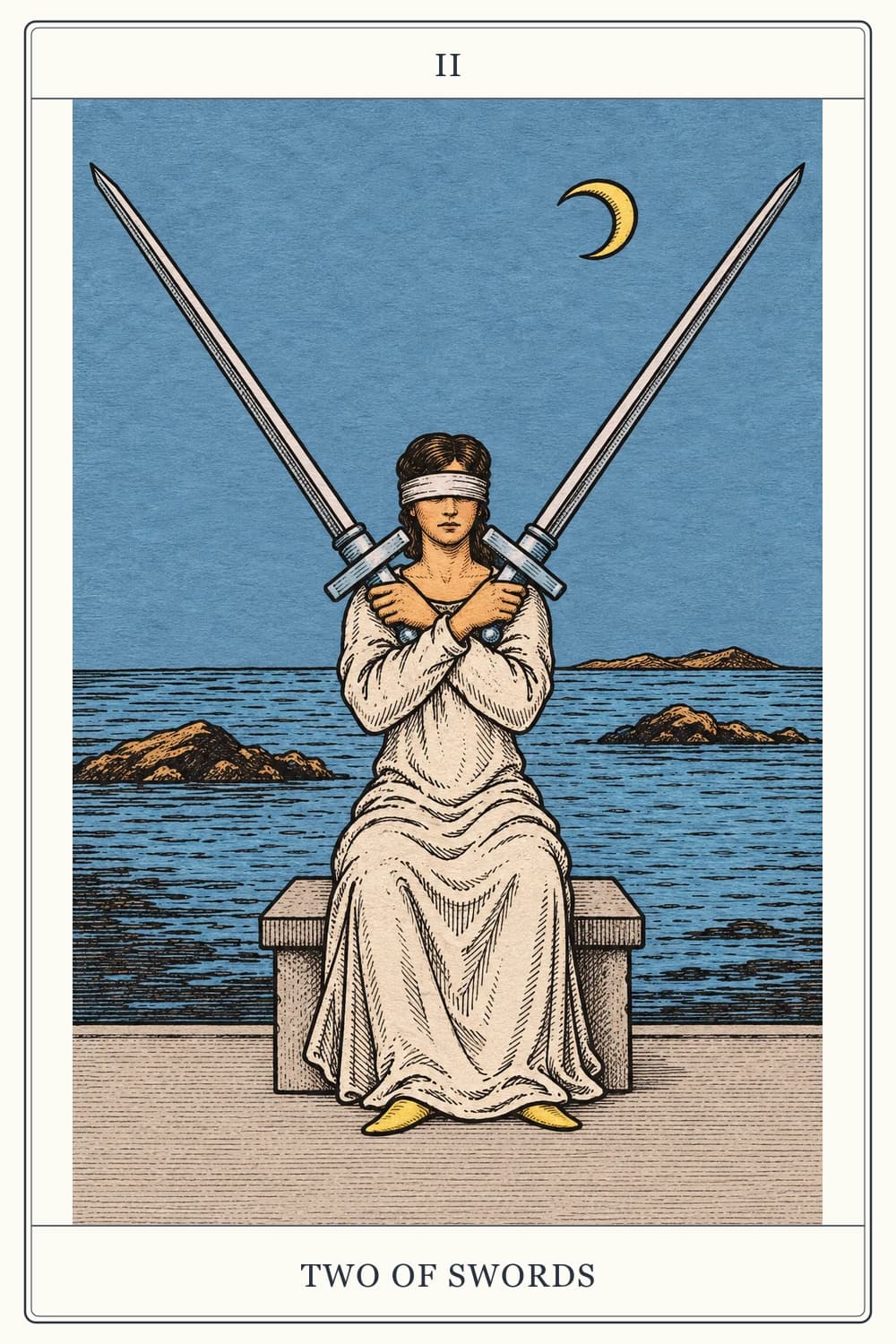
Illustrative card · Mind
Two of Swords — read the card meaningA blindfolded figure holds crossed swords. Joan Bunning includes stalemate among this card’s associations. In Mind, the image invites you to examine the two options you keep holding apart.
Here, “everything or nothing” leaves out an option the invitation already allows. The useful interpretation is “My framing may be narrower than the actual choice.” That comes from comparing your repeated thought with the invitation, rather than assuming the blindfold reveals a hidden problem.
2 · Body — Strength
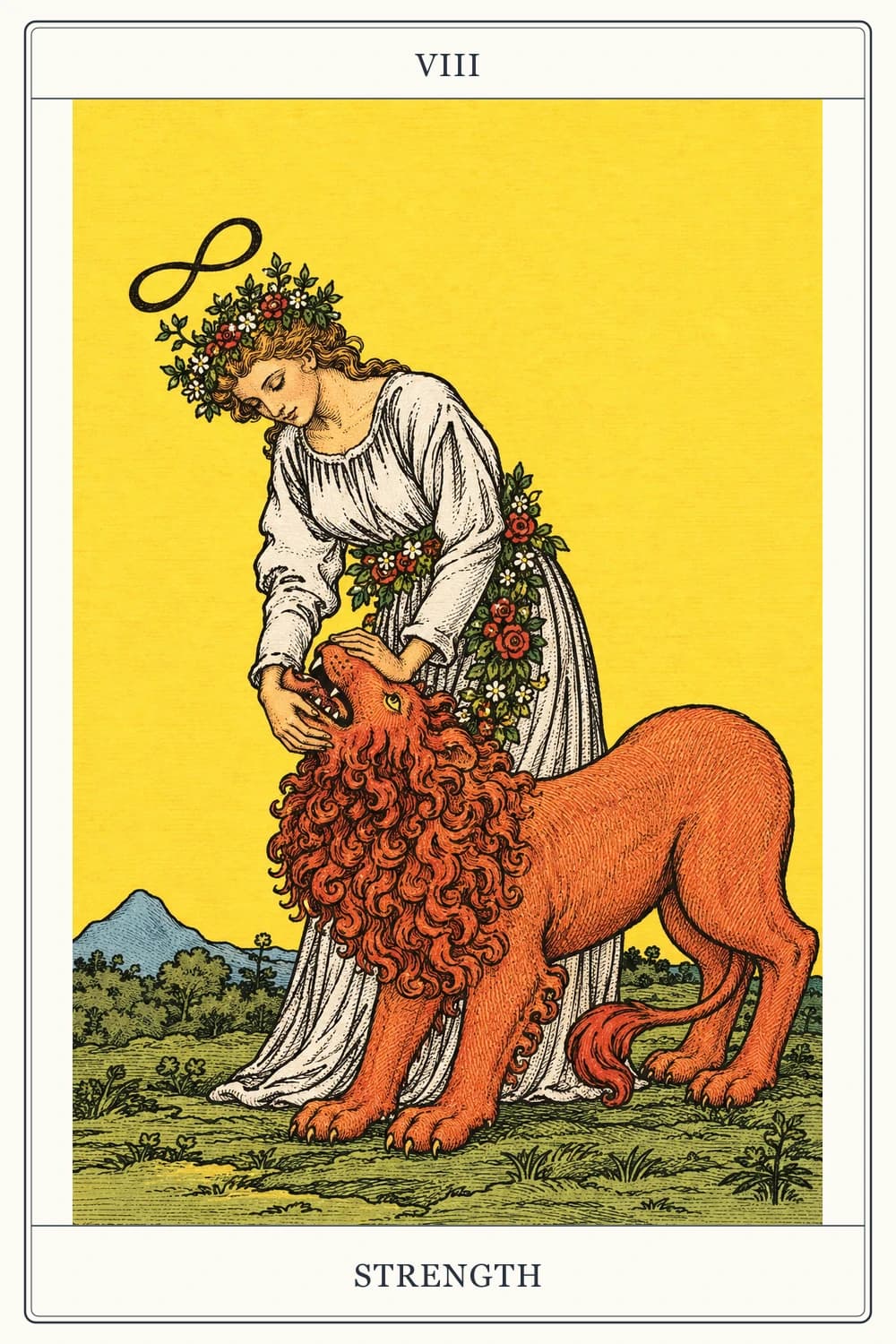
Illustrative card · Body
Strength — read the card meaningA figure places gentle hands around a lion’s mouth. Bunning connects Strength with patience and compassion. In Body, this can suggest responding considerately to the tiredness you have already noticed.
You could take part in the quiet activity without committing to the noisy dinner. Strength also has an endurance theme, but “push through the whole event” fits less well here: you have reported wanting a quieter pace, and attending both parts is optional.
3 · Spirit — Temperance
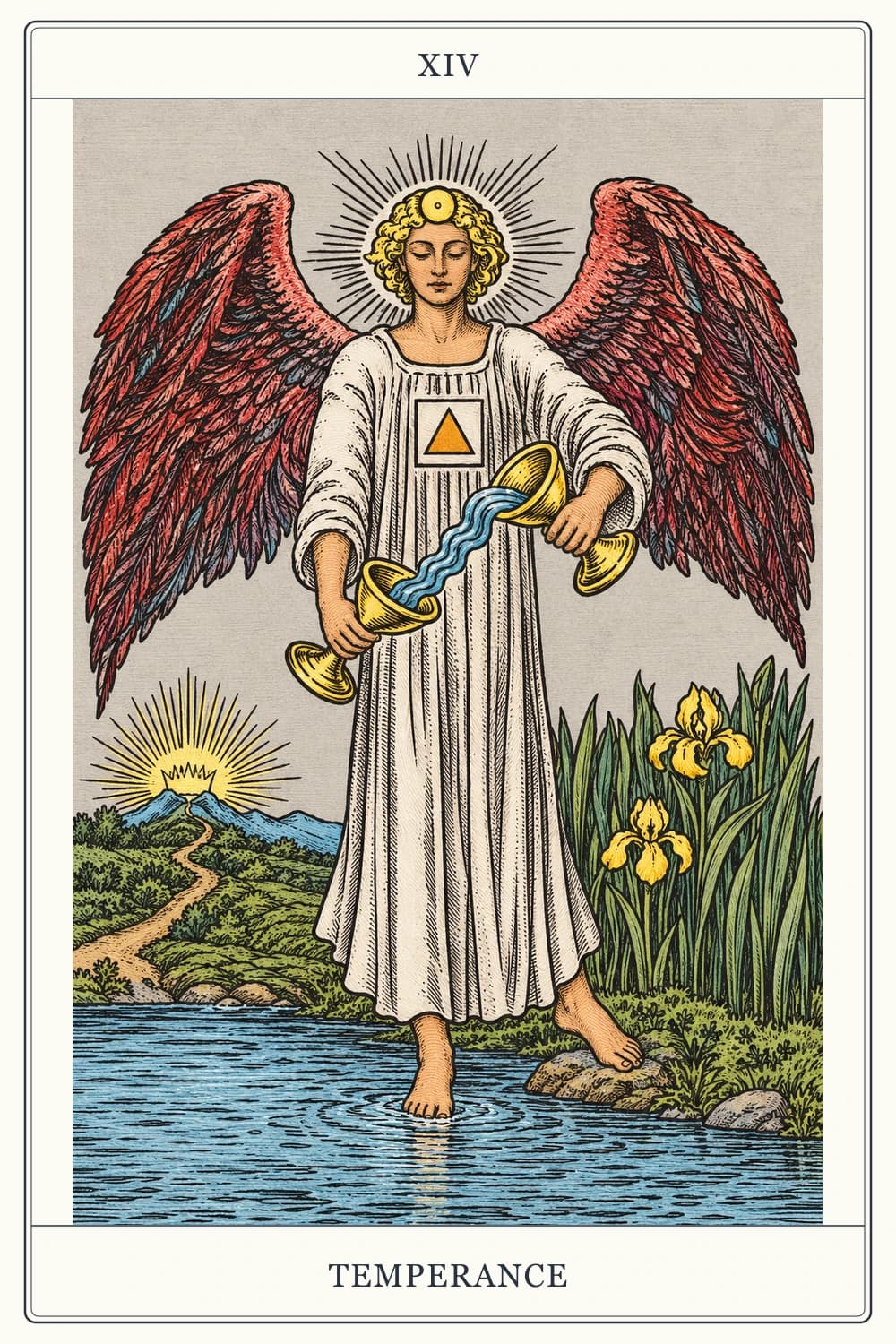
Illustrative card · Spirit
Temperance — read the card meaningA winged figure pours water between two cups, with one foot in water and the other on land. Balance and combination are themes in Bunning’s reference. In Spirit, ask what you want the mixture to preserve.
You name friendship and making things together. Both are present in the craft afternoon. Attending that part lets you express those values while taking your preference for quiet seriously. Temperance does not require a compromise every time; if you wanted solitude more than company today, declining could fit your priorities better.
Bring the perspectives into one response
Together, the cards suggest “I can loosen an all-or-nothing thought, be considerate about my pace and still make room for friendship.” Reply that you would like to join the craft afternoon and skip dinner. The arrangement is possible because the invitation offers it.
Initial note: “Two of Swords / Mind: question the either-or. Strength / Body: respect my wish for quiet. Temperance / Spirit: keep shared creativity. Response: join the afternoon only; afterward, notice whether I enjoyed the company and how the pace felt.”
Illustrative later note: “I enjoyed making something alongside my friends. I was still tired afterward, and I felt a little left out when dinner photos arrived. I would choose the afternoon again, but I can see what I gave up.” A response can suit your priorities and still involve a loss.
Optional practice
After a restful morning, you feel comfortable with either part of the invitation, but you still do not want to go. Does Strength in Body settle the decision? Which perspective could you explore next?
See one possible answer
Your changed experience means tiredness no longer explains the hesitation by itself. Explore Mind or Spirit: what are you expecting, and do you actually want this kind of company today? You might accept or decline after that reflection. Do not invent a hidden motive or insist on attending just because you now feel rested.
Review the fit, including the trade-off
Keep the note in your own notebook or document. When you review it, compare the response with the needs you named. Include enjoyment, discomfort or mixed feelings in your own words; there is no balance score to achieve.
The setup link starts a new reading. It does not save this worksheet or preload the teaching cards.
A quick journal note
Situation / question:
Mind / Body / Spirit — card and perspective:
One response and the trade-off:
Later: how it fit my needs and what I would reconsider:
Detailed journal worksheet
Mind, Body & Spirit note
Date and question:
What I know, feel and value in this situation:
Mind — card, image detail, theme and thought to examine:
Body — card, image detail, theme and my reported experience:
Spirit — card, image detail, theme and personal value:
How the three perspectives connect:
Another response that could fit different priorities:
My chosen response and its trade-off:
When to review:
Later: what happened and how it felt:
Sources and further reading
External references for these reading methods. Orara created the examples on this page.