Horseshoe tarot spread: connect seven positions into one reading
Seven cards can examine different influences on one situation. Learn the role of each position, connect the groups into a conditional reading and choose a response you can check against actual agreements and events.
Start here
You can read individual cards and want to connect several influences on one situation.
In the book-exchange example, notice what the helper has confirmed and what is still only an idea. Trace how the seven roles lead to a smaller proposal, then compare it with the actual agreement and event.
Follow seven roles into an agreement and event reviewOrara editorial · Updated · Our approach
Horseshoe at a glance
- Past
- Present
- Future
- Your approach
- Surroundings
- Obstacle
- Possible direction
Use when: Several influences are involved and you have room for a fuller reading.
Choose another approach if: You need a quick single focus or a guaranteed outcome.
Example questions
- What could help me understand the different influences on this situation?
- How might I approach this change with more perspective?
- What is shaping my response, and what can I influence?
On this page
Follow the numbered arch and give each position one role
A spread is a layout of cards, and a position gives a card its task. Orara’s Horseshoe places seven cards in an arch: start at the lower left, follow the numbers up to 4 at the top and finish at 7 on the lower right. Use the labels below for this reading; other Horseshoe layouts may assign different roles.
Choose one situation with several connected influences. Write your question and known facts before interpreting. The book-exchange example uses a past experience, a current plan, your choices, available help and venue requirements. Seven cards give those aspects separate roles, rather than seven unrelated answers.
| Position | What it contributes |
|---|---|
| 1 · Past | Known earlier experience relevant to this situation. |
| 2 · Present | The situation and demands you can describe now. |
| 3 · Future | A possible near development if current conditions continue. |
| 4 · Your approach | Your stated aim, attitude or choices within this situation. |
| 5 · Surroundings | Observable circumstances, help and limits outside your own approach. |
| 6 · Obstacle | A difficulty that matters to the aim, supported by facts or left as a question. |
| 7 · Possible direction | A conditional direction formed by connecting the earlier roles. |
Distinguish Future from Possible direction, then connect the groups
Future asks what might develop from the current situation. Possible direction asks where the whole picture could lead, including how you respond to its influences and obstacle. Neither is a guaranteed result. In this guide, tarot supplies themes for reflection; records, conversations and events supply evidence.
Begin with 1–3: what carries forward, what is different now and what development remains possible? Next connect 4–5: how could your approach use the support actually available? Then connect 6–7: what must change or be checked for the proposed direction to become workable?
Write a sentence that retains those links: “Given this history and current situation, this could develop; with this approach and available support, I could address this obstacle and explore this direction.” Replace each phrase with details from the actual reading. If one link lacks evidence, keep that part uncertain instead of inventing a missing fact.
Prepare seven upright cards and a place to keep their order
You can read the chosen example without drawing. For your own attempt, keep a notebook or document and a card reference available. Record the question, earlier events you can substantiate, current requirements and unknowns. Leave space for all seven names and roles so that the final card cannot displace the rest of the reading.
The example uses upright cards: the pictures face the normal way up. A reversed card is upside down and may have a separate reference meaning. For an upright-only physical reading, choose that convention before shuffling, take seven cards without looking and place them upright in the numbered arch described above.
In Orara, Start Horseshoe opens setup. Check Horseshoe, enter your question if useful, clear Include reversed cards, then use Draw 7 cards. For each card, describe a visible detail, consult the upright meaning through its linked name or your deck’s guidebook, and explain how one theme fits the role and known situation. Finish the connections before choosing a response.
Example: keep a book exchange manageable and welcoming
In this invented example, you are planning on Tuesday, 20 October 2026, for a book exchange on Saturday, 24 October. You helped at last year’s exchange. Your dated note says, “Visitors asked how to join; I welcomed them and explained the exchange table.” You want this event to be welcoming too.
The room is booked from 14:00 to 16:00, including setup and clearing. The exchange is planned for 14:30–15:30. The venue requires two assigned organisers to be present through setup, the exchange and closing. A helper has confirmed 14:00–16:00, but you have not agreed their tasks.
The venue’s rules allow each visitor up to three books and require them to take home any of their books that remain. Your draft adds a recommendation wall and a reading corner; neither extra has been announced or promised. Setup, welcoming visitors and clearing the room still need named owners. The venue contact and helper are available for a planning conversation tomorrow.
Question: “What could help me approach the book exchange I am organizing?” The seven upright cards were selected for teaching, rather than drawn for you. The planning conversation, event and later notes below are also illustrative.
| Position | Annotated card |
|---|---|
| 1 · Past | Six of Cups in Past |
| 2 · Present | Two of Pentacles in Present |
| 3 · Future | Wheel of Fortune in Future |
| 4 · Your approach | The Chariot in Your approach |
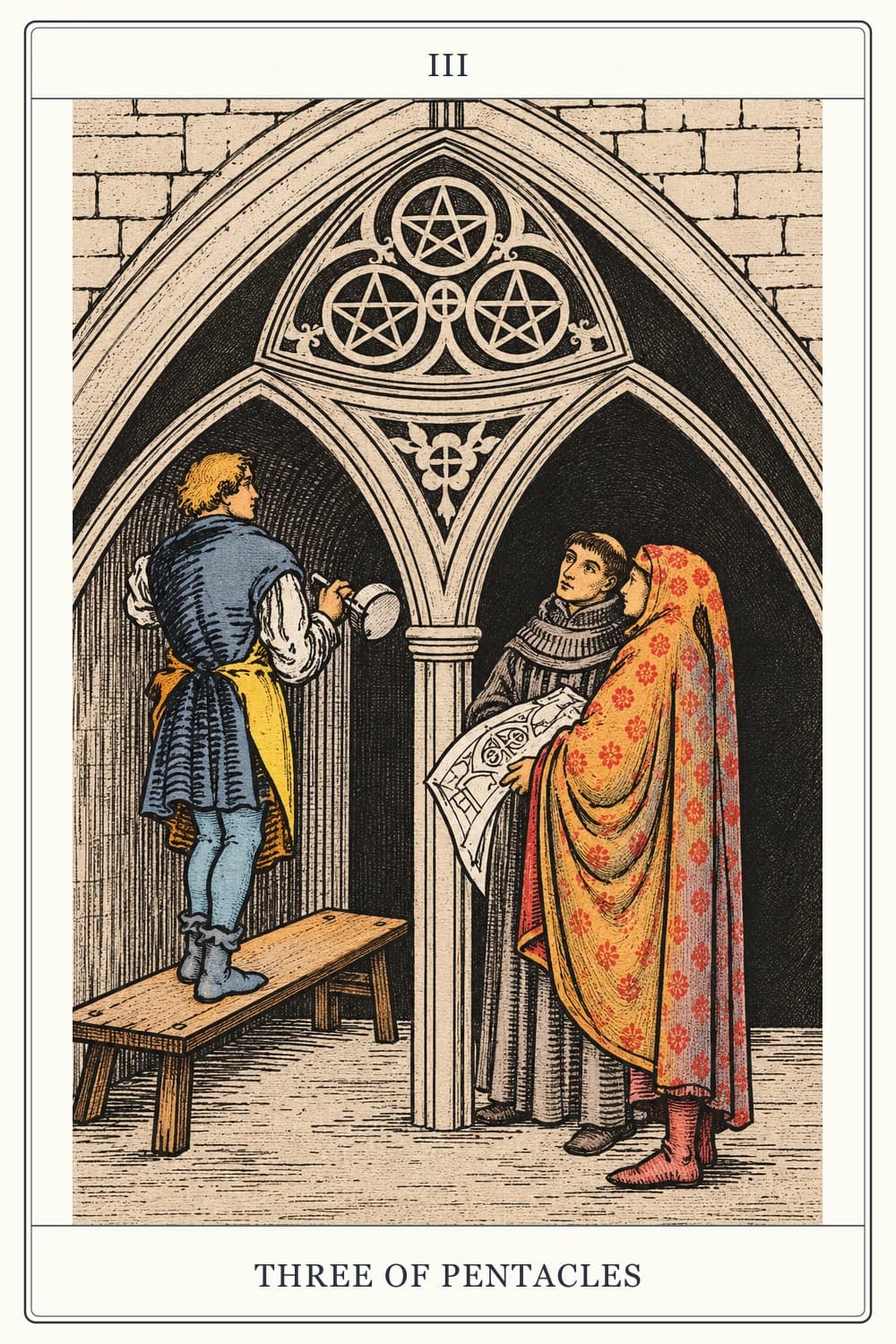
| 5 · Surroundings | Three of Pentacles in Surroundings |
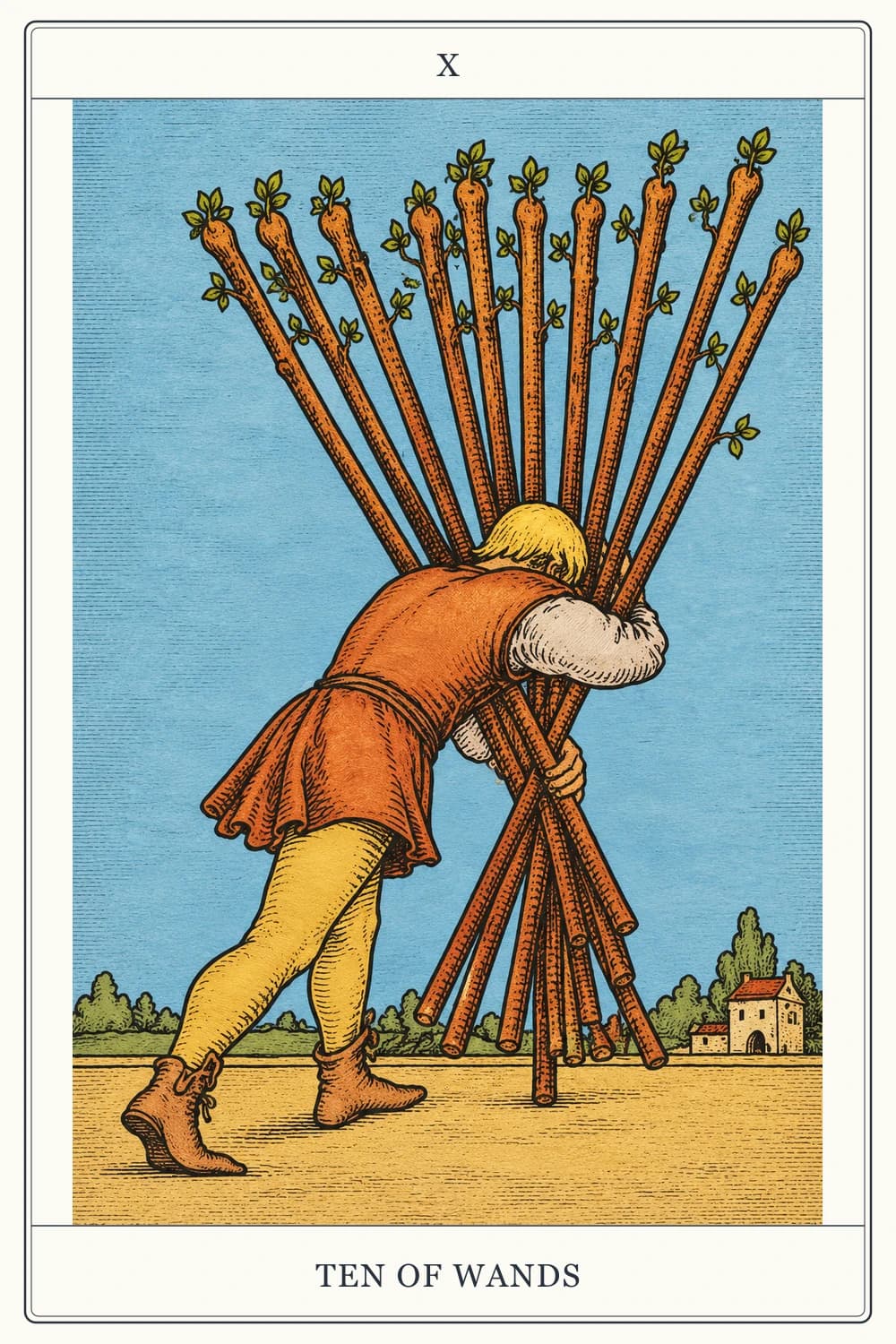
| 6 · Obstacle | Ten of Wands in Obstacle |
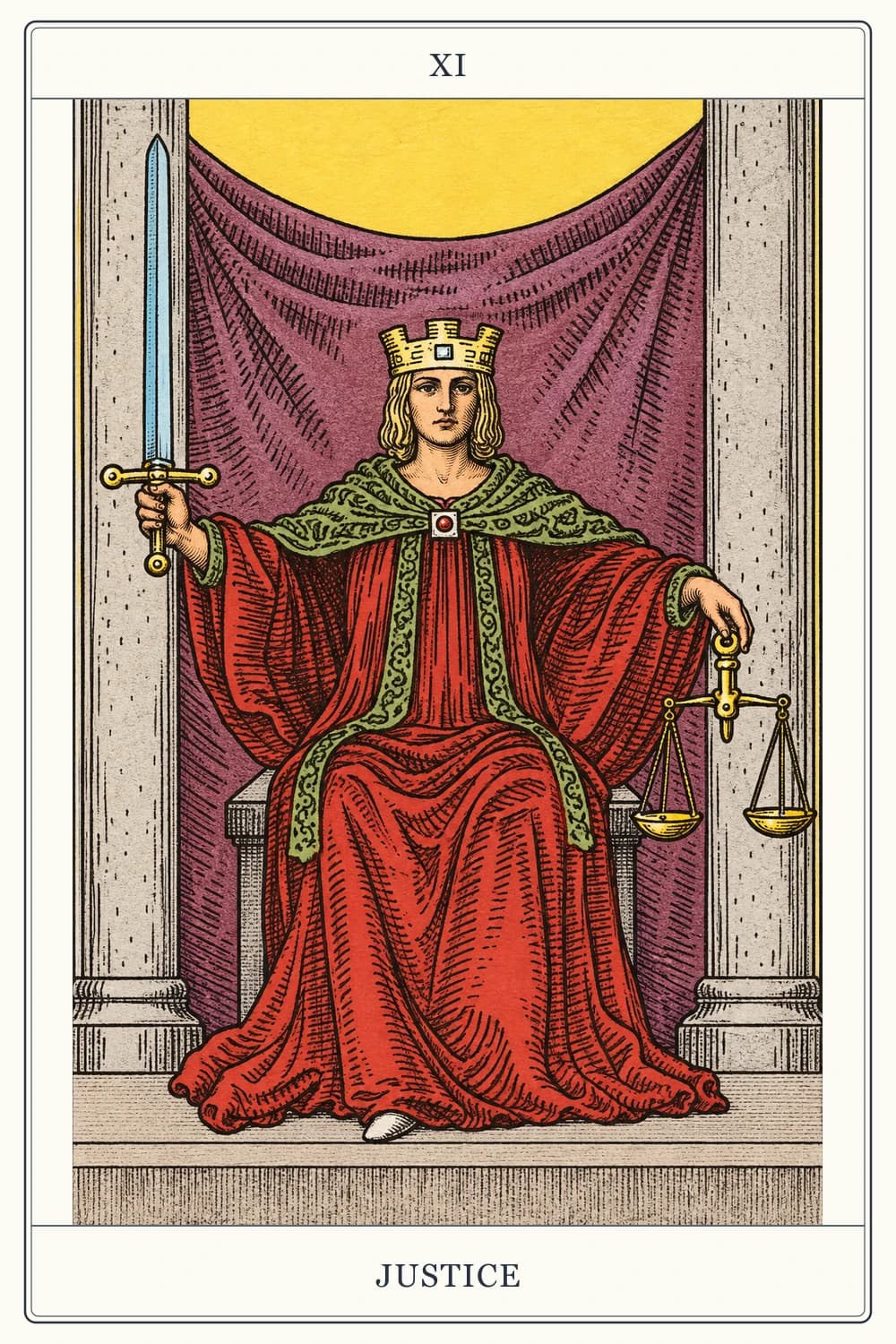
| 7 · Possible direction | Justice in Possible direction |
1 · Past — Six of Cups
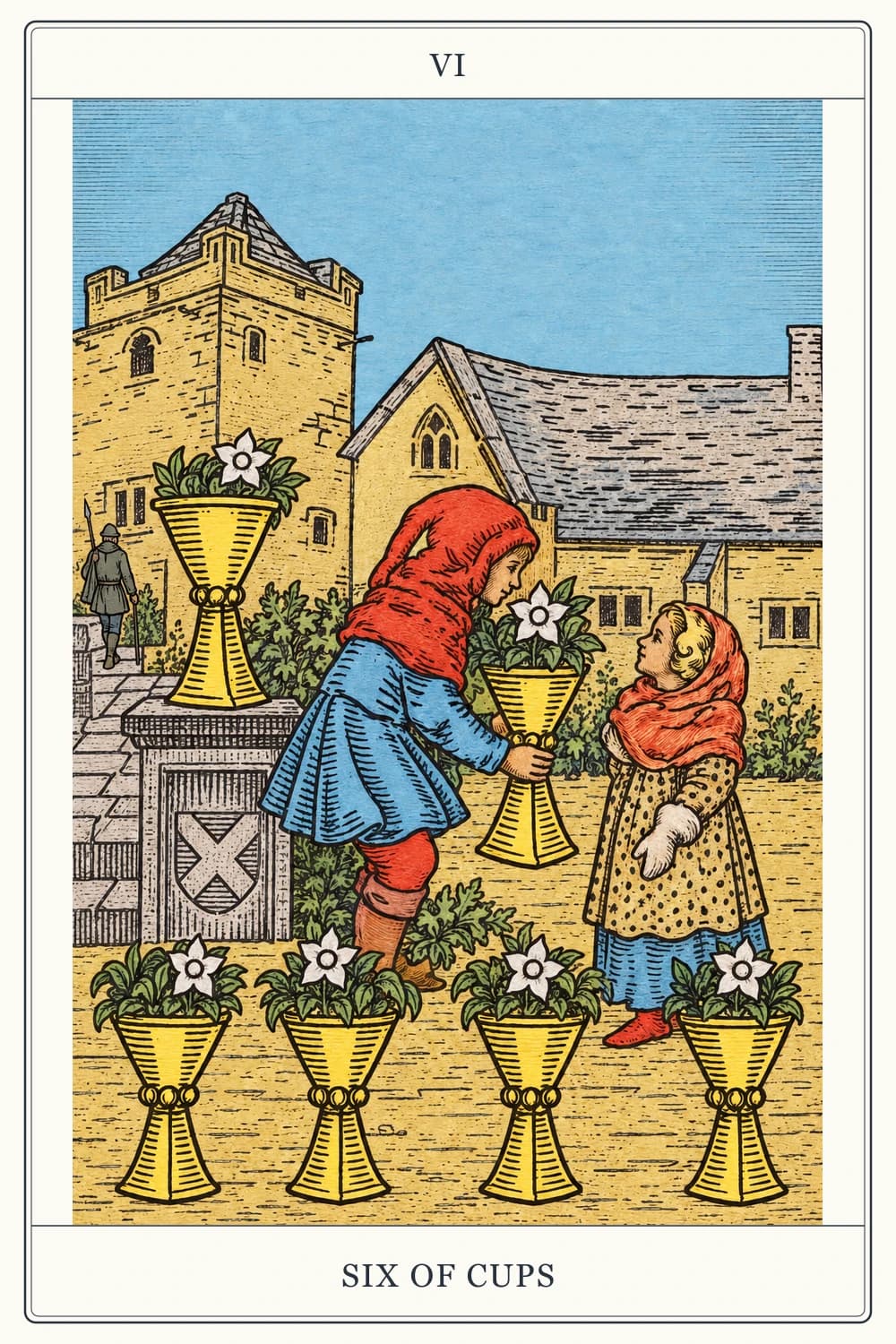
Illustrative card · Past
Six of Cups — read the card meaningA child offers another child a flower-filled cup, with more cups in the courtyard. Joan Bunning’s reference connects Six of Cups with goodwill and simple kindness; Orara’s upright entry also names memory. In Past: “The useful part of last year’s exchange was helping newcomers understand how to join.”
That reading uses your dated note about welcoming visitors and explaining the table. The card does not recover a forgotten event or establish how everyone felt. Keep the welcoming action as a possibility for this event, while checking its different staffing and room arrangements.
2 · Present — Two of Pentacles
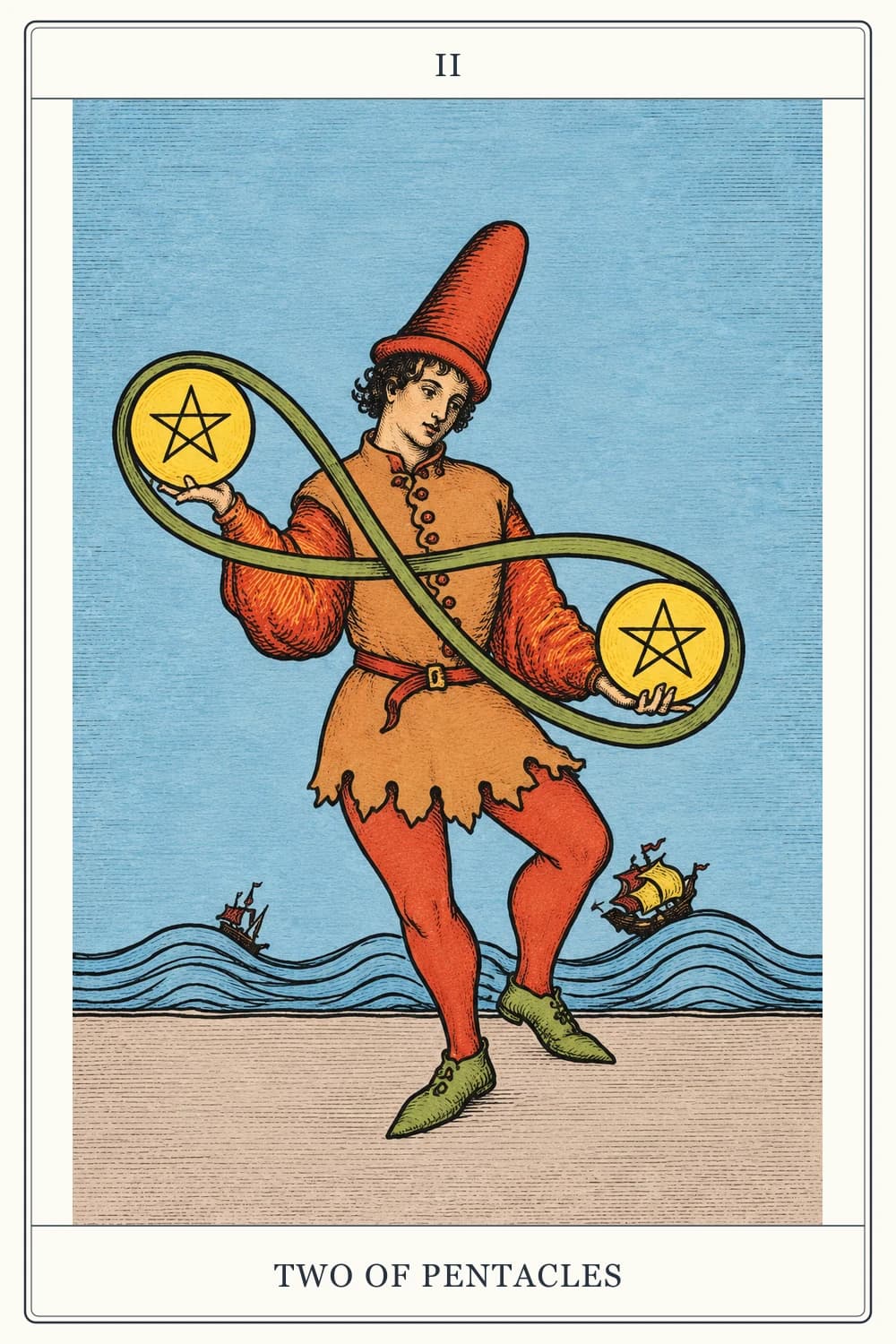
Illustrative card · Present
Two of Pentacles — read the card meaningA figure holds two star-marked discs, called pentacles, inside a looping ribbon; ships ride waves behind them. Juggling demands and flexibility are themes in Bunning’s reference. In Present: “I am coordinating a confirmed booking and helper alongside a draft that still has unassigned work.”
The room and helper’s hours are facts. A recommendation wall and reading corner are still your optional ideas. This position describes the present mix; it does not establish that you can fit every idea simply by becoming more flexible.
3 · Future — Wheel of Fortune
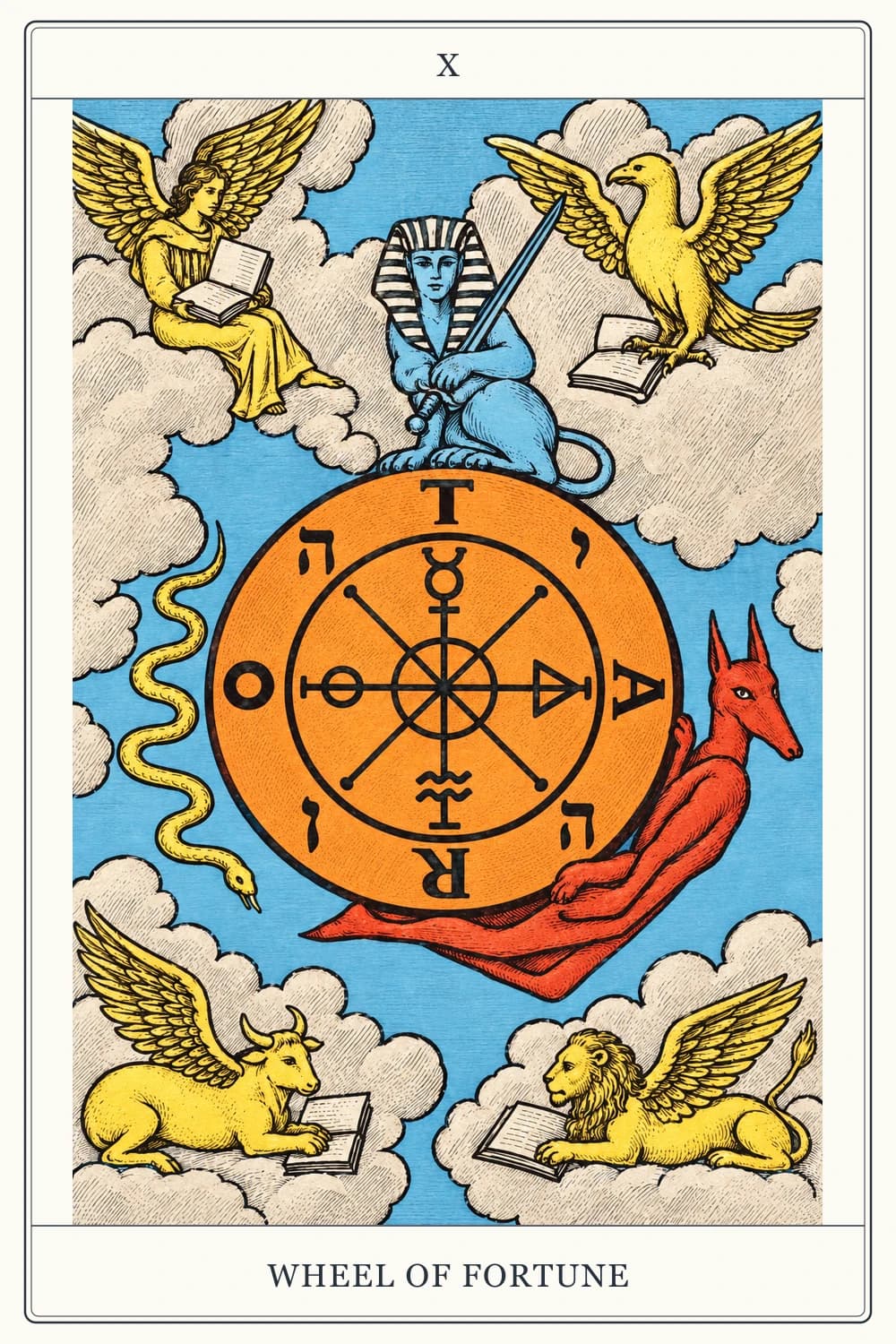
Illustrative card · Future
Wheel of Fortune — read the card meaningA large wheel sits among creatures, with four winged figures reading books in the corners. Movement and changing circumstances appear in Bunning’s reference; Orara’s upright meaning also asks what can adapt. In Future: “While activities and responsibilities remain open, a reply about capacity could require another version of the plan.”
The condition is the unfinished planning, not a forecast that the helper will cancel. A reply might instead confirm the draft. Keep either possibility open until you ask. This card describes a possible near development under current conditions; it does not choose your response or provide a date.
4 · Your approach — The Chariot
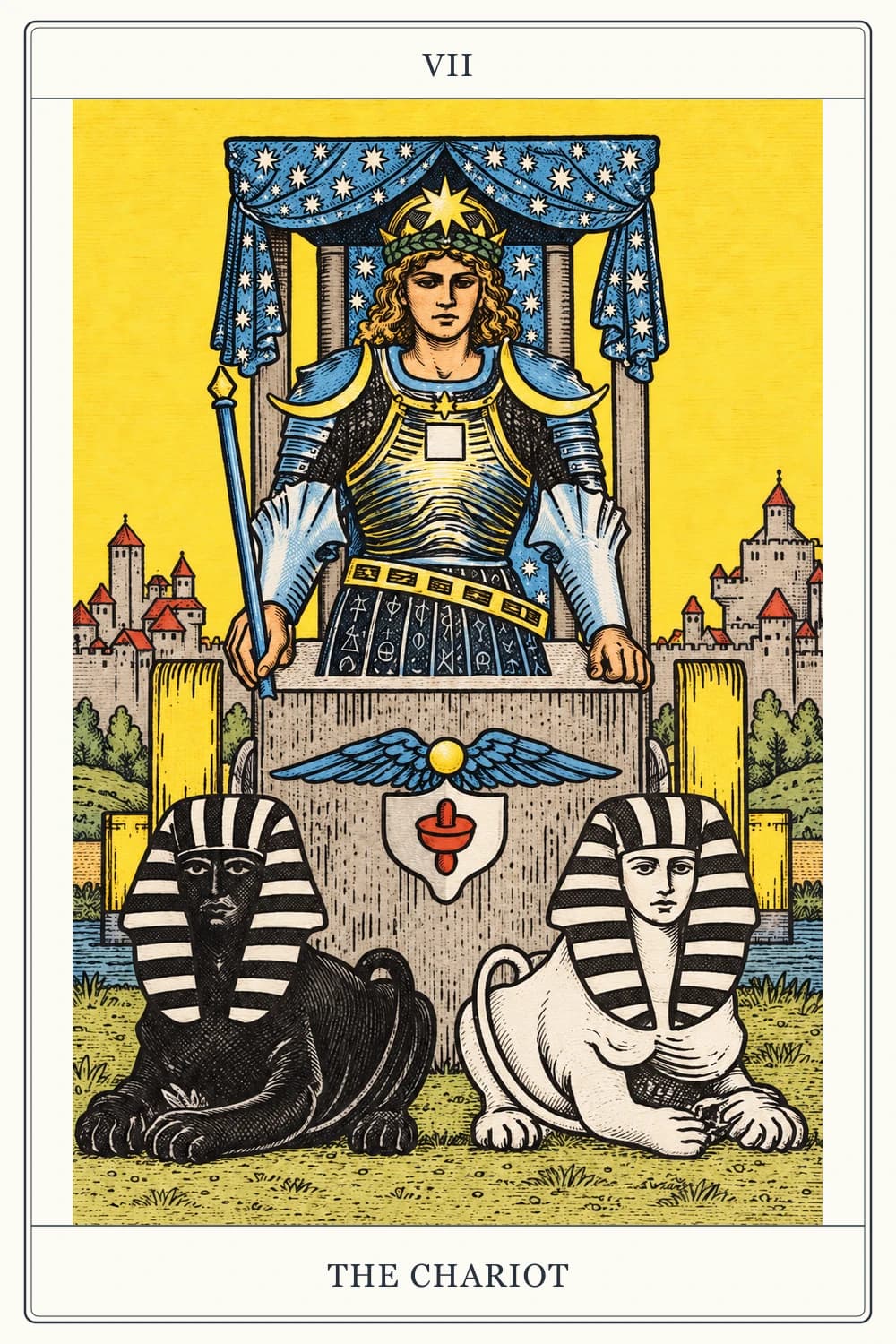
Illustrative card · Your approach
The Chariot — read the card meaningAn armoured driver sits above a black sphinx and a white sphinx. Bunning’s reference includes determination and focused intent; Orara’s entry connects a clear goal with managing different demands. In Your approach: “I want to lead this toward a welcoming exchange, but my draft gives attention to several activities.”
Use the stated goal to choose what deserves that effort. You can bring a focused proposal to the helper instead of treating every idea as essential. The reading examines a choice in this plan; it does not establish that you are controlling by nature or that determination guarantees the event.
5 · Surroundings — Three of Pentacles
Illustrative card · Surroundings
Three of Pentacles — read the card meaningA craftsperson stands on a bench while two people examine the work and a drawing. Teamwork and planning are associations in Bunning’s reference; Orara’s upright entry also stresses clear roles. In Surroundings: “There is an opportunity to agree the work with the helper and use the venue’s stated conditions.”
The booking and the helper’s 14:00–16:00 availability are confirmed. Their tasks are not. Ask what they can take on before allocating extra work to them. Surroundings concerns observable support and limits, not a claim that the helper secretly approves or dislikes your ideas.
6 · Obstacle — Ten of Wands
Illustrative card · Obstacle
Ten of Wands — read the card meaningA figure bends forward under a bundle of wooden wands while walking toward buildings. Burden and overextending are themes in Bunning’s reference. In Obstacle: “The optional activities add preparation and hosting work before the essential jobs have owners.”
This is the practical difficulty in the draft, rather than another description of everything currently present. Removing an unannounced extra can reduce that load; removing required setup or closing would break the venue’s conditions. The card does not prove that the helper is unwilling or that the event must fail.
7 · Possible direction — Justice
Illustrative card · Possible direction
Justice — read the card meaningA crowned figure sits between pillars with scales and an upright sword. Bunning’s reference discusses fairness, responsibility and weighing a decision. In Possible direction: “If we narrow the scope and agree who does the required work, we could proceed with a clearer shared plan.”
This connects the welcoming purpose in Past, the unfinished Present and possible revisions in Future with your choice of focus, confirmed support and the extra load. Make the venue’s three-book limit and responsibility for unclaimed books clear to visitors. The direction remains conditional on the work being agreed and completed; Justice does not certify that the event will feel fair to everyone.
Join the seven roles, agree a smaller plan and review it
The first three cards connect a remembered welcoming action with an unfinished, expanding plan: the form may change when responsibilities are discussed. Cards 4–5 connect your aim with actual help: focus the proposal and ask what the helper can undertake. Cards 6–7 connect the unassigned extra load with a conditional direction: a smaller scope and explicit responsibilities could make the event more manageable.
A complete reading could say: “I want to carry last year’s welcome into a plan that still needs coordination and may change after a reply. I can use my organising effort and the confirmed helper’s time to agree the essential work, leave unassigned extras out and test whether that clearer arrangement works.” All seven roles contribute; the final card alone does not say the exchange will succeed.
An alternative is to keep one extra after its work and owner are confirmed. That could fit a plan with available capacity, but none has been established for either extra here. Leaving both out of the current proposal protects the stated purpose without withdrawing anything already promised. Do not confuse that choice with proof that optional activities are always a mistake.
Initial note, 20 October: “Question: What could help me approach the book exchange I am organizing? Selected upright cards: Past / Six of Cups — retain a welcoming action; Present / Two of Pentacles — coordinate confirmed arrangements and draft extras; Future / Wheel of Fortune — the plan could change when capacity is clarified; Your approach / The Chariot — focus on the exchange’s purpose; Surroundings / Three of Pentacles — agree work with the confirmed helper; Obstacle / Ten of Wands — extra jobs have no owners; Possible direction / Justice — a smaller, explicit agreement, if the required work is covered. Response: propose the core exchange tomorrow and review the agreement, then the event.”
In the illustrative conversation on 21 October, the helper agrees to prepare the table with you, welcome visitors during the exchange and clear the room with you afterwards. They cannot prepare or host either extra activity as well. You agree to manage the exchange table and explain the book rules. You remove both extras from the draft and write the joining instructions using the venue’s existing rules. Both organisers confirm the plan and their full 14:00–16:00 attendance.
A later note, 25 October, could read: “Both organisers were present for the agreed period on 24 October. We ran the core exchange and cleared the room by 15:55. I explained the unclaimed-book rule twice even though it was written at the entrance. The smaller plan had clear owners and fitted this booking. Next time I would make that rule visible at the exchange table too. This does not establish how the plan would work with different attendance or less help.”
The reply and event supplied new evidence; Wheel of Fortune did not predict that particular reply. Review Possible direction against the whole record: some responsibilities were clarified, the booking was met and one instruction still needed reinforcement. Keep those separate observations rather than reducing the result to “Justice was right.”
Optional practice
Keep all seven cards, the 14:00–16:00 booking and the venue’s requirement for two organisers throughout. Change the helper’s availability to 14:00–14:30 only. No other helper is available, the venue cannot waive the requirement or extend the booking, and you cannot cover both organiser places alone. Does dropping the extras make this exchange ready to run? What response and Possible direction fit now?
See one possible answer
Dropping the extras reduces work but does not supply the required second organiser after 14:30. Record the current arrangement as unworkable and contact the venue about whether another date or arrangement is possible; leave that enquiry pending until confirmed. Update Surroundings and its connection with Your approach, then revise Obstacle and Possible direction. Justice can prompt an honest agreement about the unmet requirement, not permission to bypass it. Do not invent another helper, a waiver or an extended booking, and do not claim the exchange can proceed under the stated conditions.
Keep all seven roles beside the agreement and later result
Keep the original reading and append the planning reply and event review with their own dates. Opening Horseshoe setup does not preload the example’s cards or save this worksheet. A notebook or document lets you retain the order and revise a condition without rewriting what you first thought.
Distinguish a proposal, a confirmed agreement and an observed result. If a requirement remains unmet, record it even when several cards suggest useful themes. Use the compact record first; the detailed worksheet gives each role and connection more space.
A quick journal note
Date / question / known history, current facts and requirements:
Past / Present / Future — cards and interpretations:
Your approach / Surroundings — cards and interpretations:
Obstacle / Possible direction — cards and interpretations:
Connection across all seven / alternative / chosen response:
Review dates: actual reply, agreement and later observation:
Conditions that changed / what remains unresolved:
Detailed journal worksheet
Horseshoe reading worksheet
Date and one situation question:
Known earlier events and the source of that knowledge:
Current facts, requirements and unknowns:
1 · Past — card, orientation, image detail and interpretation:
2 · Present — card, orientation, image detail and interpretation:
3 · Future — card, orientation, image detail and conditional development:
4 · Your approach — card, orientation, image detail and interpretation:
5 · Surroundings — card, orientation, image detail and observable support or limit:
6 · Obstacle — card, orientation, image detail and supported difficulty:
7 · Possible direction — card, orientation, image detail and conditions:
Connection across 1–3:
Connection across 4–5:
Connection across 6–7 and the earlier cards:
One sentence retaining all seven contributions:
Alternative interpretation and what would support it:
Chosen response within my influence:
What needs another person’s agreement or verification:
When to review the reply and any later event:
Later dates: what was said, agreed and actually happened:
What changed in the conditions or interpretation:
What remains unresolved:
Sources and further reading
External references for these reading methods. Orara created the examples on this page.
- Joan Bunning — Six of Cups: goodwill and simple kindness
- Joan Bunning — Two of Pentacles: juggling demands and flexibility
- Joan Bunning — Wheel of Fortune: movement and changing circumstances
- Joan Bunning — The Chariot: determination and focused intent
- Joan Bunning — Three of Pentacles: teamwork and planning
- Joan Bunning — Ten of Wands: burden and overextending
- Joan Bunning — Justice: fairness, responsibility and decisions