Decision tarot spread: compare two options with the same criteria
Use Decision to examine two named actions against your real limits and priorities. Follow a class-versus-workbook example through missing information, a fair comparison, a chosen trade-off and a later observation.
Start here
You have two named actions and want a reasoned comparison.
In the class-versus-workbook example, separate the sixty-minute limit from the preference for live conversation. Follow the organiser’s reply and shared criteria: what limitation would you accept with either choice?
Follow two options from missing facts to a chosen trade-offOrara editorial · Updated · Our approach
Decision at a glance
- Option A
- Option B
- What matters most
Use when: Two real paths you control and want to compare.
Choose another approach if: One option only, lottery luck, or a forecast the cards cannot verify.
Example questions
- Take the new role or stay where I am — what does each path ask of me?
- Move now or wait six months — what would each choice emphasize?
- Reach out or give them space — what does each path highlight?
On this page
Name two actions, your limits and your priorities
Write what Option A and Option B would involve before selecting cards. “Attend this weekly language class” and “use my workbook at home” give each card a definite path to examine. “Success or failure” does not name two actions you can take. Keep the assignments fixed throughout the reading.
List hard limits, any actual decision deadline and your priorities in order. A limit determines whether an action fits at all; a preference helps you choose between actions that fit. Mark unconfirmed details as questions to check before treating an option as available.
Use the third position to examine a criterion
A spread is a layout of cards, and each position gives its card a role. Decision uses Option A, Option B and What matters most. This guide uses them as prompts for reflection on a comparison. The third card invites you to consider what standard deserves attention, then test it against your stated priorities and the facts.
You can reconsider a priority, but write down why it changed. A card’s appealing theme does not make one path suitable, and an uncomfortable theme does not disqualify it. Apply the same question to both options. Leave a missing fact unknown until you can check it.
| Position | Job in the comparison |
|---|---|
| 1 · Option A | Explore one aspect of the first named action using its known conditions. |
| 2 · Option B | Explore one aspect of the second named action using its known conditions. |
| 3 · What matters most | Examine a criterion or priority and apply it consistently to both actions. |
Prepare three roles and a comparison record
You can follow the selected cards below without drawing. For your own attempt, keep a notebook or document, the facts about each action and a card reference available. Record your question, assignments, limits and priorities before selecting cards.
This example uses upright cards, with the pictures the normal way up. A reversed card is upside down and can use another reference meaning. With a physical deck, choose the upright-only method before shuffling, take three cards without looking and place them upright left to right as Option A, Option B and What matters most.
In Orara, Start Decision opens setup. Check the selected layout, enter a question naming both actions, clear Include reversed cards, then select Draw 3 cards. For each card, describe an image detail, read its upright meaning through its linked name or your deck’s guidebook, and connect one theme to the assigned role. Keep facts and interpretation distinct.
Example: a language class or a workbook at home
In this invented example, you are choosing one main language-study routine for four weeks beginning 19 October 2026. Option A is a free online class on four Wednesdays, 18:00–18:45. Option B is your existing workbook in two available twenty-minute weekend sessions each week. The workbook is ready and your computer and internet are available for the class.
You can attend the first, third and fourth classes, but a fixed commitment rules out the second Wednesday. Your limit is sixty minutes of language practice per week, including required preparation. Both complete routines together would take eighty-five minutes in an attending week, so combining them as described exceeds that limit.
Before reading, you rank live conversation first and weekly continuity second. No conversation partner is arranged for workbook study. The class advertises group practice, but you have not checked its format, absence policy or preparation requirements. Its place is held until Sunday, 18 October, at 20:00; those details need checking before the deadline.
Question: “What matters when I compare the four-week language class with workbook study at home?” These upright cards were chosen for teaching, rather than drawn for you. The later reply and outcome below are also illustrative.
| Position | Annotated card |
|---|---|
| 1 · Option A | Two of Swords in Option A |
| 2 · Option B | Ace of Wands in Option B |
| 3 · What matters most | Justice in What matters most |
1 · Option A — Two of Swords
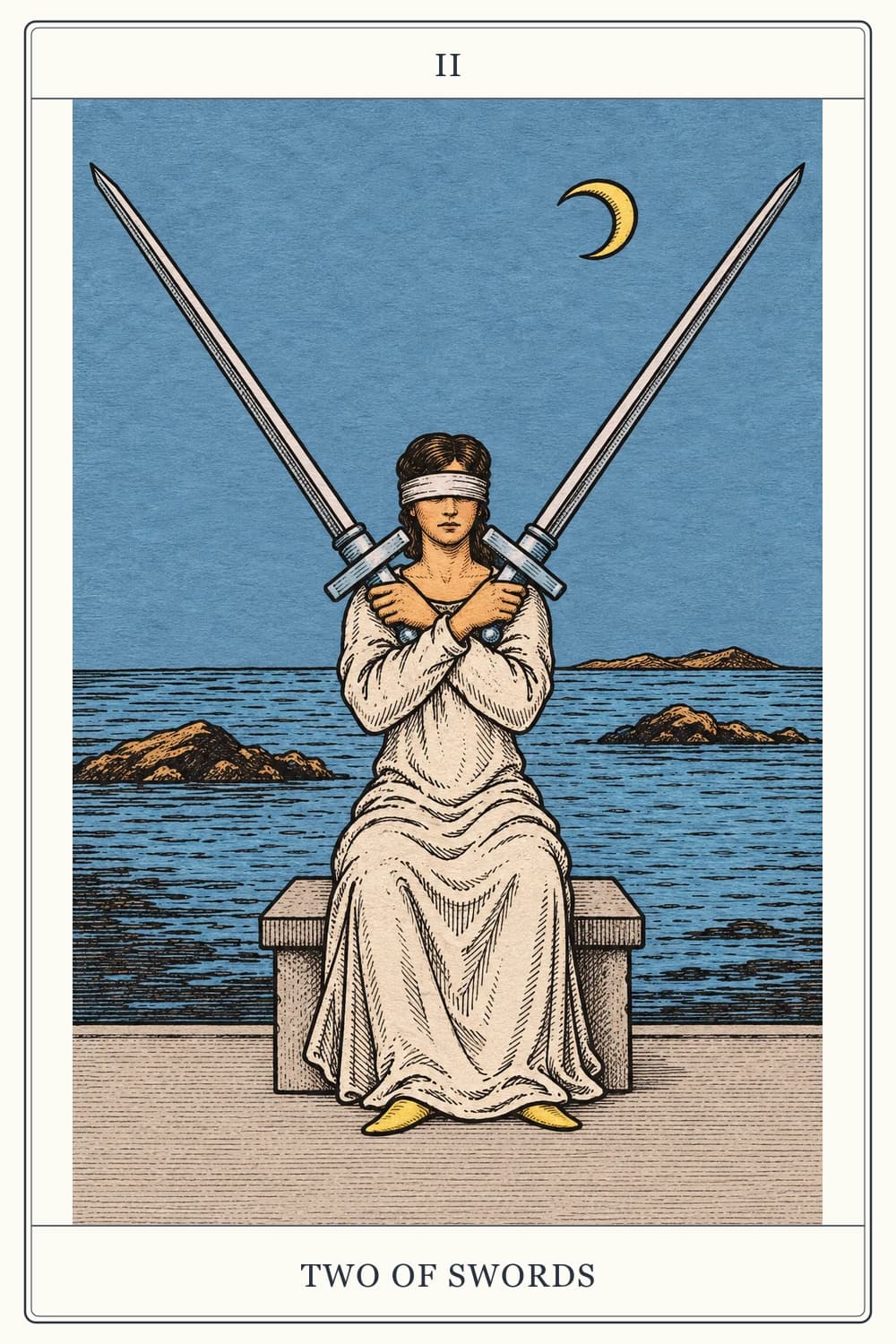
Illustrative card · Option A
Two of Swords — read the card meaningA blindfolded figure sits by water, holding two crossed swords. Joan Bunning’s reference includes stalemate; Orara’s upright entry also describes a difficult choice and information needed for comparison. In Option A: “I need to check whether this class can accommodate the absence I already know about.”
The scheduling conflict and unanswered policy question support that interpretation. Ask whether one missed class is permitted, what speaking practice is included and whether preparation would exceed your time limit. The card does not supply the reply or establish that the class is a bad choice. This position examines A; it does not rename the class “Obstacle.”
2 · Option B — Ace of Wands
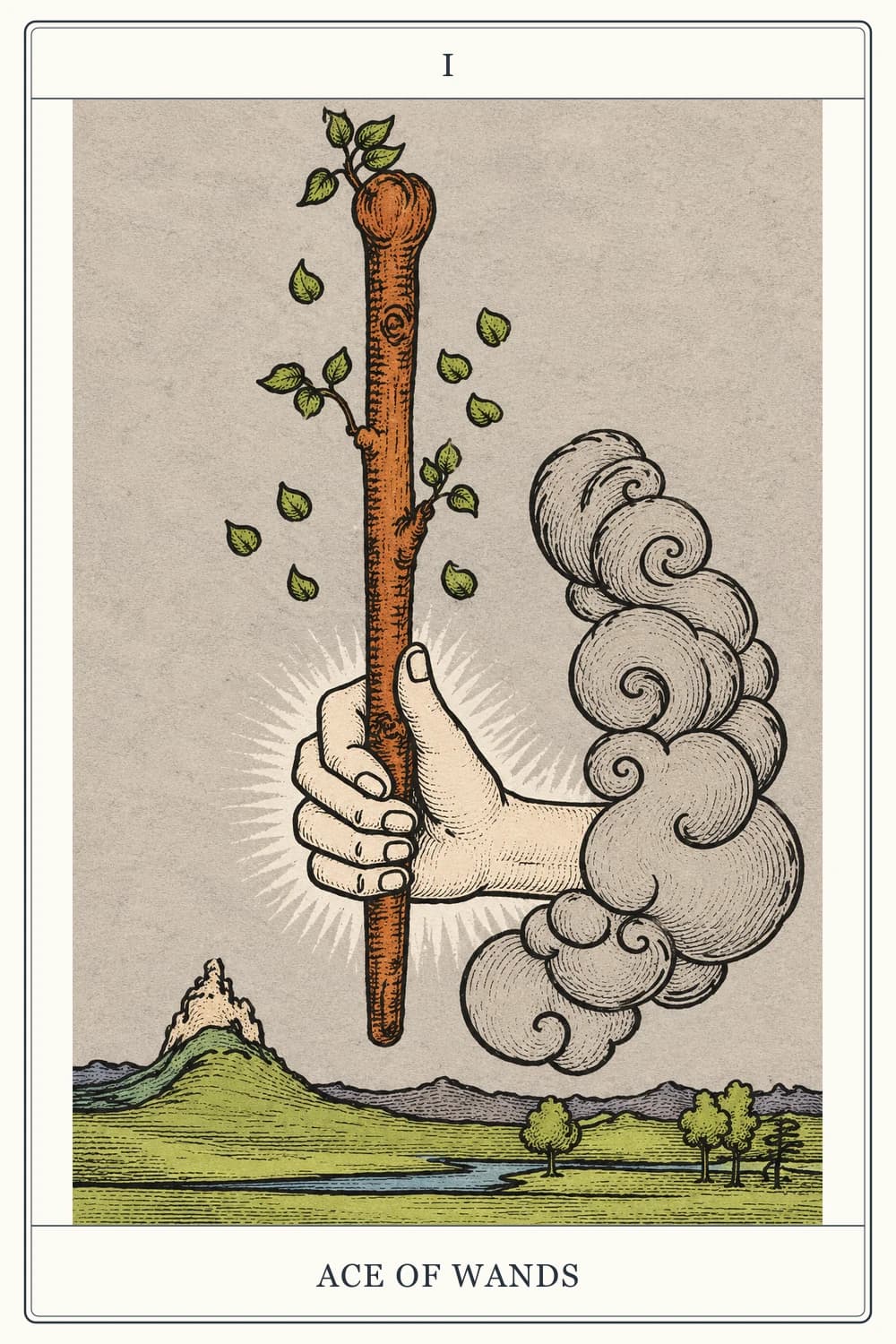
Illustrative card · Option B
Ace of Wands — read the card meaningA hand emerging from a cloud holds a wooden wand with fresh leaves. Enthusiasm and creative possibility are associations in Bunning’s reference; Orara’s upright entry suggests exploring interest through a first attempt. In Option B: “I could begin with the workbook I already have in the weekend time available.”
The workbook and two slots make that action available. The card’s lively theme does not establish that motivation will last or that exercises alone provide live conversation. Reading aloud could be part of independent study, but it would not create the missing partner. Keep that limitation beside the appeal of choosing your own pace.
3 · What matters most — Justice
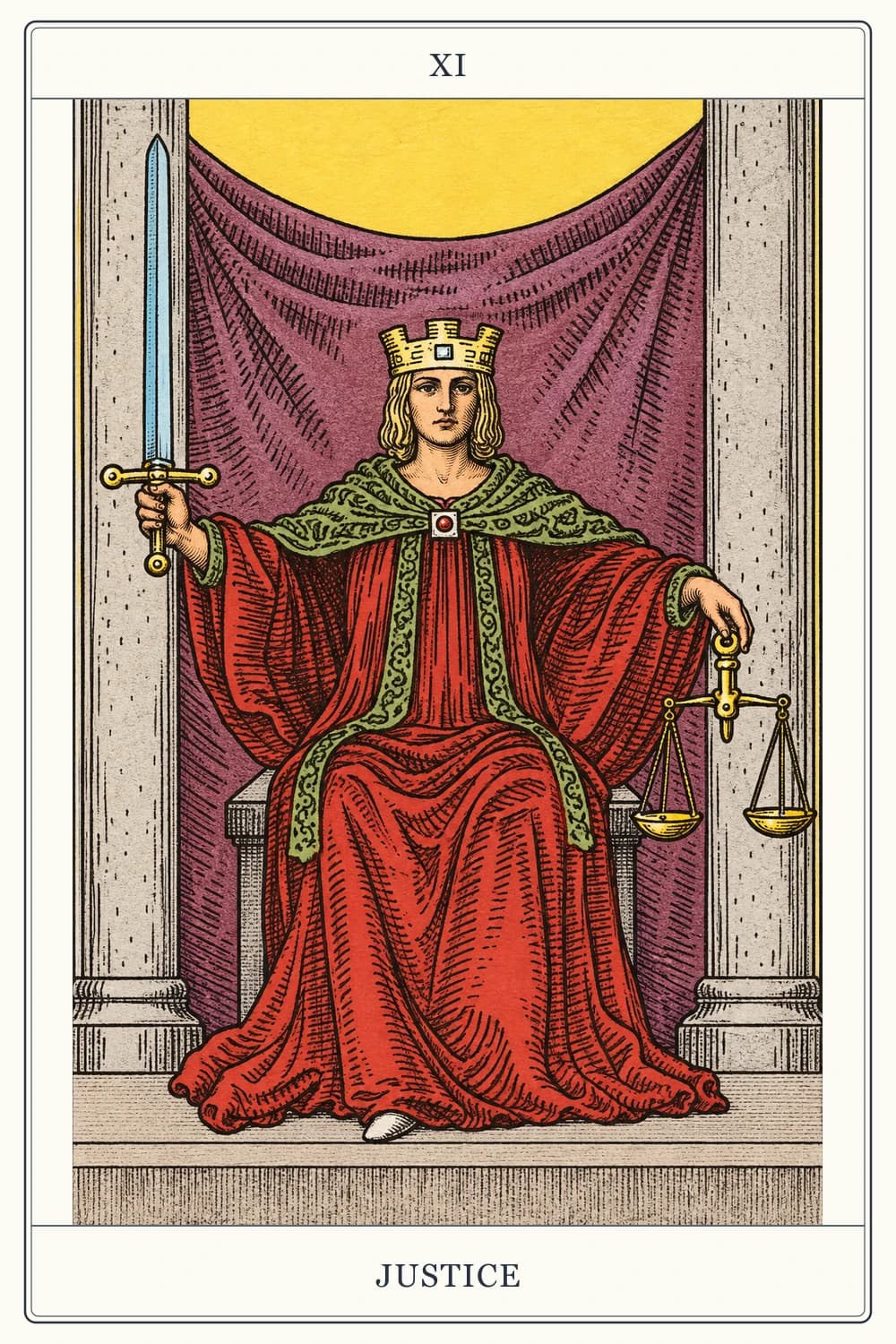
Illustrative card · What matters most
Justice — read the card meaningA crowned figure holds scales and an upright sword between two pillars. Bunning’s reference associates Justice with fairness, responsibility and weighing a decision; Orara’s entry also emphasises facts and consequences. In What matters most, a useful standard is: “Compare the kind of practice each route provides, within the same time limit.”
Your priority of live conversation was written before the reading. Justice can prompt a fair examination of it: are you comparing actual opportunities, or an attractive promise for A against a known limitation for B? Check the class details and name what the workbook lacks. The scales do not rank the cards or declare either action morally better.
Check the reply, then apply the same criteria to both
In this example, the organiser replies before the Sunday deadline: one absence is allowed, the class includes live pair conversations, and no preparation is required. There is no replacement conversation session for the missed week. These supplied facts make A a possible three-session choice within your time limit; they do not come from Justice.
The table compares opportunities and plans, rather than predicted results. Ask each question of both routes. Two of Swords and Ace of Wands draw attention to different aspects, but both options still need the same practical check.
| Criterion | A · Online class | B · Workbook at home |
|---|---|---|
| Weekly time (limit: 60 minutes) | 45 minutes; no preparation required. | 2 × 20 minutes: 40 total. |
| Continuity over 4 weeks | 3 of 4 classes; second week missed. | 2 sessions planned each week. |
| Live conversation (first priority) | Pair practice confirmed. | No partner arranged. |
| Control over timing | Fixed Wednesday slot. | Two weekend slots; self-paced work. |
Choose a trade-off and record what you later experience
A connected reading could say: “The class permits the absence I need; the workbook offers an available start but no conversation partner. A fair comparison gives the confirmed speaking opportunity more weight because that is my first priority.” A reasonable choice is A: accept the fixed timing and missed second week for live practice in the other three.
You could choose B if weekly continuity or control over pace mattered more to you. State that priority change rather than saying the Ace defeated the Two. The same facts can support a different choice when the person’s priorities differ. Neither choice guarantees learning progress.
Initial note, 18 October 2026: “Question: What matters when I compare the four-week language class with workbook study at home? A: class; B: two twenty-minute workbook sessions weekly. Selected upright example: Two of Swords / A; Ace of Wands / B; Justice / What matters most. Limit: sixty minutes weekly. Priority: live conversation, then continuity. Organiser confirmed one absence allowed, pair conversations and no preparation; no replacement session. Choice: class, accepting a missed second week. Review after the first class: what speaking practice did I actually do, and did the time fit?”
An illustrative later note, 21 October: “I attended the forty-five-minute class and took part in two short pair exchanges. Finding words was difficult, but I did have live practice. The first session fitted the time limit. I still cannot attend the second Wednesday. I have not assessed progress over four weeks or tried the workbook routine.”
This observation concerns the chosen route and one session. It cannot establish how the untried route would have felt or prove that the class will remain useful. Keep the original comparison so you can revise it when experience or conditions change.
Optional practice
Use a different reply before choosing: attendance at all four classes is compulsory, and no exception or replacement session is offered. Your fixed second-Wednesday commitment, sixty-minute limit and Sunday deadline remain. Keep the same cards. What changes in the available actions, and what stays unresolved?
See one possible answer
A as described is unavailable because you cannot meet its attendance condition. Justice does not override the commitment or supply an exception. B remains an available study routine, but it still has no conversation partner. You could choose B while recording that the live-conversation priority remains unmet, or decline the class and leave the study choice unresolved. Do not invent another class, move the fixed commitment or call the two unchanged paths equally available. If you later compare different actions, name them explicitly before another reading.
Keep your reasons beside the later result
Use a notebook or document for the comparison and a dated update. Opening Decision setup does not save this worksheet or preload the teaching cards. Keep the difference between a hard limit, a priority, a checked fact and an interpretation visible.
You do not need an invented numerical score for the cards. A useful decision note names the action you choose, the evidence and priority behind it, the limitation you accept and what you will review. An unanswered question can also be the next step when the information is not yet available.
A quick journal note
Date / decision deadline:
Option A / Option B:
Hard limits / priorities in order / unknown facts:
Cards in Option A / Option B / What matters most:
The same criteria applied to both actions:
Choice or next check / trade-off / review point:
Later: what I experienced and what remains untested:
Detailed journal worksheet
Decision spread comparison worksheet
Date / decision and actual deadline:
Option A — the action as defined before drawing:
Option B — the action as defined before drawing:
Hard limits for either option:
Priorities before reading, in order:
Missing facts and where they can be checked:
Option A — card, orientation, image detail and interpretation:
Option B — card, orientation, image detail and interpretation:
What matters most — card, orientation, image detail and criterion to examine:
Same criteria and checked evidence for A and B:
How the three roles connect:
Another possible interpretation or priority order:
Choice or next check, with accepted limitations:
Any priority I changed and why:
When to review and what I will observe:
Later date: what I actually experienced:
What remains unknown about this route or the untried alternative:
Common questions
- Could I combine parts of both routines?
- Possibly. For example, attending the available classes and using the workbook in the missed week would be a third action to define and assess. The eighty-five-minute comparison rules out both complete routines in the same attending week, not every mixture. Write a mixed plan’s schedule and conditions explicitly; keep the original A and B assignments fixed while interpreting this reading.
- Do I need to draw again after receiving new information?
- You can add the reply to your record and compare the same named actions using the original cards. If a condition removes one action, acknowledge that change. A new draw cannot make it available; a later comparison of different actions needs new, explicit option names.
Sources and further reading
External references for these reading methods. Orara created the examples on this page.