Celtic Cross tarot spread: connect ten roles and check the result
Read one situation through ten distinct roles. Learn how the central challenge, earlier experience, stated aims and outside conditions connect, then use that reading for one practical check rather than a guaranteed outcome.
Start here
You can follow a smaller spread and want to compare a situation’s context, aims and outside limits.
In the workshop example, compare ninety available minutes with the draft’s 110-minute estimate. Follow how the ten roles shape one request, then check which possibility becomes real and which venue condition stays unresolved.
Follow ten roles through an offer, reply and revised planOrara editorial · Updated · Our approach
Celtic Cross at a glance
- Present
- Obstacle
- Past
- Future
- Your goal
- Foundation
- Your approach
- Surroundings
- Hopes & fears
- Possible direction
Use when: You want to sit with one complex situation and examine how its parts connect.
Choose another approach if: You want a quick answer, certainty about the future, or proof of someone else's feelings.
Example questions
- How can I understand this situation as a whole?
- What perspectives could help me approach this turning point?
- How do my hopes, circumstances, and choices connect here?
On this page
Choose one situation with several connected influences
Celtic Cross is a ten-card spread: a layout that gives each card a role, called a position. It suits a situation where the present difficulty, earlier experience, aims, assumptions and available support need comparing. Ten cards do not make a reading more certain.
Bring one question and write the facts you already know. The example concerns preparing a community workshop alongside work. A small spread is easier when you need only one perspective or a simple situation-and-obstacle comparison; use the related guide at the end to choose that route.
Use Orara’s order for the cross and the staff
The cross is positions 1–6: place 1 at the centre and 2 sideways across it; put 3 left, 4 right, 5 above and 6 below. The staff is the separate vertical row on the right: place 7 at the bottom, then 8, 9 and 10 upwards. Keep the numbers and role names together.
Published Celtic Cross conventions differ, especially for 3–6. Bunning’s linked method uses a different sequence. This article follows Orara throughout, with Past at 3, Future at 4, Your goal at 5 and Foundation at 6.
Future considers a possible near development under stated conditions. Possible direction connects the whole reading, including your choices and outside limits. Foundation examines a possible assumption; Hopes & fears considers reported feelings. Those roles do not establish hidden truths about you or another person.
| Position | Question for the role |
|---|---|
| 1 · Present | What describes the situation now? |
| 2 · Obstacle | What difficulty matters to the current aim? |
| 3 · Past | Which known earlier experience is relevant? |
| 4 · Future | What near development is possible under stated conditions? |
| 5 · Your goal | What aim have you actually named? |
| 6 · Foundation | Which stated habit or assumption is worth examining? |
| 7 · Your approach | What response is within your influence? |
| 8 · Surroundings | What help and conditions can be checked? |
| 9 · Hopes & fears | What reported hope and worry pull on the same aim? |
| 10 · Possible direction | What direction fits the whole reading and its conditions? |
Read the central pair, then compare context and response
Start with 1 + 2, Present and Obstacle: how does the difficulty affect what you can do with the situation? Then compare 3 + 4, Past and Future: what could carry forward, and what possible development still depends on a condition?
Compare 5 + 6, Your goal and Foundation: does a stated assumption help or hinder the aim? Move to 7 + 8, Your approach and Surroundings: how could your response meet the support or limits you can verify? Finally connect 9 with the whole picture and 10: which concern needs checking before treating a possible direction as workable?
These pairs are a way to organise attention, not five separate verdicts. After reading them, write one account that retains the central challenge and the conditions in the staff. If a link needs an unknown fact, leave that part open.
Prepare ten upright cards and keep crossing separate from reversal
You can follow the selected example without drawing. For your own attempt, use a notebook or document and a card reference. Record the question, known events, reported feelings, real constraints and unknowns before selecting cards.
All ten teaching cards use upright meanings, with their pictures normally the right way up. A reversed card is upside down and can use a different reference meaning. For a physical deck, choose upright-only before shuffling, take ten cards without looking and use the placement above. Rotate card 2 sideways to cross card 1 while retaining its upright interpretation.
In Orara, Start Celtic Cross opens setup. Check Celtic Cross, enter your question if useful, clear Include reversed cards, then use Draw 10 cards. For each card, describe a visible detail, consult its linked upright meaning or your deck’s guidebook, and explain how a theme answers that role using known facts. Connect the roles before choosing what to check or try.
Example: prepare a beginner workshop within real limits
In this invented example, you are planning on Monday, 19 October 2026. You previously attended a paper-booklet workshop. Your note says, “The host demonstrated one fold slowly and left space for questions.” You know that booklet method and have paper available. Your stated goal is a welcoming session where beginners can try one booklet and ask questions.
For project preparation after this reading, your checked calendar gives you 19:00–20:00 on Tuesday, 20 October, and 19:00–19:30 on Thursday, 22 October: ninety minutes. Your draft estimates twenty minutes for a basic sample, thirty for a second cover activity, thirty for instructions and thirty for venue enquiries and invitation copy. Those working estimates total 110 minutes, before any planning conversation.
You assigned every task to yourself and wrote, “Unless I handle every detail, people will be disappointed.” You report worrying that one activity will feel insufficient. No participants have been invited and nothing has been promised. You have a fixed no-extra-spending limit.
A friend has said they could help with some preparation and agreed to a ten-minute conversation at 19:00 on Tuesday. No preparation task, time contribution or payment is agreed. You would like a community room on Saturday, 24 October, from 14:00 to 15:30, but it is not booked and its availability and cost are unknown.
Question: “How can I approach organizing a small community workshop alongside my work?” These ten upright cards were selected for teaching. The conversation, preparation and later note below are also illustrative.
| Position | Annotated card |
|---|---|
| 1 · Present | Two of Pentacles in Present |
| 2 · Obstacle | Ten of Wands in Obstacle |
| 3 · Past | Six of Cups in Past |
| 4 · Future | Three of Pentacles in Future |
| 5 · Your goal | The Star in Your goal |
| 6 · Foundation | Four of Pentacles in Foundation |
| 7 · Your approach | Strength in Your approach |
| 8 · Surroundings | Six of Pentacles in Surroundings |
| 9 · Hopes & fears | Nine of Swords in Hopes & fears |
| 10 · Possible direction | Temperance in Possible direction |
1 · Present — Two of Pentacles
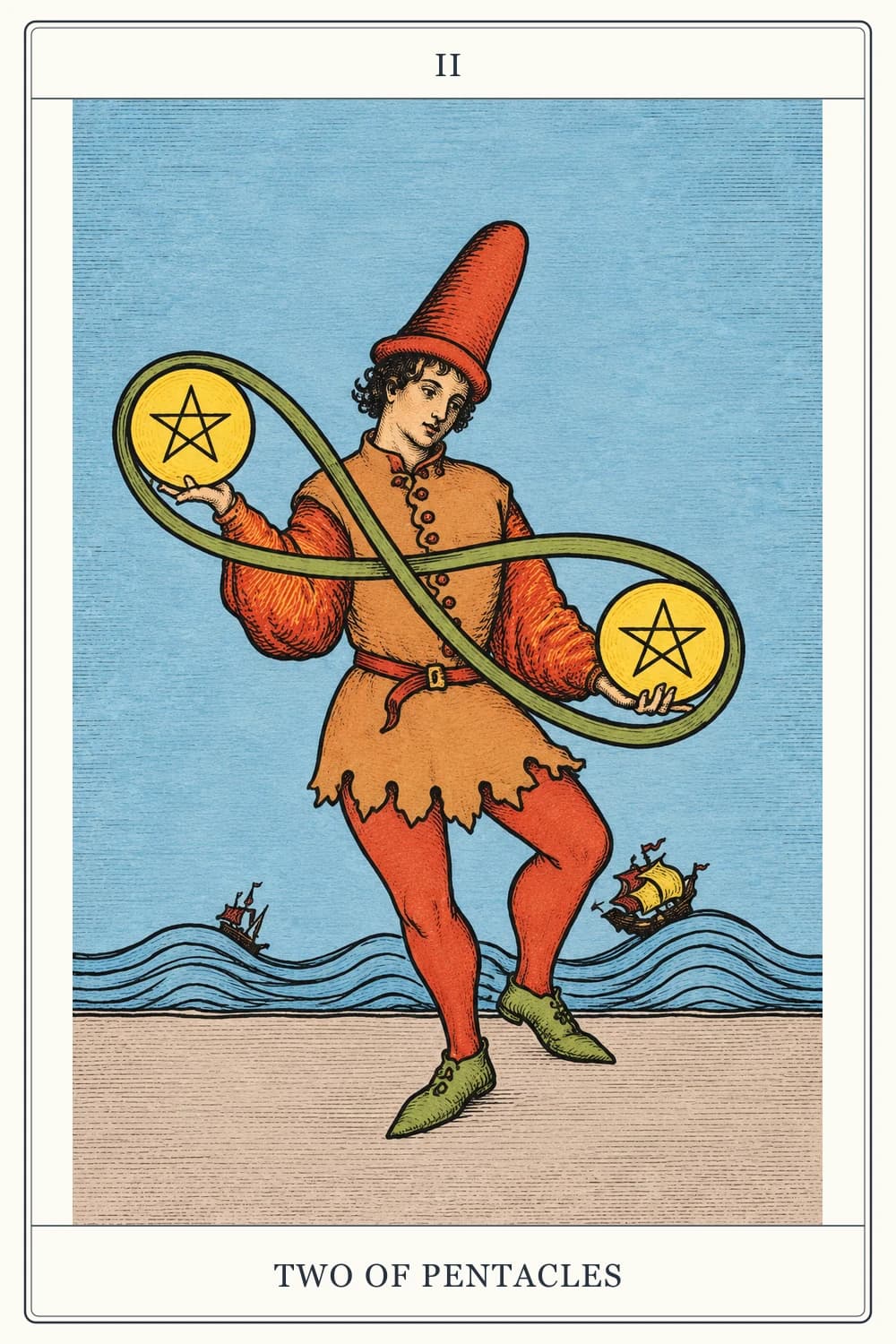
Illustrative card · Present
Two of Pentacles — read the card meaningA figure balances two star-marked discs inside a looping ribbon, with ships on waves behind them. The discs are called pentacles. Orara’s upright entry describes balancing changing demands. In Present: “The workshop is one project among my work commitments, with ninety minutes currently available for preparation.”
The timetable and unfinished draft supply that situation. The picture does not establish that every task will fit. Keep your available minutes beside the task estimates before interpreting flexibility as a solution.
2 · Obstacle — Ten of Wands
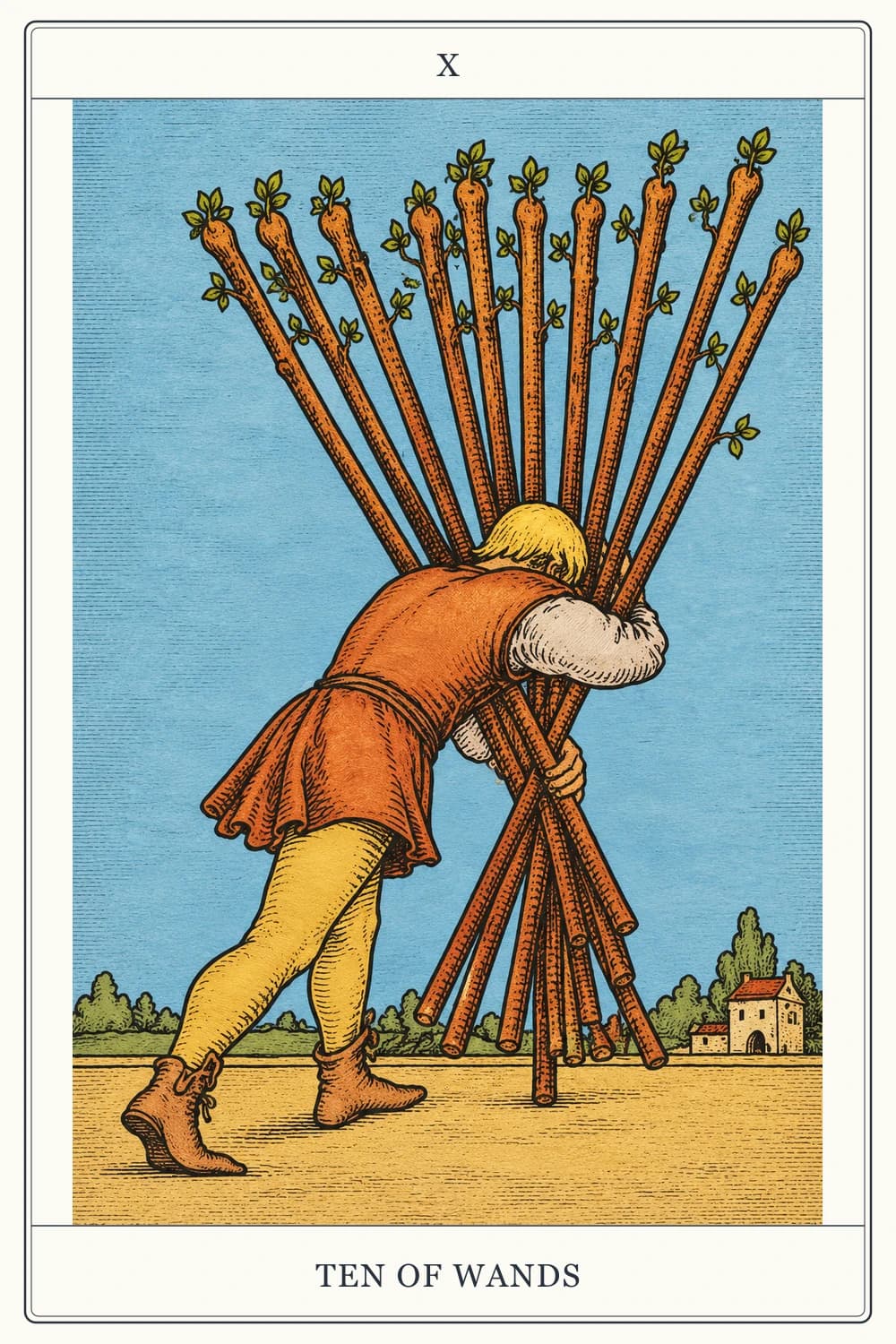
Illustrative card · Obstacle
Ten of Wands — read the card meaningA figure bends forward under a bundle of wooden wands while walking toward buildings. Orara’s reference connects the card with a workload that is hard to carry. In Obstacle: “My draft assigns me an estimated 110 minutes of preparation, before a planning conversation, against ninety available minutes.”
The mismatch belongs to this task list. You can examine scope and shared work without concluding that the event must fail or that someone else is to blame. In the physical layout this card crosses Present sideways; its assigned meaning in this example is still upright.
3 · Past — Six of Cups
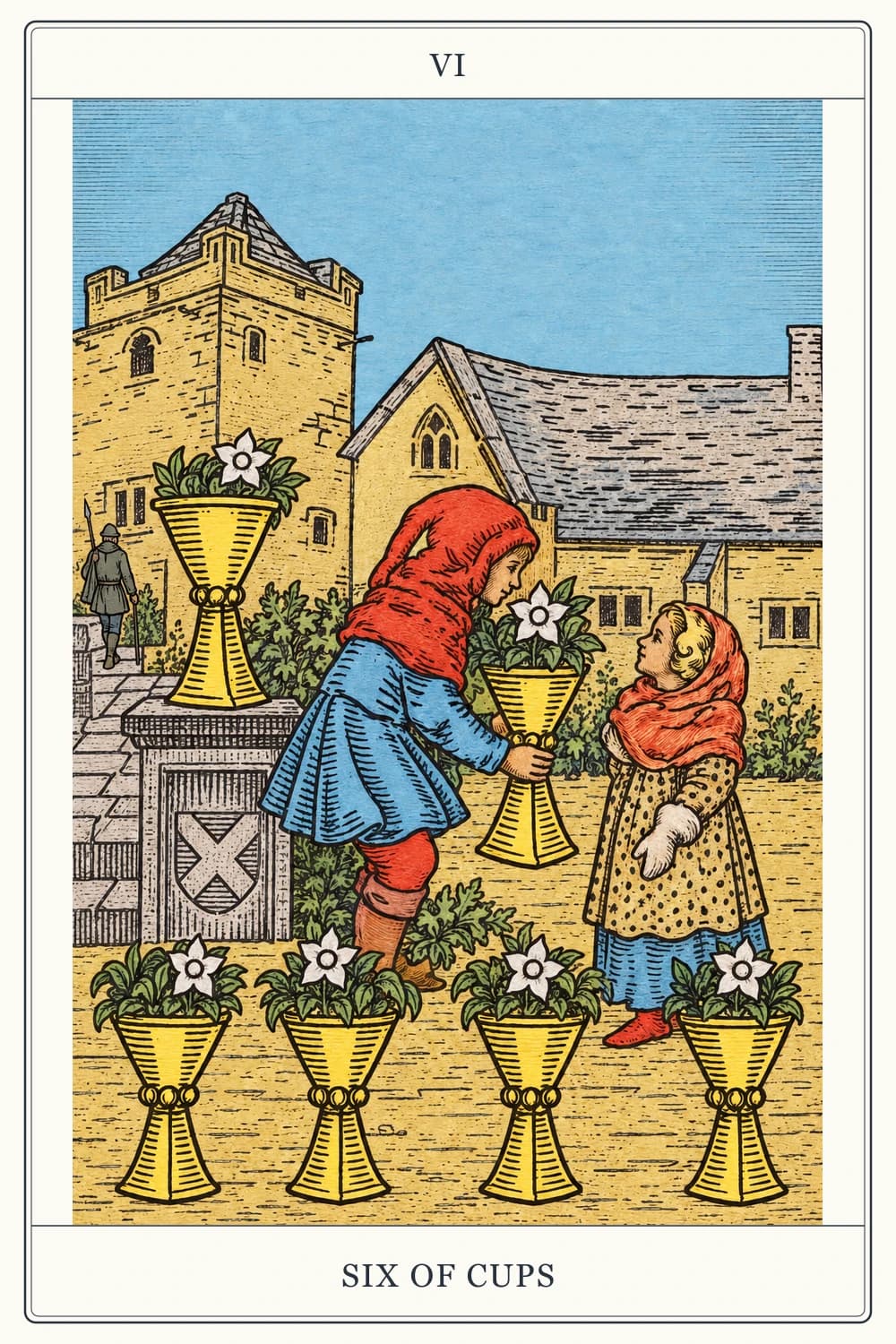
Illustrative card · Past
Six of Cups — read the card meaningA child offers another child a cup of flowers in a courtyard. Orara’s entry connects Six of Cups with memory and familiar kindness. In Past: “I want to retain the patient welcome I experienced at the earlier workshop.”
Your note records a host demonstrating one fold slowly and leaving space for questions. That is the memory being used; the card has not recovered it. It gives you a quality to preserve without requiring the earlier event’s entire programme.
4 · Future — Three of Pentacles
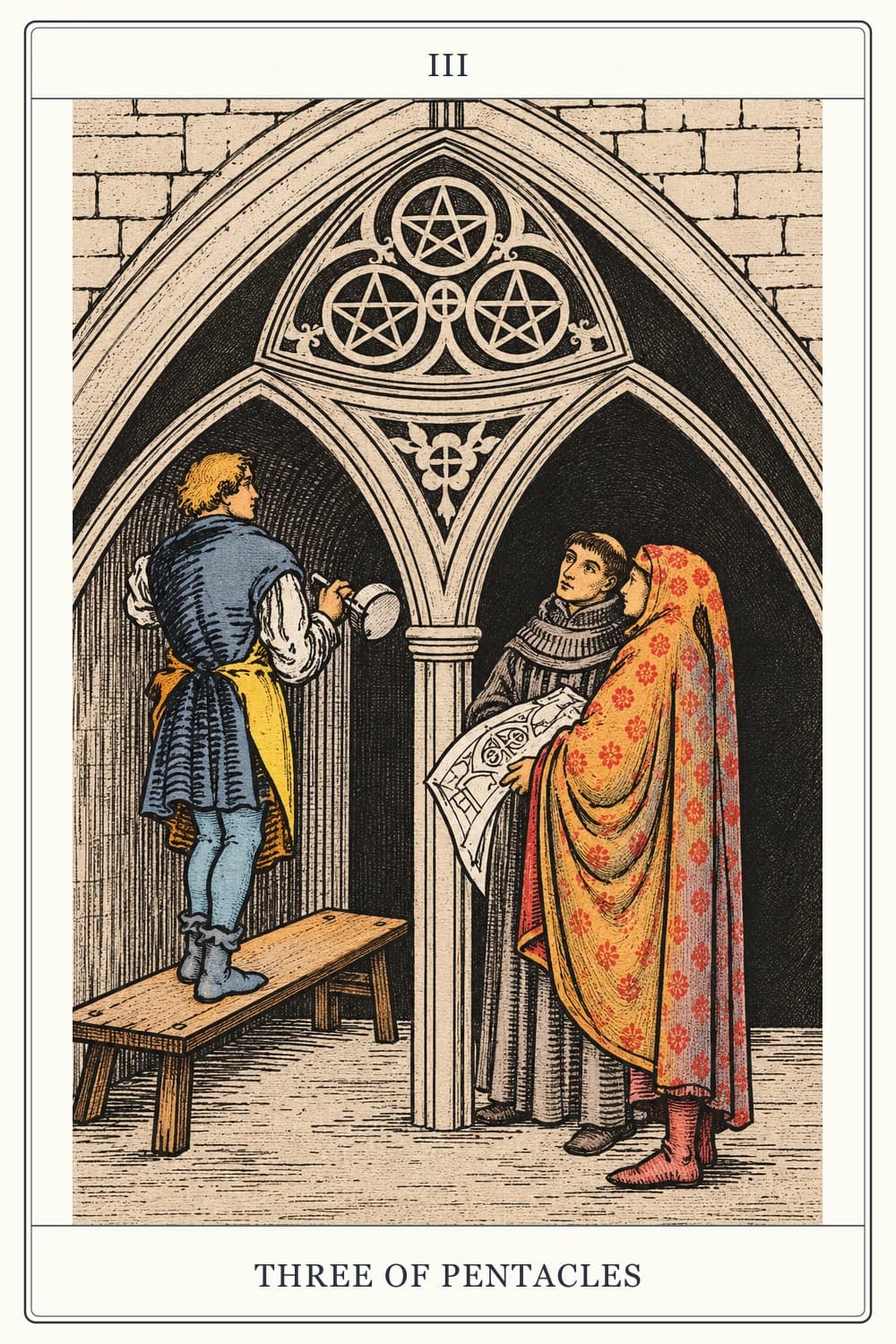
Illustrative card · Future
Three of Pentacles — read the card meaningA craftsperson stands on a bench while two people examine the work and a drawing. Orara’s upright meaning describes shared skills, feedback and clear roles. In Future: “If the offer becomes a specific agreement, preparation could move from my private list to a shared task.”
The friend has agreed to a conversation, not yet to a preparation job. They may offer less than you hope or be unable to take one on. This role considers a possible development; it does not promise collaboration, choose a task for them or confirm the venue.
5 · Your goal — The Star
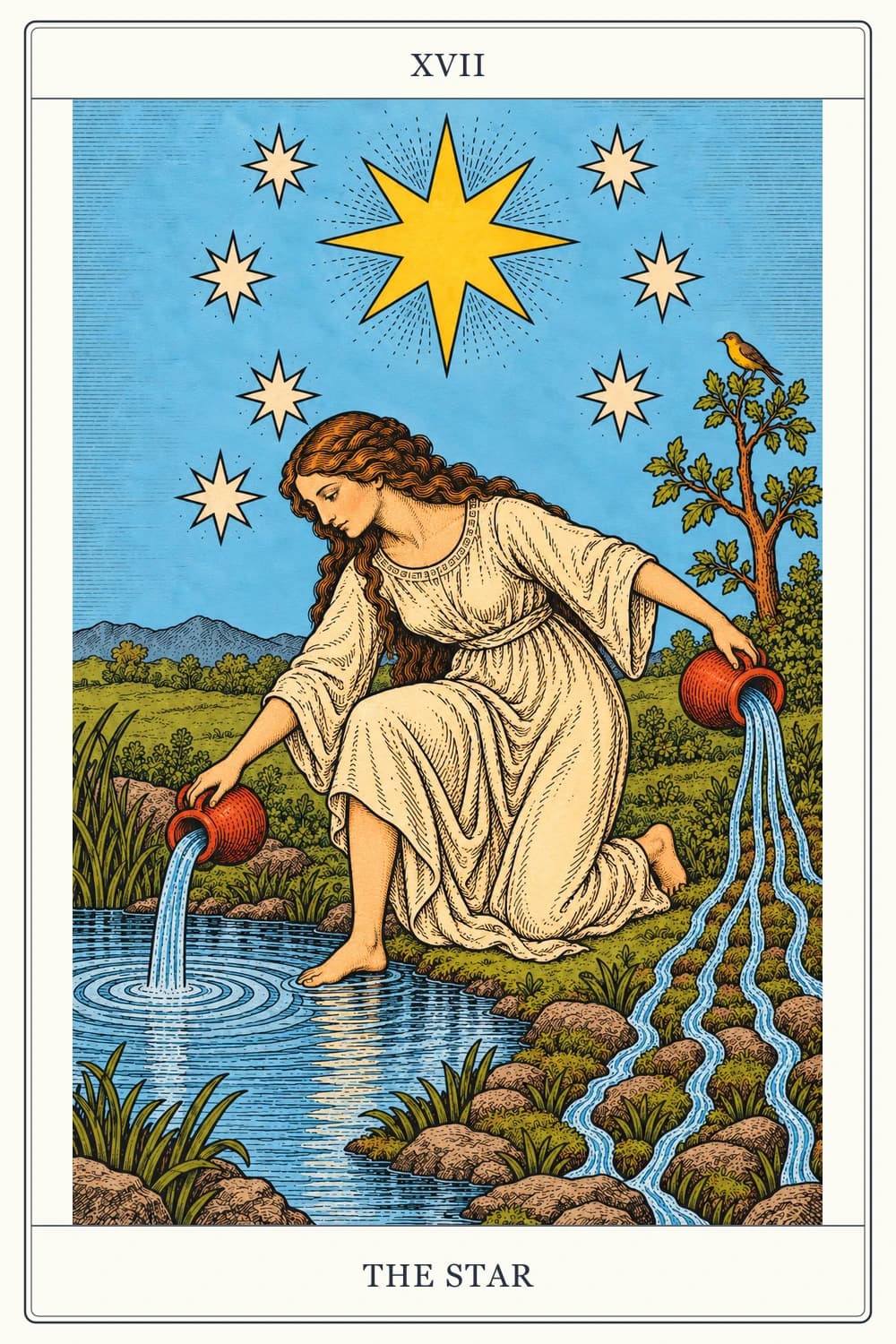
Illustrative card · Your goal
The Star — read the card meaningA person kneels beside a pool, pouring water from one jug into the pool and another onto the ground. Joan Bunning’s reference includes hope and generosity; Orara’s entry also names care. In Your goal: “I want beginners to feel welcome to try one paper booklet and ask questions.”
That aim was stated before the cards. A second activity is not automatically necessary to meet it. The Star can help you articulate what you hope to offer, but does not establish that participants will feel confident or enjoy the session.
6 · Foundation — Four of Pentacles
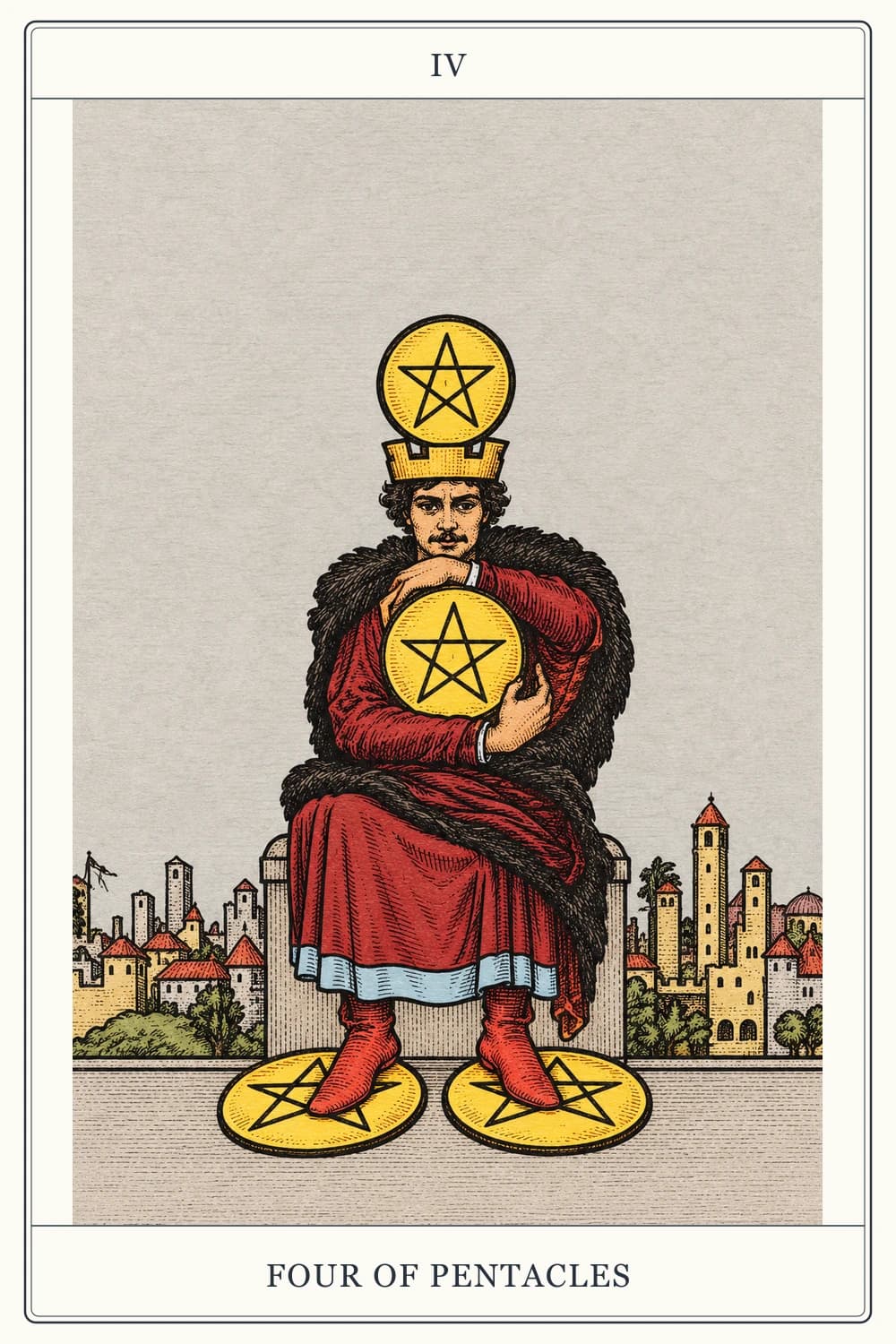
Illustrative card · Foundation
Four of Pentacles — read the card meaningA seated figure holds one pentacle against their chest, with another above their head and two under their feet. Bunning’s reference explores holding control and setting limits; Orara’s entry asks what a practical limit protects. In Foundation: “I have written that I must handle every detail to prevent disappointment. Does that rule require every task to remain mine?”
That is an examination of your recorded assumption, not a diagnosis or hidden biography. An alternative is that retaining a final cost check protects the real no-extra-spending limit. You can keep that check while sharing a sample-making task. The card alone cannot decide which motive explains your whole approach.
7 · Your approach — Strength
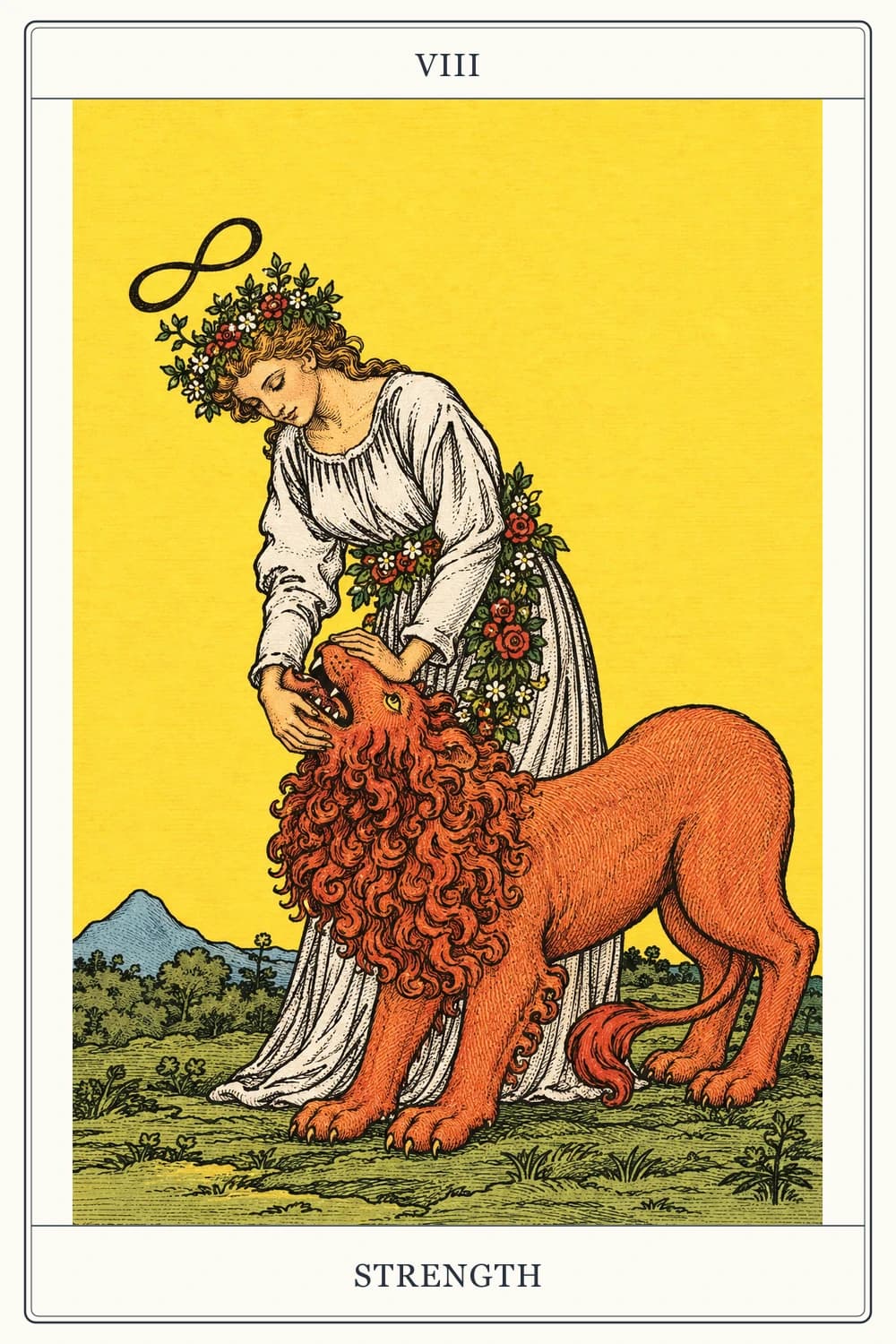
Illustrative card · Your approach
Strength — read the card meaningA woman rests her hands on a lion’s open mouth, with a loop-shaped symbol above her head. Patience and compassion are themes in Bunning’s reference; Orara’s entry describes a steady, considerate response. In Your approach: “State my available time and spending limit plainly, then ask what help the friend can offer.”
One opening is: “I have ninety preparation minutes and cannot add spending. Could you take one clearly defined task, and what time would you have?” Leave room for a smaller offer or no. Calm wording makes your request clearer; it does not require the friend to agree.
8 · Surroundings — Six of Pentacles
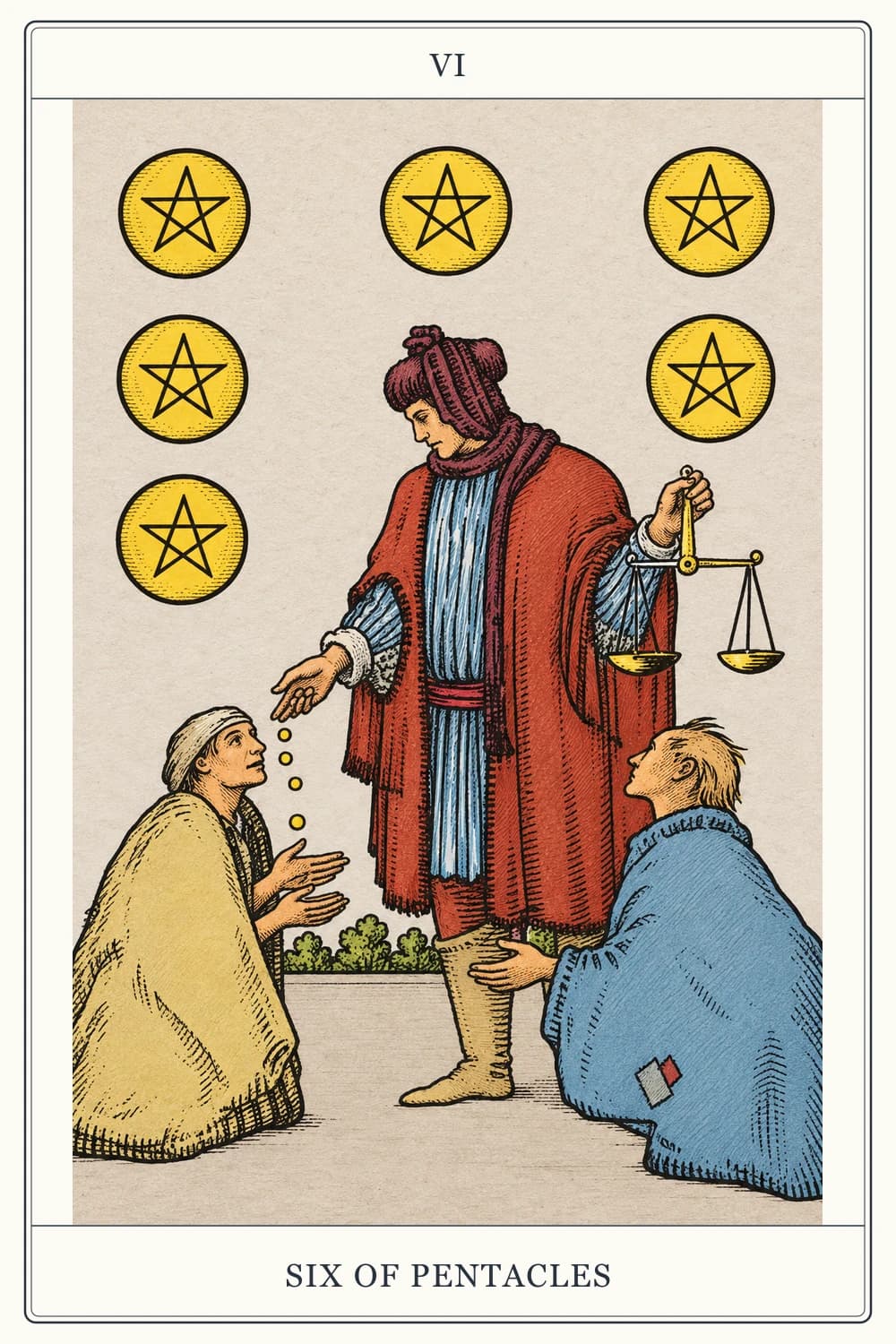
Illustrative card · Surroundings
Six of Pentacles — read the card meaningA standing figure holds scales and gives coins while two people kneel nearby. Orara’s upright entry considers giving, receiving and clear terms. In Surroundings: “There is an offer to clarify, alongside a room whose availability and cost remain unconfirmed.”
The known offer concerns some preparation help. No payment or booking has been offered. Ask about the friend’s task and time, and ask the venue about the room and any charge. This role concerns observable terms, not the friend’s private feelings or an imagined promise to fund the event.
9 · Hopes & fears — Nine of Swords
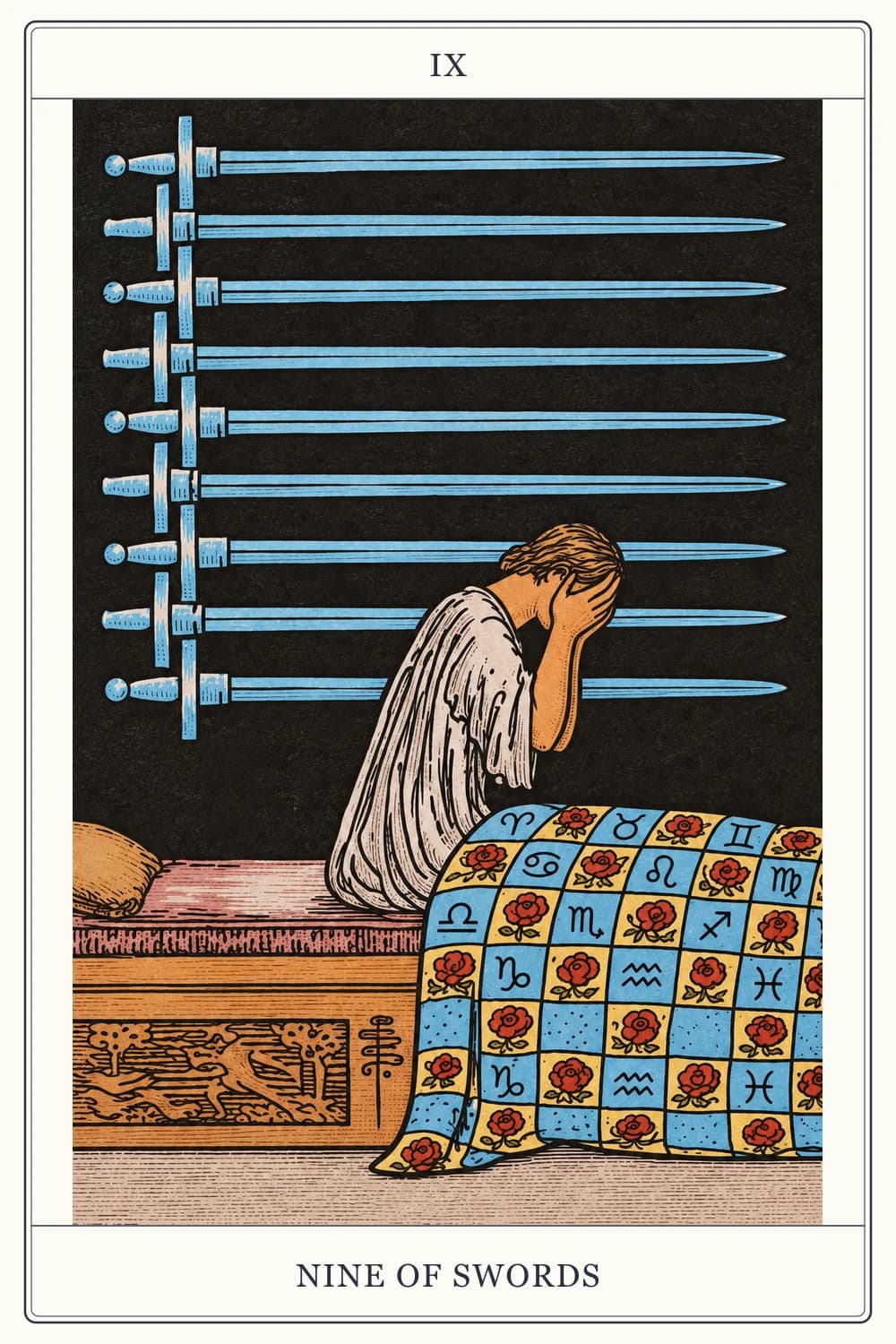
Illustrative card · Hopes & fears
Nine of Swords — read the card meaningA person sits up in bed with their face in their hands beneath nine swords. Bunning’s reference names worry; Orara’s upright entry suggests distinguishing a concern from what can be checked. In Hopes & fears: “I hope people feel welcome and worry that one activity will disappoint them.”
You reported that worry, but nobody has been promised two activities and no participants have been invited. Keep the concern separate from actual expectations. The card does not establish a health condition or reveal that the worry caused every extra task.
10 · Possible direction — Temperance
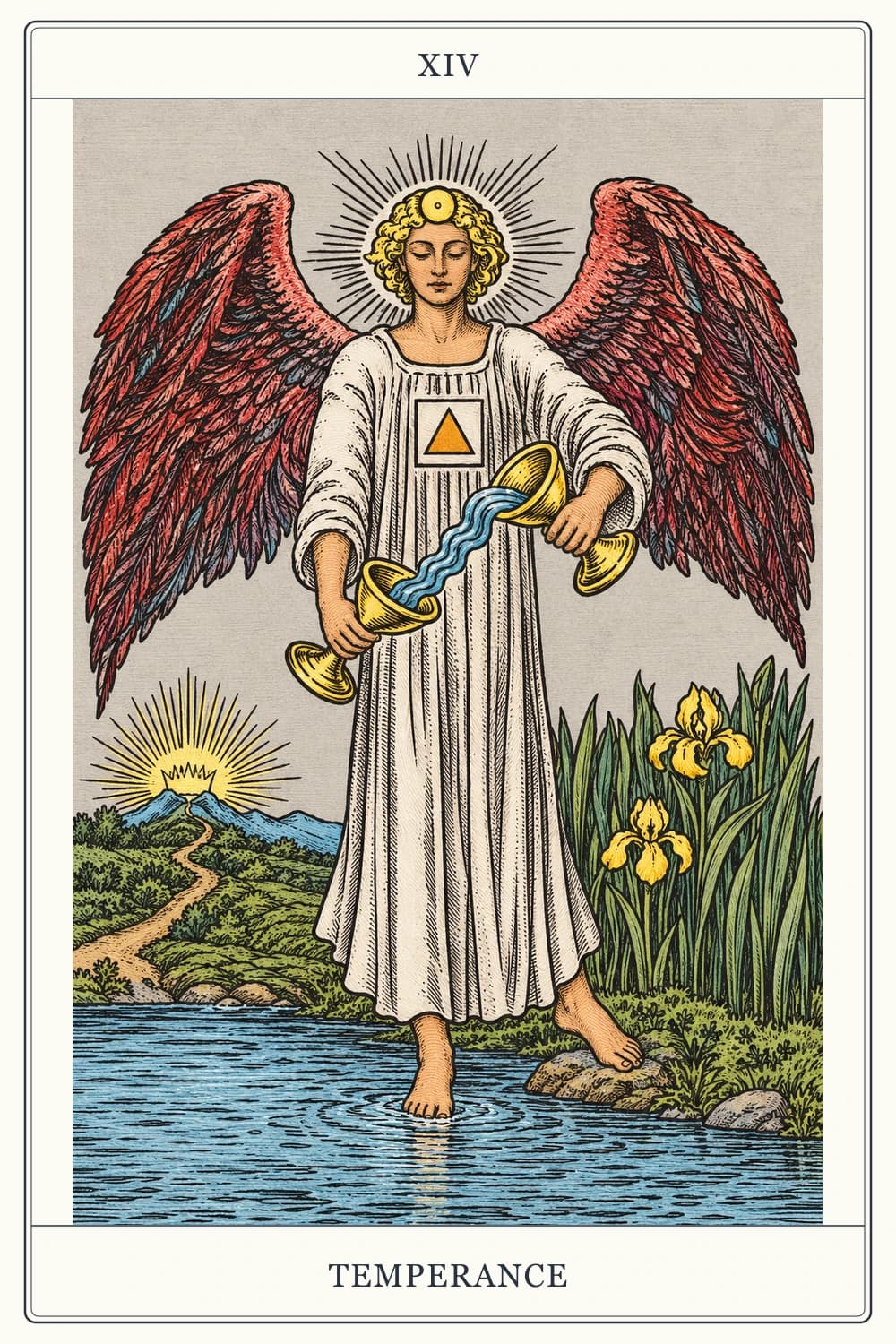
Illustrative card · Possible direction
Temperance — read the card meaningA winged figure pours water between two cups, with one foot in water and the other on land. Balance and combination are themes in Bunning’s reference; Orara’s entry describes small adjustments between needs. In Possible direction: “A one-activity draft could combine the welcoming aim, my available time and a specific shared task, if the help and venue terms fit.”
This uses the central workload mismatch, the remembered welcome, the goal and assumption, your proposed request, the actual offer and your reported worry. It is broader than Future’s possible agreement, but still conditional. Temperance does not create time, pay for the room or make the workshop ready to announce.
Connect the pairs, check the offer and retain the unresolved venue
1 + 2: the ninety-minute preparation window meets a draft estimated at 110 minutes before discussion. Two of Pentacles and Ten of Wands focus the reading on the size and distribution of the work, rather than an instruction to work harder.
3 + 4: the remembered patient demonstration could be retained in a shared preparation task if the offer becomes concrete. 5 + 6: the welcoming aim does not require owning every job; keep the spending limit while questioning the broader ownership rule.
7 + 8: a calm, specific request meets an offer whose terms remain unknown. 9 + 10: the reported fear of disappointing people needs separating from any actual promise, while a smaller draft remains conditional on real help and a usable room.
A complete reading could say: “I want to keep the patient welcome I remember, but my draft exceeds the time I have. I can question the rule that every task must be mine, state my limits and clarify one offer. If a task is shared and the room fits the spending limit, one activity could be a workable first plan; nobody has yet confirmed the venue or promised the participants’ response.”
Initial note, 19 October: “Question: How can I approach organizing a small community workshop alongside my work? Selected upright cards: Present / Two of Pentacles — ninety minutes; Obstacle / Ten of Wands — draft estimated at 110; Past / Six of Cups — patient welcome; Future / Three of Pentacles — possible shared task; Your goal / The Star — one welcoming activity; Foundation / Four of Pentacles — examine owning every detail, retain spending limit; Your approach / Strength — state limits and ask; Surroundings / Six of Pentacles — clarify help and venue; Hopes & fears / Nine of Swords — reported worry, no promise; Possible direction / Temperance — smaller draft if conditions fit. Response: use Tuesday’s ten-minute conversation; review the actual offer and venue status on Thursday.”
In the illustrative reply on 20 October, the friend says they can make the basic sample from paper they already have, using twenty minutes after the conversation. They cannot write the instructions or pay for a room. You agree that task, remove the unpromised second activity and retain the instructions, venue enquiries and invitation copy yourself. Your original estimates allow thirty minutes for instructions and thirty for enquiries and copy. With the ten-minute conversation, that uses seventy of your ninety minutes on paper; it is a planning estimate, not proof of completion.
Later note, 22 October: “The friend supplied the basic sample. I drafted instructions for one activity and sent the venue enquiry; its written reply is still pending. Sharing one task did not require giving up the spending check. The possible collaboration became an agreement and a completed sample, but the room is still unbooked. I have not invited participants or established how they would respond.”
A different reading of Four of Pentacles could favour keeping a final check for practical security. That fits the spending boundary and can coexist with sharing preparation; it does not justify keeping every task. The actual reply narrows the support, and the pending venue keeps Temperance’s direction provisional.
Optional practice
Keep all ten cards, the ninety-minute preparation window and the no-extra-spending limit. Change the reply: the friend can talk but cannot prepare a sample or pay for anything. The only room available for the proposed date charges a mandatory fee. This workshop needs a booked room; no free alternative, waiver or sponsor is confirmed, and the spending limit cannot change. What must be revised, and what can a first response achieve?
See one possible answer
The shared preparation in Future is unconfirmed, and Surroundings now includes help limited to conversation plus a room that does not fit the budget. Reassess the workload in Present and Obstacle, and keep Foundation’s spending check. Record that this workshop cannot currently be confirmed under the stated conditions. You can ask about a later no-fee option, but leave it pending until verified. Temperance can support revising the plan; it does not supply money, a free venue, extra preparation time or the friend’s labour. The welcoming aim can remain while this proposed event stays unarranged.
Keep the connected reading beside the agreement and later evidence
Use a notebook or document to preserve the first interpretation, then append dated updates. Opening Celtic Cross setup does not preload the teaching cards or save this worksheet. Separate a possible contribution, an agreed task, completed work and a confirmed booking.
The short note can refer to the ten-role list beside your cards; the detailed worksheet gives each role its own line. Keep reported beliefs and worries distinct from observations, and state which conditions remain unresolved before taking another step.
A quick journal note
Date / question / known facts and fixed limits:
Ten cards with their numbered roles and orientations:
Connections: 1+2 / 3+4 / 5+6 / 7+8 / 9 with the whole reading and 10:
Connected interpretation / alternative / conditions:
Chosen response / when and what to review:
Later date: actual reply, agreement and completed work:
Venue or other unresolved requirement:
Detailed journal worksheet
Celtic Cross reading worksheet
Date, question and scope:
Known history, current facts and fixed limits:
Reported aim, assumption and worry — separate from observations:
For every card: record its name, orientation and visible detail before the role-specific notes below.
1 · Present — card, orientation, image detail and interpretation:
2 · Obstacle — card, upright/reversed meaning distinct from crossing placement:
3 · Past — card, image detail and known earlier event:
4 · Future — card, interpretation and condition for a near development:
5 · Your goal — card and the aim I have actually named:
6 · Foundation — card, possible assumption and alternative explanation:
7 · Your approach — card and a response within my influence:
8 · Surroundings — card, observable support and unresolved terms:
9 · Hopes & fears — card, reported feelings and what remains unknown:
10 · Possible direction — card and conditions from the whole reading:
Connections: 1+2 / 3+4 / 5+6 / 7+8 / 9 with 10 and the earlier roles:
One connected interpretation and a plausible alternative:
Chosen action or enquiry, time allowed and required agreement:
When to review and what evidence to inspect:
Later dates: what was said, agreed, completed or left pending:
Which interpretation changed and what remains unresolved:
Common questions
- Why does another Celtic Cross guide use a different order?
- Published conventions differ, especially for positions 3–6. This article uses Orara’s order. If you choose another convention for a physical deck, decide before drawing and keep its role labels throughout.
- Does the crossing card count as reversed?
- No. Crossing is card 2’s sideways placement. Upright or reversed identifies the meaning being used. This teaching example uses upright meanings for all ten cards, including Obstacle.
- Should I redraw a possible direction I dislike?
- First check its links to the earlier roles and known conditions. A pending reply or unmet requirement calls for a factual check or revised response. An immediate replacement card does not settle that uncertainty.
Sources and further reading
External references for these reading methods. Orara created the examples on this page.
- Joan Bunning — Celtic Cross: cross, staff and differing conventions
- Joan Bunning — position pairs; adapt the numbers to Orara’s roles
- Joan Bunning — The Star: hope and generosity
- Joan Bunning — Four of Pentacles: holding control and setting limits
- Joan Bunning — Strength: patience and compassion
- Joan Bunning — Nine of Swords: worry
- Joan Bunning — Temperance: balance and combination