Your Relationship tarot spread: ask, observe and revise
Explore your part in a relationship and the interaction you can describe. Follow three cards from changed plans to one invitation, then let the actual reply update the reading instead of treating a possible perspective as private knowledge.
Start here
Changed plans leave you unsure what to ask or keep open.
In the friendship example, separate the wish to meet from a confirmed arrangement. Follow the actual reply: which possibility from Another view needs revising, and what is still unknown?
Follow a possible perspective through a different replyOrara editorial · Updated · Our approach
Your Relationship at a glance
- You
- Another view
- Between you
Use when: You want to understand how you participate in a relationship.
Choose another approach if: You want to plan a specific conversation or compare two options.
Example questions
- How can I be more honest in this relationship?
- What part of our dynamic is within my influence?
- What could I ask rather than assume about this relationship?
On this page
Begin with an interaction and your own response
Choose a friendship, family relationship, collaboration or romantic connection and name an interaction you have noticed. “Two agreed plans changed” is an observation. “They no longer care” is an explanation you have not established. Write your own feelings and needs separately from what the other person has said.
A useful question is “How can I approach the way my friend and I make weekend plans?” It directs attention to your contribution and a shared process. This guide uses tarot for reflection on those observations, with room for the other person to describe a different experience.
Keep You, Another view and Between you distinct
A spread is a layout of cards, and each position gives its card a role. Your Relationship uses You, Another view and Between you. Read You for your participation, Another view as a possibility to ask about and Between you for what happens in the interaction, including your part in it.
The second card cannot establish another person’s feelings, motives or needs. A theme such as rest can suggest a question about timing or a pause. Their answer can differ from that possibility. The third card also needs evidence: a theme of connection does not by itself show that planning is already mutual.
| Position | Question to consider |
|---|---|
| 1 · You | What do I feel, need and choose in this interaction? |
| 2 · Another view | What possibility could I ask about while leaving the answer open? |
| 3 · Between you | What have we actually said, done or agreed, and what remains unconfirmed? |
Prepare the reading and a question they can answer differently
You can study the example without drawing. For your own attempt, keep a notebook or document and a card reference available. Record the question, observed interaction, your reported feelings and what remains unknown before selecting cards.
This example uses upright cards, with the pictures the normal way up. A reversed card is upside down and can use another reference meaning. With a physical deck, choose the upright-only method before shuffling, take three cards without looking and place them upright from left to right as You, Another view and Between you.
In Orara, Start Your Relationship opens setup. Check the layout, enter your question if useful, clear Include reversed cards, then select Draw 3 cards. For each card, describe an image detail, read its upright reference through the linked name or your deck’s guidebook, and connect a theme to the assigned role. Turn a possible perspective into a question with room for a different explanation; do not present it as what the other person must feel.
Example: arrange a weekend meeting with a friend
In this invented example, your friend said two agreed meetings could not go ahead. You do not know the reasons for each change. They have said their weekends are busy and that they would like to meet again. You suggested replacement times and continued leaving time open even when no new arrangement was confirmed.
You feel disappointed and prefer confirming plans early. On Monday, 19 October 2026, you can offer only Saturday, 24 October, from 14:00 to 15:00 at your usual park. You are willing to hold that hour until Friday at 18:00; after that, you want to make your own plans if it is still unconfirmed. No meeting for this weekend is agreed yet.
Question: “How can I approach the way my friend and I make weekend plans?” The following upright cards were selected for teaching, rather than drawn for you. The invitation, replies and later record below are illustrative too.
| Position | Annotated card |
|---|---|
| 1 · You | Queen of Cups in You |
| 2 · Another view | Four of Swords in Another view |
| 3 · Between you | Two of Cups in Between you |
1 · You — Queen of Cups
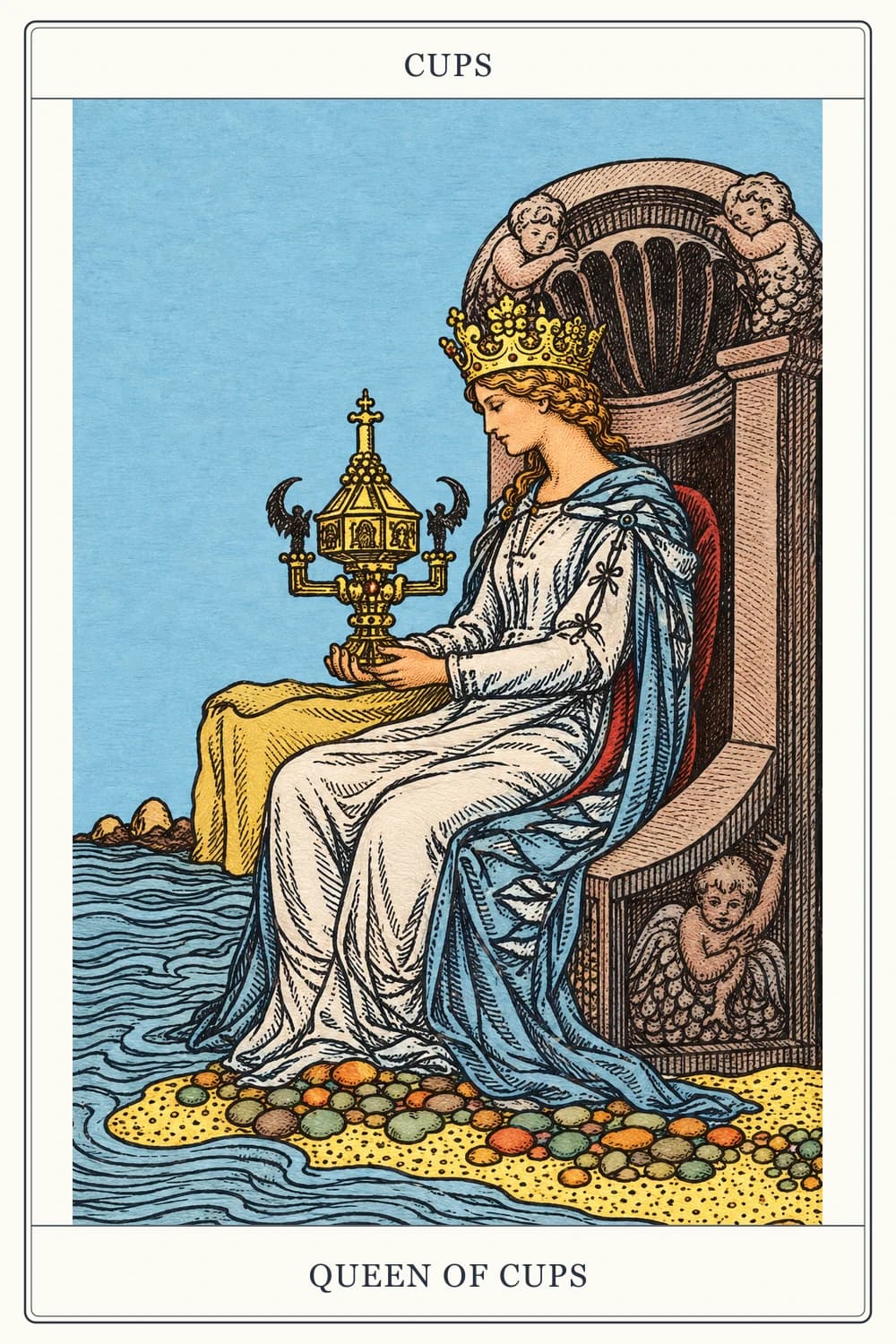
Illustrative card · You
Queen of Cups — read the card meaningThe Queen sits beside water, looking at an ornate covered cup held in both hands. Joan Bunning’s reference includes care and sensitivity; Orara’s upright entry also describes listening while keeping your own needs visible. In You: “I can acknowledge my disappointment and say what planning would help me.”
The feeling and preference come from your report. A considerate response can include saying when you can meet and how long you will keep the hour open. You can listen to your friend without promising unlimited availability. The Queen is used here as an approach to your part in the exchange.
2 · Another view — Four of Swords
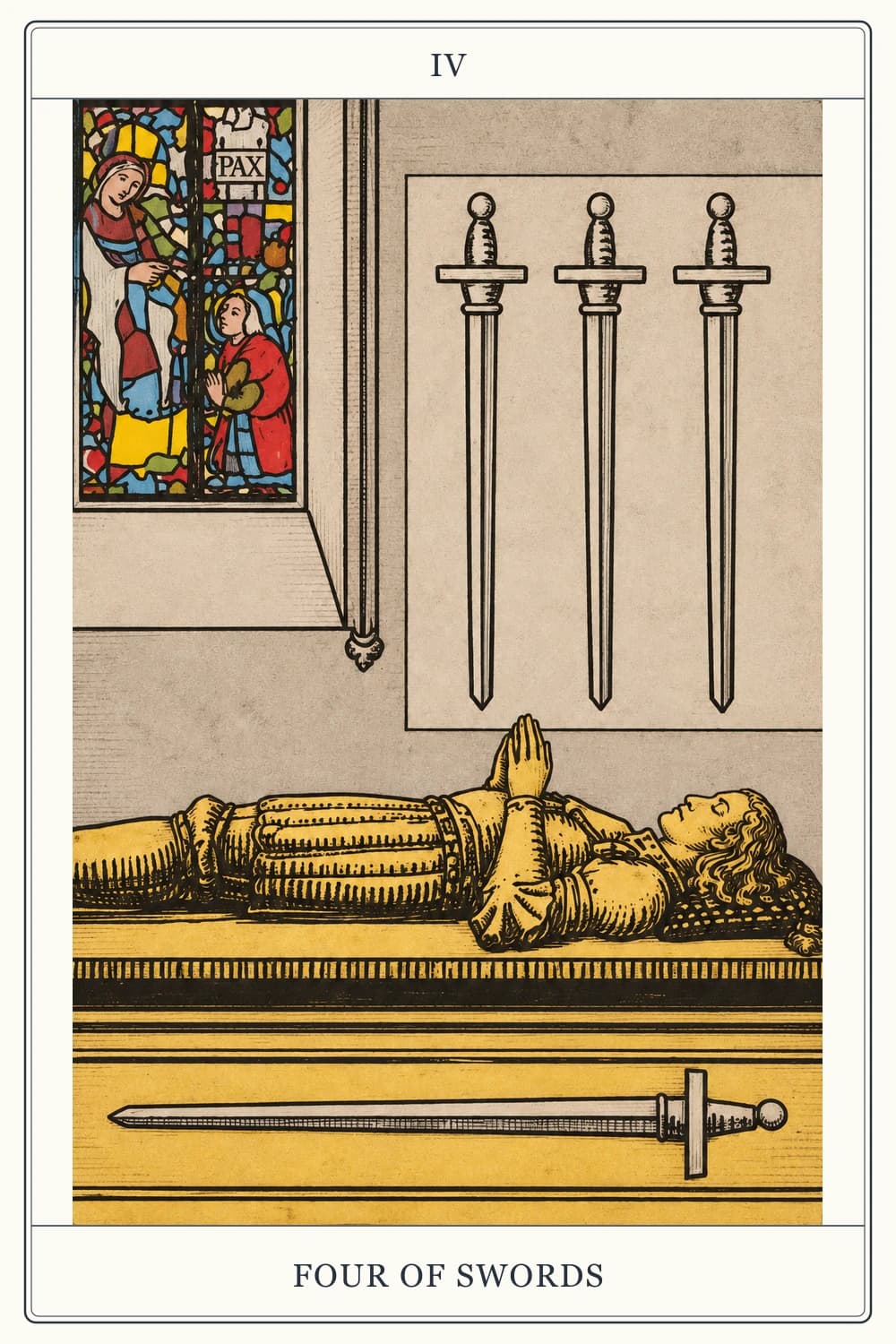
Illustrative card · Another view
Four of Swords — read the card meaningA still figure lies on a platform with hands together; three swords hang above and one lies below. Rest, contemplation and quiet preparation are associations in Bunning’s reference. In Another view, that theme raises a possibility: “Would a pause between suggestions help, or is the difficulty something else?”
Your friend’s statement that weekends are busy makes timing worth asking about. It does not establish a need for rest or distance. Changing work hours, another commitment or a preference you have not discussed could also explain difficulty making plans. Ask rather than deciding which account is true.
If the answer points to a scheduling issue instead of rest, use the answer. Do not describe it as a disguise for the card’s supposedly deeper message. This role supplies a possible question, not information that overrides what the person tells you.
3 · Between you — Two of Cups
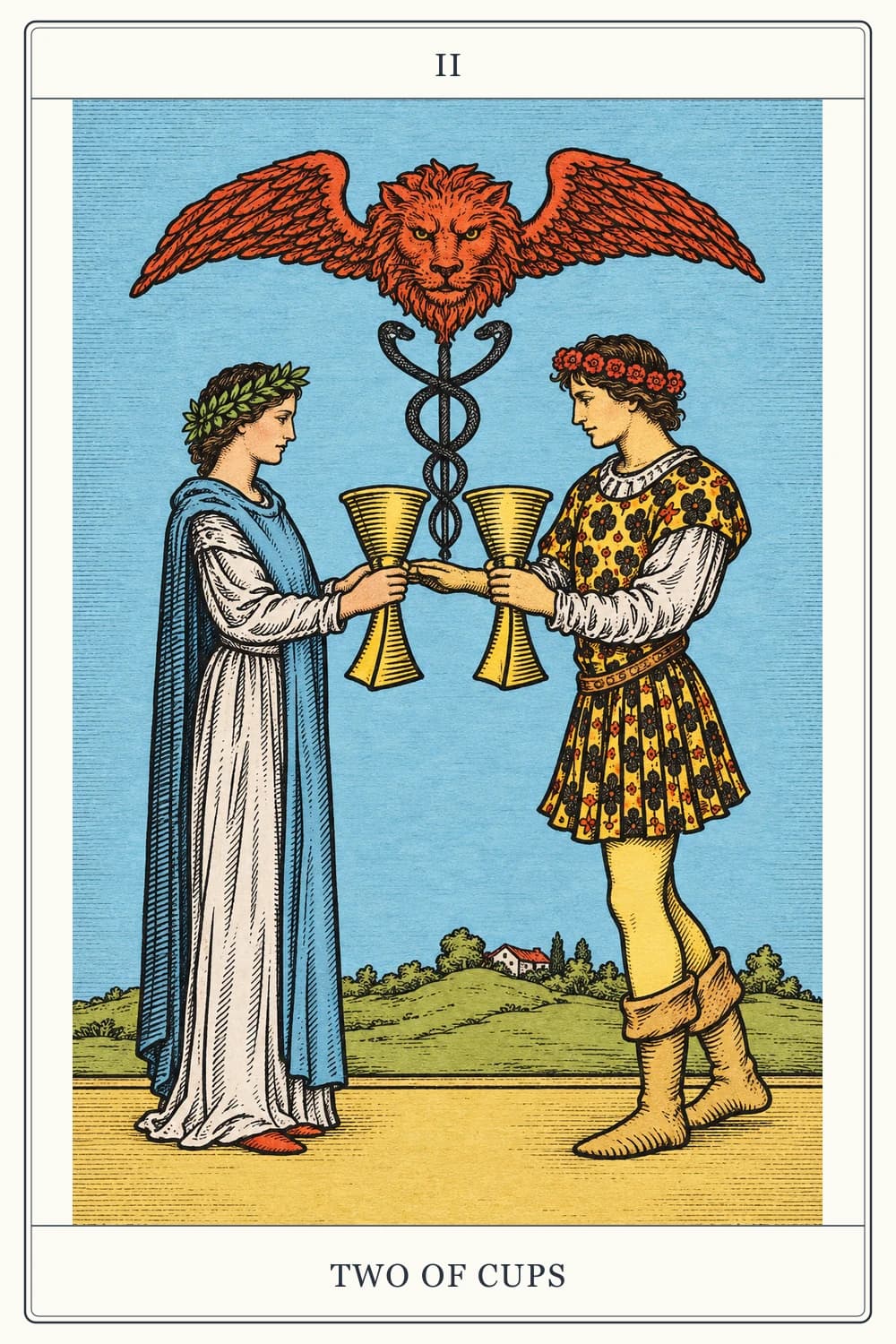
Illustrative card · Between you
Two of Cups — read the card meaningTwo people face each other, each holding a cup toward the other. Connection and cooperation are associations in Bunning’s reference; Orara’s entry asks how both people participate in an exchange. In Between you: “We have expressed interest, but a time still needs both people’s agreement.”
The known interaction includes two changed plans, your replacement suggestions and an unconfirmed new meeting. Mutual planning is something to make concrete: offer a time, invite an answer and treat it as agreed only when both people confirm the same arrangement. The two pictured cups do not establish compatibility or guarantee that a common time exists.
Make one invitation and review what was actually said
A connected reading could say: “I can express disappointment and my need for an early answer; a pause is one possibility to ask about, while our next meeting still needs a shared agreement.” The first position identifies your need and contribution, the second keeps the explanation open and the third focuses on confirmation.
An opening could be: “I felt disappointed when the last two plans fell through, and I’d like to see you. I can meet at the park on Saturday, 14:00–15:00. I can keep that hour open until Friday at 18:00; if we haven’t confirmed, I’ll make other plans. Would more time between suggestions help, or is something else making the timing difficult?” This states your availability and asks a question. It gives no guarantee of a reply or an agreement.
Initial note, 19 October 2026: “Question: How can I approach the way my friend and I make weekend plans? Chosen upright example: Queen of Cups / You — name my feeling and planning need; Four of Swords / Another view — ask whether a pause would help; Two of Cups / Between you — check for a shared arrangement. Two changed plans, both expressed interest, no new time confirmed. Offer Saturday 24 October, 14:00–15:00 at the park, held until Friday 18:00. Review the reply and whether the same time is confirmed; reasons for the earlier changes remain unknown.”
In an illustrative reply on 20 October, your friend says: “I don’t need more space between suggestions; my shifts keep changing. I’ll know my weekend hours on Thursday and can tell you then.” You agree to wait until Thursday rather than repeating the invitation. On Thursday they confirm Saturday, 14:00–15:00 at the park, and you confirm it too.
Later note, 25 October: “My friend described changing shifts, rather than a need for a pause. We confirmed the same hour and place on Thursday and met on Saturday as arranged. Asking made the scheduling issue discussable in this exchange. I still do not know the reason for each earlier cancellation, or whether early confirmation will work every time.” The reply revises the proposed explanation; one completed plan does not settle the whole relationship.
If no confirmation arrives by the time you stated, you can release the hour without claiming to know why the person did not reply. A proposal and a wish to meet are different from an agreed plan. If they decline or ask for a pause, let that response guide what you do next.
Optional practice
Keep the same cards and your Saturday-only availability. Use a different reply: your friend cannot meet on Saturday and offers only Sunday morning. You are unavailable then, and no other shared time is confirmed. How can you respond, and what can Between you honestly describe?
See one possible answer
You could say, “I can’t do Sunday, so this weekend won’t work for me. Let’s leave it unplanned.” Do not invent another free time or treat Two of Cups as an agreement. Between you now includes an offer from each person but no matching availability; the meeting remains unarranged. Queen of Cups can support a considerate answer with your limit intact. Four of Swords may prompt leaving room before another suggestion, but it does not establish that your friend wanted distance or that either person lacks interest.
Keep observations, possible views and actual replies separate
Keep the initial reading in your notebook or document and append the actual exchange with its own date. Record what was offered, declined or confirmed, including what you said. Opening Your Relationship setup does not save this worksheet or preload the selected cards.
An alternative to offering another time is choosing not to arrange a meeting yet. You can first clarify what you are willing to hold open, especially if your own availability is uncertain. The invitation fits the supplied case because both people have expressed interest and you have one real hour to offer; the cards do not create either condition.
A quick journal note
Date / question:
Observed interaction / my feeling and need / unknown reasons:
You / Another view / Between you — cards and interpretations:
One question or response, with my actual availability:
Later date: actual reply and what was agreed or declined:
What changed in the interpretation / what remains unknown:
Detailed journal worksheet
Your Relationship reading worksheet
Date and question about one interaction:
What happened or was said, and how I know:
My reported feelings, needs and contribution:
What I do not know about the other person:
You — card, orientation, image detail and interpretation:
Another view — card, orientation, image detail and possible question:
Between you — card, orientation, image detail and observable exchange:
Connection across all three roles:
An alternative explanation I have not ruled out:
One question or response I can choose:
My actual availability or limit; what requires their agreement:
When to review and what counts as confirmation:
Later date: what each person actually said or did:
What was agreed, declined or left unconfirmed:
Which interpretation changed and what remains unknown:
Sources and further reading
External references for these reading methods. Orara created the examples on this page.