Tarot for reflection, not prediction
A card can give you an idea to examine without telling you what will happen. Learn to explain that idea, check what supports it and choose a response while the outcome remains unknown.
Start here
You are tempted to treat an encouraging card as a yes to an unanswered invitation.
In the Sun example, identify which parts of the walk are already available and which still depend on a reply. Would an enjoyable solo walk establish that your friend accepted? Compare your answer with the later note.
Follow the invitation from uncertainty to the actual replyOrara editorial · Updated · Our approach
On this page
What changes when you read for reflection?
In Orara’s reflective approach, a card is a starting point for a question or a possible response. Prediction would turn it into a claim about an event that has not happened. A warm, encouraging card can offer a useful perspective without establishing that an invitation will be accepted.
Keep three things separate: a detail you can see in the picture, a meaning you find in a reference, and an interpretation you make for this situation. The first is an observation about an image; the second is a symbolic association; the third needs checking against your context. None is a reply from the person you invited.
Evidence addresses the particular claim. A message can establish that someone accepted an invitation; a card’s bright scene cannot. Even a message does not establish every private reason behind the reply. Adding “may” or “could” to an invented motive leaves that motive unverified.
Turn the interpretation into something you can review
Use this process on a reading you already have. You do not need another draw to check a claim. A position is a card’s assigned role, such as Focus or Advice; it helps you decide which question to ask of a meaning.
For an unfamiliar card, check the meaning linked beside its illustration or your deck’s guidebook. Choose a theme you can connect to the picture and role, then show how the known facts support your use of it. If they do not, leave the interpretation unresolved.
- Write the question and facts known before the reading. Keep an unanswered question marked as unknown.
- Name one visible detail, one reference theme and the card’s role. Write what that combination invites you to consider.
- Mark any leap from a theme to a supposed fact, motive or guaranteed result. Name what evidence would be needed to establish it.
- Choose, revise or decline a response using the time, access and options actually available. Consider another plausible use of the theme.
- Record your interpretation and chosen response before acting. Set a review point; later append what happened, including a mismatch or a proposal you could not test.
The Sun while you wait for an invitation reply
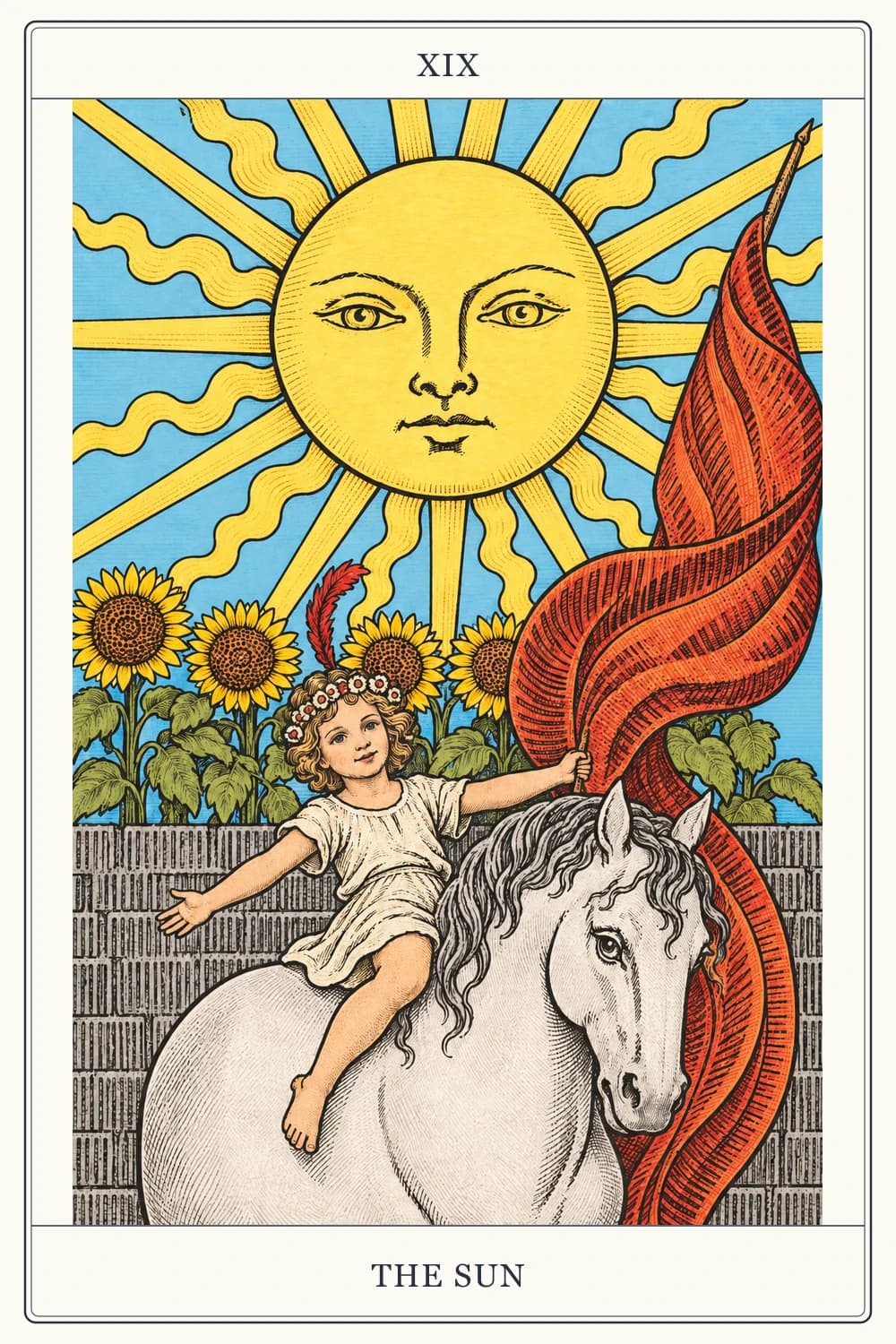
This invented example uses one selected card, not a live draw. On Thursday you invited a friend for a sketching walk at 10 on Saturday. At noon on Friday, no reply has arrived. You know the route, have your materials ready and would also enjoy going alone. You want to settle your own plan by 6 on Friday. You do not know whether your friend is available or why they have not replied.
Ask: “What can I focus on while I wait?” Give the upright Sun the role Focus; upright means the picture is the normal way up. This role asks where you could put attention. It does not ask the card to supply your friend’s answer.
Look at the child riding a white horse beneath a large sun, with sunflowers behind a wall. Joan Bunning associates The Sun with understanding and vitality, including joy. Orara’s upright reference also uses joy, openness and clarity. These are symbolic themes: the illuminated scene does not reveal a private message or someone’s feelings.
Through Focus, clarity could become: “Separate my known plan from the unanswered invitation.” The route, materials and option of going alone are already available; your friend’s attendance is not confirmed. You could keep the walk undecided until your stated 6 o’clock review, then choose whether to go alone if there is still no reply. The time limit comes from your planning need, not the card.
Joy offers another plausible focus: appreciate the sketching time available whether or not the friend joins. That fits your stated enjoyment of going alone. If you only wanted a shared outing, this alternative would need revising; the card would not create an interest in walking alone. Neither theme supports “My friend is happy to join.”
Initial note: “Friday noon. Invitation unanswered; solo walk available and enjoyable to me. Selected Sun / Focus / upright. Clarity suggests separating my plan from their unknown availability. Review at 6: if no reply, decide whether to use the solo option. The card does not tell me their answer.”
Illustrative later note: “At 6 there was still no reply, so I chose to go alone. I took the walk on Saturday. On Sunday my friend replied that they could not join. My plan was workable, but the positive-reply prediction would have been wrong. I still do not know why the reply was late.” Enjoying the walk would not turn the refusal into evidence that the card predicted a yes.
The table keeps the same card and facts while changing the claim. A reflective rewrite changes what you can examine or choose; it does not conceal the same prediction in softer language.
| Unsupported claim | A reflective use of The Sun | What remains unknown |
|---|---|---|
| They will accept because The Sun is positive. | Clarity: distinguish the available solo plan from an unconfirmed shared plan. | Whether they will accept, until they answer. |
| They may be silent because they secretly want me to chase them. | Openness: leave their reason unanswered and decide what communication, if any, is appropriate. | Their reason for not replying; the card supplies no evidence of a motive. |
| The Sun means I must go alone and enjoy it. | Joy: consider the solo option because I already said I would enjoy it; I can still decline. | How the walk will feel and whether I will choose to go. |
Optional practice
Keep The Sun in Focus, but change the facts: the park is closed on Saturday and no other place or time is available. Can the original solo-walk plan still be tested? Rewrite the response and say what the later note should leave unresolved.
See one possible answer
The walk is unavailable, so do not substitute another park, invent spare time or insist on a cheerful outing. A clarity-based response could be: “Record that this walk cannot go ahead and tell my friend the invitation is cancelled.” Later, record whether you sent that update. Leave the walk untested and your friend’s original availability and reason for silence unknown unless they tell you. The closure is a new fact that changes the response; it does not change the card into a prediction of cancellation.
When the answer needs evidence beyond a reading
The same distinction applies to a position called Future: the name assigns a topic to examine, not access to future facts. Describe a possibility and its conditions, then check relevant information. A vivid image, a confident paragraph or a repeated card does not supply the missing evidence.
Use appropriate information and qualified support for health, legal, financial or safety decisions. A tarot interpretation cannot supply a diagnosis, establish a legal outcome or determine whether a situation is safe. You can use a note to identify questions you need answered without treating the cards as the answer.
Orara checks input for defined crisis, abuse, medical, legal and financial patterns; detected questions can receive support information instead of a tarot interpretation. Detection is limited. An unblocked question or a completed reading is not a certificate that its claims are suitable or correct.
You may finish by getting information, making a bounded choice or leaving a matter open. If you want to practise this distinction in a different scene, the short lesson below starts with a card picture and an everyday response.
Common questions
- What if a reading seems to come true?
- Keep the original wording and compare it with the specific later event, including anything that did not match. A match does not by itself establish that the card caused or predicted it. Do not rewrite a broad phrase after the event or use one apparent match to justify unrelated claims.
- Does reflection mean I have to find a positive message?
- No. You can record that an interpretation did not fit, that an action was unavailable, or that you still do not know the answer. In the example, the friend’s refusal remains a refusal even if the solo walk was enjoyable.
Sources and further reading
External references for these reading methods. Orara created the examples on this page.